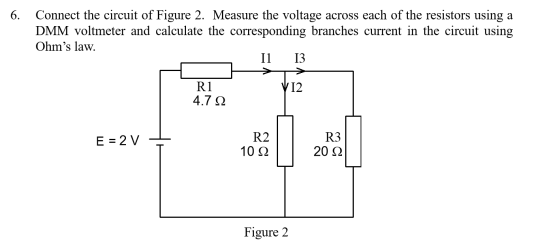
calculate the corresponding branches current
6. calculate the corresponding branches current in the circuit using Ohm’s law.
Homework Answers
1. Using circuit 3-1, calculate the total current (which is also the capacitor current and resistor...
 1. Using circuit 3-1, calculate the total current (which is also
the capacitor current and resistor current) by using Ohm’s Law. To
do this, you must first compute the total impedance of the circuit,
in polar form. Also, remember that Vs (source voltage) phase shift
is 0 degrees. Write your answer in polar form.
2. Compute the voltage across the capacitor (C1), using Ohm’s
Law and your result from #1. Write your answer in polar form.
3. In a series...
1. Using circuit 3-1, calculate the total current (which is also
the capacitor current and resistor current) by using Ohm’s Law. To
do this, you must first compute the total impedance of the circuit,
in polar form. Also, remember that Vs (source voltage) phase shift
is 0 degrees. Write your answer in polar form.
2. Compute the voltage across the capacitor (C1), using Ohm’s
Law and your result from #1. Write your answer in polar form.
3. In a series...
Problem 3: Branches and Loops II (25pts). Consider the following circuit: Ri=521 = 12 V D...
 Problem 3: Branches and Loops II (25pts). Consider the following circuit: Ri=521 = 12 V D WB+C V = 6 v L R =1003 ER-52 V - 24V E Ri= 150 1. Identify the branches and the loops of the circuit. 2. Using Kirschoff's rules and the loop current method, calculate the voltage and the current across each resistor. 3. Calculate the electric power dissipated in each resistor.
Solving DC circuits 1) simplify and sketch the given circuit 2) apply Kirchoff’s Law and Ohm’s...
 Solving DC circuits
1) simplify and sketch the given circuit
2) apply Kirchoff’s Law and Ohm’s Law to calculate the voltage
drop across and current through each resistor in the circuit.
V=6V
Solving DC circuits
1) simplify and sketch the given circuit
2) apply Kirchoff’s Law and Ohm’s Law to calculate the voltage
drop across and current through each resistor in the circuit.
V=6V
In the following circuit, the current in one of the branches is known to be 0.07A,...
 In the following circuit, the current in one of the branches is known to be 0.07A, as shown in the diagram. Use Kirchhoff's Rules to determine the other two currents, l1and 12, in the circuit. 25 w 5 V 10 V 750 11 12 w 1000 0.07 AN WA 20 V 5012 I ww 150 12
In the following circuit, the current in one of the branches is known to be 0.07...
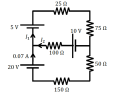 In the following circuit, the current in one of the branches is
known to be 0.07 A, as shown in the diagram. Use
Kirchhoff’s Rules to determine the other two currents, ?1
and ?2, in the circuit.
25 Ω ww 5 V 75 Ω 10 V 11 12 ww 100 Ω 0.07 Α. 20 V 50 Ω ww 150 Ω
In the following circuit, the current in one of the branches is
known to be 0.07 A, as shown in the diagram. Use
Kirchhoff’s Rules to determine the other two currents, ?1
and ?2, in the circuit.
25 Ω ww 5 V 75 Ω 10 V 11 12 ww 100 Ω 0.07 Α. 20 V 50 Ω ww 150 Ω
When resistors are in series, each resistor has the same current but the voltage is...
When resistors are in series, each resistor has the same current but the voltage is different for each according to Ohm’s Law. A given circuit consists of two resistors in series connected to a 24.0-V battery. The current in the circuit is 0.0320 A. If R_1=250.0 Ω,and R_2=500.0 Ω. Find the potential difference across each resistor. Find the equivalent resistance. If the circuit in Problem 6 above is reconnected with the two resistors in parallel, the...
Problem 05 Use Ohm's Law to calculate the AC current i(t) in the following circuit when...
 Problem 05 Use Ohm's Law to calculate the AC current i(t) in the following circuit when the switch is in position 1 and position 2, respectively, 10023 3 150 2 3sin(501) Position 1: i(t) = Position 2: i(t) = Problem 06 Determine the number of branches, nodes and independent loops in the following circuit ΤΩ 12 V 38.2 3522 (2A b = n Problem 07 Use KCL to obtain currents 11, 12, and is in the following circuit. 12 mA...
Consider the circuit below. (a) Using Kirchhoff's rules, determine electric currents in all of the branches....
 Consider the circuit below. (a) Using Kirchhoff's rules, determine electric currents in all of the branches. Make sure to clearly label each of the currents on the diagram. (b) Calculate the amount of power dissipated by the 6 Ohms resistor. 1.12 2.12 3.12 5V 10V 6123 20V
Find the current through all branches of this circuit. Credit will be awarded based on the...
 Find the current through all branches of this circuit. Credit will be awarded based on the work that is shown, as well as the accuracy of the answer. (Note: no credit will be awarded for attempts to add resistors in parallel or add resistors in series) R1 150Ω R2 50 Ω 24 Vニ 100 Ω R4 300 Ω R, 250 Ω
1) In the circuit below the currents are named A, and lc The current direction is determined by the source (out of positive terminal) in the middle and right branches and is clockwise in the left bra...
 1) In the circuit below the currents are named A, and lc The current direction is determined by the source (out of positive terminal) in the middle and right branches and is clockwise in the left branch · IA flows through R2 and R1 Is flows through R4 and Vb cflows through R3, Vc AB R2 R3 R4 R1 Vb a) Draw the circuit and show the 3 currents described above, including arrows showing the current direction. Show the voltage...
 1. Using circuit 3-1, calculate the total current (which is also
the capacitor current and resistor current) by using Ohm’s Law. To
do this, you must first compute the total impedance of the circuit,
in polar form. Also, remember that Vs (source voltage) phase shift
is 0 degrees. Write your answer in polar form.
2. Compute the voltage across the capacitor (C1), using Ohm’s
Law and your result from #1. Write your answer in polar form.
3. In a series...
1. Using circuit 3-1, calculate the total current (which is also
the capacitor current and resistor current) by using Ohm’s Law. To
do this, you must first compute the total impedance of the circuit,
in polar form. Also, remember that Vs (source voltage) phase shift
is 0 degrees. Write your answer in polar form.
2. Compute the voltage across the capacitor (C1), using Ohm’s
Law and your result from #1. Write your answer in polar form.
3. In a series...
 Problem 3: Branches and Loops II (25pts). Consider the following circuit: Ri=521 = 12 V D WB+C V = 6 v L R =1003 ER-52 V - 24V E Ri= 150 1. Identify the branches and the loops of the circuit. 2. Using Kirschoff's rules and the loop current method, calculate the voltage and the current across each resistor. 3. Calculate the electric power dissipated in each resistor.
 Solving DC circuits
1) simplify and sketch the given circuit
2) apply Kirchoff’s Law and Ohm’s Law to calculate the voltage
drop across and current through each resistor in the circuit.
V=6V
Solving DC circuits
1) simplify and sketch the given circuit
2) apply Kirchoff’s Law and Ohm’s Law to calculate the voltage
drop across and current through each resistor in the circuit.
V=6V
 In the following circuit, the current in one of the branches is known to be 0.07A, as shown in the diagram. Use Kirchhoff's Rules to determine the other two currents, l1and 12, in the circuit. 25 w 5 V 10 V 750 11 12 w 1000 0.07 AN WA 20 V 5012 I ww 150 12
 In the following circuit, the current in one of the branches is
known to be 0.07 A, as shown in the diagram. Use
Kirchhoff’s Rules to determine the other two currents, ?1
and ?2, in the circuit.
25 Ω ww 5 V 75 Ω 10 V 11 12 ww 100 Ω 0.07 Α. 20 V 50 Ω ww 150 Ω
In the following circuit, the current in one of the branches is
known to be 0.07 A, as shown in the diagram. Use
Kirchhoff’s Rules to determine the other two currents, ?1
and ?2, in the circuit.
25 Ω ww 5 V 75 Ω 10 V 11 12 ww 100 Ω 0.07 Α. 20 V 50 Ω ww 150 Ω
 Problem 05 Use Ohm's Law to calculate the AC current i(t) in the following circuit when the switch is in position 1 and position 2, respectively, 10023 3 150 2 3sin(501) Position 1: i(t) = Position 2: i(t) = Problem 06 Determine the number of branches, nodes and independent loops in the following circuit ΤΩ 12 V 38.2 3522 (2A b = n Problem 07 Use KCL to obtain currents 11, 12, and is in the following circuit. 12 mA...
 Consider the circuit below. (a) Using Kirchhoff's rules, determine electric currents in all of the branches. Make sure to clearly label each of the currents on the diagram. (b) Calculate the amount of power dissipated by the 6 Ohms resistor. 1.12 2.12 3.12 5V 10V 6123 20V
 Find the current through all branches of this circuit. Credit will be awarded based on the work that is shown, as well as the accuracy of the answer. (Note: no credit will be awarded for attempts to add resistors in parallel or add resistors in series) R1 150Ω R2 50 Ω 24 Vニ 100 Ω R4 300 Ω R, 250 Ω
 1) In the circuit below the currents are named A, and lc The current direction is determined by the source (out of positive terminal) in the middle and right branches and is clockwise in the left branch · IA flows through R2 and R1 Is flows through R4 and Vb cflows through R3, Vc AB R2 R3 R4 R1 Vb a) Draw the circuit and show the 3 currents described above, including arrows showing the current direction. Show the voltage...
Most questions answered within 3 hours.
-
Where is the error in this code sequence?
String s1 = "Hello";
String s2 = "ello";...
asked 10 months ago -
Financial data for Joel de Paris, Inc., for last year
follow:
Joel de Paris, Inc.
Balance...
asked 10 months ago -
Consider this reaction:
Al2(SO4)3 (aq)+ BaCl3
(aq) Al2Cl6 (aq)- +
3BaSO4(s) . What is the...
asked 10 months ago -
Suppose that Savneet is considering increasing her
recent random sample from 20 car rentals to 40...
asked 10 months ago -
Trucks arrive at an unloading terminal at an average rate of 120
per hour.
Trucks arrive...
asked 10 months ago -
Why are methanol and ethanol completely soluble in water while
octanol is not very little soluble....
asked 10 months ago -
A facilities manager at a university reads in a research report
that the mean amount of...
asked 10 months ago -
When the CuSO4 is rehydrated by adding water to the anhydrous
compound, is this an endothermic...
asked 10 months ago -
A ray of sunlight is passing from diamond into crown glass; the
angle of incidence is...
asked 10 months ago -
A block of mass 0.249 kg is placed on top of a light, vertical
spring of...
asked 10 months ago -
how do the kidneys compensate in the presences of acidosis
a) trigger hyperventilate
b) reserve acid...
asked 10 months ago -
Question 501 pts
The rental rate of capital to the firm increases. Which of the
following...
asked 10 months ago