
Homework Answers

SOLUTION :
Consider pulley be frictionless, so tension before pulley and
after pulley remains same.
Aș per forces acing on block M1 :
M1 g - T = M1 a
=> 3 *9.8 - T = 3 a
=> 29.4 - T = 3 a ……..……. (1)
Aș per forces acing on block M2 :
T - µk * M2 g = M2 a
=> T - 0.3*2*9.8 = 2 a
=> T - 5.88 = 2 a ………. (2)
Add (1) and (2) :
=> 23.52 = 5 a
=> a = 23.52/5 = 4.704 m/s^2
Let final velocity after 80cm movement be v m/s.
So,
v = 0 + a t = 4.704 t m/s
Average velocity during interval t seconds
= (0 + 4.704 t) / 2
= 2.352 t m/s
Distance moved in t sec. = avg. velocity * t
=> 80/100 = 2.352 t * t
=> t = sqrt(0.8/2.352)
=> t = 0.5832 sec.
So,
final velocity after 80 cm movement
= v
= a t
= 4.704 * 0.5832
= 2.74 m/s (ANSWER).
Add Answer to:
5
The system shown is released from rest and moves 80 cm. What is the final...
Consider the system shown in the figure below with m_1 = 24.0 kg, m_2 = 12.6...
 Consider the system shown in the figure below with m_1 = 24.0 kg, m_2 = 12.6 kg, R = 0.260 m, and the mass of the pulley M = 5.00 kg. Object m_2 is resting on the floor, and object m_1 is 4.60 m above the floor when it is released from rest. The pulley axis is frictionless. The cord is light, does not stretch, and does not slip on the pulley. Calculate the time interval required for m_1 to...
The system shown below is released from rest. The m_b = 26 kg block is 2...
 The system shown below is released from rest. The m_b = 26 kg block is 2 m above the ledge. The pulley is a uniform disk with a radius of 10 cm and mass m = 6.0 kg. Assume that the string does not slip on the pulley. (a) Find the speed of the 26 kg block just before it hits the ledge. (b) Find the angular speed of the pulley at that time. (c) Find the tensions in the...
3. (25) Refer to the figure. The system is released from rest. (A) Assuming that the...
 3. (25) Refer to the figure. The system is released from rest. (A) Assuming that the pulley is massless and the table is frictionless, determine the acceleration of the 2-kg mass. (B) Now assume that the pulley is a disk of mass 0.5 kg and radius 8 cm, and that the coefficient of kinetic friction on the table is 0.3. Determine the acceleration of the 2-kg mass.
A 65-N weight is released from rest and falls to the floor as shown in the...
A 65-N weight is released from rest and falls to the floor as shown in the figure. It is suspended by a string of negligible mass that is wrapped around a 5.0 kg pulley that is essentially a solid disk of a radius of 1.75 m and rotates through 5.5 radians. What is the angular speed of the pulley? (Note: Since the pulley has mass, the sum total of the forces acting on the pulley is not simply the weight...
only final asnwer If the system is released from rest, determine the speed of the 30-kg...
 only final asnwer
If the system is released from rest, determine the speed of the 30-kg cylinders A and B after B has moved upward a distance of 0.50 m. The differential pulley has a mass of 20 kg with a radius of gyration about its center of mass of ko = 100 mm. 200 m 100 mm B
only final asnwer
If the system is released from rest, determine the speed of the 30-kg cylinders A and B after B has moved upward a distance of 0.50 m. The differential pulley has a mass of 20 kg with a radius of gyration about its center of mass of ko = 100 mm. 200 m 100 mm B
. The pulley system shown below is initially held at rest before being released. What is...
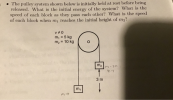 . The pulley system shown below is initially held at rest before being released. What is the initial energy of the system? What is the speed of each block as they pass each other? What is the speed of each block when mi reaches the initial height of m2? m, 5 kg m,-10kg 3 m m1 MISD
A solid disk of mass M and radius R is released from rest at a vertical...
 A solid disk of mass M and radius R is
released from rest at a vertical height h from the ground
on an inclined plane having an angle of inclination ? as
shown in the figure below. The disk will roll on the inclined
plane. Find the speed of the disk when it reaches the bottom of the
inclined plane.
A solid disk of mass M and radius R is
released from rest at a vertical height h from the ground
on an inclined plane having an angle of inclination ? as
shown in the figure below. The disk will roll on the inclined
plane. Find the speed of the disk when it reaches the bottom of the
inclined plane.
Greezy works in a factory because he does not make enough money from The Charming Beggars....
 Greezy works in a factory because he does not make enough money from The Charming Beggars. He is pushing a very large crate of 50 kg across the floor at a constant velocity with a force of 200 N. He is pushing on the crate upwards at an angle of 20 degree. See diagram. (a) What is the coefficient of kinetic friction between the ground and the crate? (b) Greezy increases his force to 400 N. What is the acceleration...
The Atwood’s machine in the figure is released from rest and accelerates as shown. The pulley...
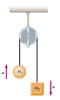 The Atwood’s machine in the figure is released from rest and
accelerates as shown. The pulley has mass m3, and is a solid disk
(I = 1 2MR2).
A.Draw the three free-body-diagrams for the three objects in the
figure.
B.Choose coordinate systems so that the acceleration will be
positive in each.
C. Write down the three Newton’s second law equations from the
free-body-diagrams
D.Use the system of equations to solve for the acceleration in
terms of g, m1, m2, and...
The Atwood’s machine in the figure is released from rest and
accelerates as shown. The pulley has mass m3, and is a solid disk
(I = 1 2MR2).
A.Draw the three free-body-diagrams for the three objects in the
figure.
B.Choose coordinate systems so that the acceleration will be
positive in each.
C. Write down the three Newton’s second law equations from the
free-body-diagrams
D.Use the system of equations to solve for the acceleration in
terms of g, m1, m2, and...
Three objects are situated along the x-axis as follows: A 2.00-kg object is at x =...
 Three objects are situated along the x-axis as follows: A 2.00-kg object is at x = 0.3 m, a 3.00-kg object is at x = 0.5 m, and a 2.50-kg object is at x= 0.8m. a) Where is the center of mass of these objects? b) The objects begin uniform motion at the same speed 0.800 m/s, towards the right at t = 0 and travel in the same direction as shown in Figure. (c) Find the velocity of the...
 Consider the system shown in the figure below with m_1 = 24.0 kg, m_2 = 12.6 kg, R = 0.260 m, and the mass of the pulley M = 5.00 kg. Object m_2 is resting on the floor, and object m_1 is 4.60 m above the floor when it is released from rest. The pulley axis is frictionless. The cord is light, does not stretch, and does not slip on the pulley. Calculate the time interval required for m_1 to...
 The system shown below is released from rest. The m_b = 26 kg block is 2 m above the ledge. The pulley is a uniform disk with a radius of 10 cm and mass m = 6.0 kg. Assume that the string does not slip on the pulley. (a) Find the speed of the 26 kg block just before it hits the ledge. (b) Find the angular speed of the pulley at that time. (c) Find the tensions in the...
 3. (25) Refer to the figure. The system is released from rest. (A) Assuming that the pulley is massless and the table is frictionless, determine the acceleration of the 2-kg mass. (B) Now assume that the pulley is a disk of mass 0.5 kg and radius 8 cm, and that the coefficient of kinetic friction on the table is 0.3. Determine the acceleration of the 2-kg mass.
 only final asnwer
If the system is released from rest, determine the speed of the 30-kg cylinders A and B after B has moved upward a distance of 0.50 m. The differential pulley has a mass of 20 kg with a radius of gyration about its center of mass of ko = 100 mm. 200 m 100 mm B
only final asnwer
If the system is released from rest, determine the speed of the 30-kg cylinders A and B after B has moved upward a distance of 0.50 m. The differential pulley has a mass of 20 kg with a radius of gyration about its center of mass of ko = 100 mm. 200 m 100 mm B
 . The pulley system shown below is initially held at rest before being released. What is the initial energy of the system? What is the speed of each block as they pass each other? What is the speed of each block when mi reaches the initial height of m2? m, 5 kg m,-10kg 3 m m1 MISD
 A solid disk of mass M and radius R is
released from rest at a vertical height h from the ground
on an inclined plane having an angle of inclination ? as
shown in the figure below. The disk will roll on the inclined
plane. Find the speed of the disk when it reaches the bottom of the
inclined plane.
A solid disk of mass M and radius R is
released from rest at a vertical height h from the ground
on an inclined plane having an angle of inclination ? as
shown in the figure below. The disk will roll on the inclined
plane. Find the speed of the disk when it reaches the bottom of the
inclined plane.
 Greezy works in a factory because he does not make enough money from The Charming Beggars. He is pushing a very large crate of 50 kg across the floor at a constant velocity with a force of 200 N. He is pushing on the crate upwards at an angle of 20 degree. See diagram. (a) What is the coefficient of kinetic friction between the ground and the crate? (b) Greezy increases his force to 400 N. What is the acceleration...
 The Atwood’s machine in the figure is released from rest and
accelerates as shown. The pulley has mass m3, and is a solid disk
(I = 1 2MR2).
A.Draw the three free-body-diagrams for the three objects in the
figure.
B.Choose coordinate systems so that the acceleration will be
positive in each.
C. Write down the three Newton’s second law equations from the
free-body-diagrams
D.Use the system of equations to solve for the acceleration in
terms of g, m1, m2, and...
The Atwood’s machine in the figure is released from rest and
accelerates as shown. The pulley has mass m3, and is a solid disk
(I = 1 2MR2).
A.Draw the three free-body-diagrams for the three objects in the
figure.
B.Choose coordinate systems so that the acceleration will be
positive in each.
C. Write down the three Newton’s second law equations from the
free-body-diagrams
D.Use the system of equations to solve for the acceleration in
terms of g, m1, m2, and...
 Three objects are situated along the x-axis as follows: A 2.00-kg object is at x = 0.3 m, a 3.00-kg object is at x = 0.5 m, and a 2.50-kg object is at x= 0.8m. a) Where is the center of mass of these objects? b) The objects begin uniform motion at the same speed 0.800 m/s, towards the right at t = 0 and travel in the same direction as shown in Figure. (c) Find the velocity of the...
Most questions answered within 3 hours.
-
Where is the error in this code sequence?
String s1 = "Hello";
String s2 = "ello";...
asked 10 months ago -
Financial data for Joel de Paris, Inc., for last year
follow:
Joel de Paris, Inc.
Balance...
asked 10 months ago -
Consider this reaction:
Al2(SO4)3 (aq)+ BaCl3
(aq) Al2Cl6 (aq)- +
3BaSO4(s) . What is the...
asked 10 months ago -
Suppose that Savneet is considering increasing her
recent random sample from 20 car rentals to 40...
asked 10 months ago -
Trucks arrive at an unloading terminal at an average rate of 120
per hour.
Trucks arrive...
asked 10 months ago -
Why are methanol and ethanol completely soluble in water while
octanol is not very little soluble....
asked 10 months ago -
A facilities manager at a university reads in a research report
that the mean amount of...
asked 10 months ago -
When the CuSO4 is rehydrated by adding water to the anhydrous
compound, is this an endothermic...
asked 10 months ago -
A ray of sunlight is passing from diamond into crown glass; the
angle of incidence is...
asked 10 months ago -
A block of mass 0.249 kg is placed on top of a light, vertical
spring of...
asked 10 months ago -
how do the kidneys compensate in the presences of acidosis
a) trigger hyperventilate
b) reserve acid...
asked 10 months ago -
Question 501 pts
The rental rate of capital to the firm increases. Which of the
following...
asked 10 months ago