Describe the three major pathways that are involved in the metabolism of glucose to pyruvate (15...
Describe the three major pathways that are involved in the metabolism of glucose to pyruvate (15 marks)
Homework Answers
1. Glycolysis-
Glycolysis is the metabolic pathway that converts glucose C6H12O6, into pyruvate which is a complex process requiring about 10 steps and 10 enzymes and releasing about 2 molecules of ATP.
2. Lactate fermentation-
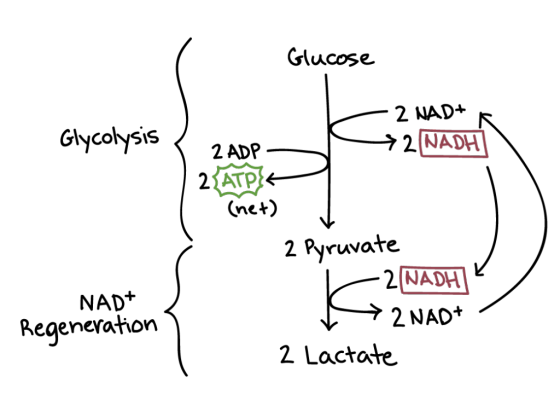
3. Alcohol fermentation-
3.
Add Answer to:
Describe the three major pathways that are involved in the
metabolism of glucose to pyruvate (15...
What other macromolecules are involved in glucose metabolism and how this can be beneficial if there...
What other macromolecules are involved in glucose metabolism and how this can be beneficial if there is a lack of glucose in the body? Where in the process of metabolism do, they function, under what conditions/environment and why? Describe their role.
describe the metabolic pathways, and energetics, involved or generated, during the catabolism of one molecule of...
describe the metabolic pathways, and energetics, involved or generated, during the catabolism of one molecule of glucose by aerobic respiration
4. What are four major pathways of glucose utilization?
 4. What are four major pathways of glucose utilization?
Describe the general pathways and end products of carbohydrate and lipid metabolism in each of the...
Describe the general pathways and end products of carbohydrate and lipid metabolism in each of the following mammalian tissues: a) Liver b) Adipose c) Muscle (skeletal and heart) d) Brain tissues e) Blood
In the Cori cycle, when glucose is degraded by glycolysis to lactate in muscle, the lactate...
 In the Cori cycle, when glucose is degraded by glycolysis to lactate in muscle, the lactate is excreted into the blood and returns to the liver. In the liver, lactate is converted back into glucose by gluconeogenesis. For each given enzyme, identify whether it is involved in the glycolysis pathyway, gluconeogenesis pathway, both pathways, or neither pathway. The enzyme aldolase is involved in The enzyme pyruvate carboxylase is involved in neither pathway. the gluconeogenesis pathway. the glycolysis pathway. The enzyme...
5. Bacterial species break down glucose to pyruvate using a variety of metabolic pathways. If acidic...
 5. Bacterial species break down glucose to pyruvate using a variety of metabolic pathways. If acidic products are produced, pH indicators can show positive glucose fermentation by the presence of acid. However, some bacteria use metabolic pathways that produce acid products which then quickly change to neutral end-products such as the butylene glycol pathway, which produces neutral end products, including acetoin and 2,3- butanediol. Other organisms use the mixed acid pathway, which produces acidic end products such as lactic, acetic,...
From the information in Chapter 8 on metabolism and Appendix A, we can see the multiple...
From the information in Chapter 8 on metabolism and Appendix A, we can see the multiple metabolic pathways involved in generating ATP from the breakdown of the nutrients glucose, protein and fats. Glycolysis generates pyruvate, the pyruvate then becomes Acetyl CoA, which enters the Krebs Cycle (TCA), products of the Krebs Cycle then enter the Electron Transport Chain (ETC) where ATP is the final product. Fat breakdown (beta-oxidation) also generates Acetyl CoA, which then enters the Krebs Cycle to produce...
Describe how the body maintains homeostasis in regulating glucose metabolism in the body. Tell what happens...
Describe how the body maintains homeostasis in regulating glucose metabolism in the body. Tell what happens when there is too much or too little of each major regulatory hormone. Describe the path food follows as it travels through the digestive system. Summarize the major structures and functions of those structures along the way.
describe a decarboxylation-redox reaction that occurs during glucose metabolism
describe a decarboxylation-redox reaction that occurs during glucose metabolism
All mechanisms of glucose metabolism begin with glycolysis and produce 2 pyruvates, 2 ATP and 2...
All mechanisms of glucose metabolism begin with glycolysis and produce 2 pyruvates, 2 ATP and 2 NADH. Make a table comparing aerobic and anaerobic metabolism (after glycolysis) to describe how pyruvate is metabolized. Columns: Cell Respiration, Lactic Acid, Alcohol Fermentation Rows: Where (in the cell) does pyruvate go? What happens to pyruvate (explain in step by step detail)? Is pyruvate oxidized or reduced? What energy-storing molecules are made? What energy-storing molecules are used? What byproducts str produced (CO2 or H2O)?...
 4. What are four major pathways of glucose utilization?
 In the Cori cycle, when glucose is degraded by glycolysis to lactate in muscle, the lactate is excreted into the blood and returns to the liver. In the liver, lactate is converted back into glucose by gluconeogenesis. For each given enzyme, identify whether it is involved in the glycolysis pathyway, gluconeogenesis pathway, both pathways, or neither pathway. The enzyme aldolase is involved in The enzyme pyruvate carboxylase is involved in neither pathway. the gluconeogenesis pathway. the glycolysis pathway. The enzyme...
 5. Bacterial species break down glucose to pyruvate using a variety of metabolic pathways. If acidic products are produced, pH indicators can show positive glucose fermentation by the presence of acid. However, some bacteria use metabolic pathways that produce acid products which then quickly change to neutral end-products such as the butylene glycol pathway, which produces neutral end products, including acetoin and 2,3- butanediol. Other organisms use the mixed acid pathway, which produces acidic end products such as lactic, acetic,...
Most questions answered within 3 hours.
-
Where is the error in this code sequence?
String s1 = "Hello";
String s2 = "ello";...
asked 10 months ago -
Financial data for Joel de Paris, Inc., for last year
follow:
Joel de Paris, Inc.
Balance...
asked 10 months ago -
Consider this reaction:
Al2(SO4)3 (aq)+ BaCl3
(aq) Al2Cl6 (aq)- +
3BaSO4(s) . What is the...
asked 10 months ago -
Suppose that Savneet is considering increasing her
recent random sample from 20 car rentals to 40...
asked 10 months ago -
Trucks arrive at an unloading terminal at an average rate of 120
per hour.
Trucks arrive...
asked 10 months ago -
Why are methanol and ethanol completely soluble in water while
octanol is not very little soluble....
asked 10 months ago -
A facilities manager at a university reads in a research report
that the mean amount of...
asked 10 months ago -
When the CuSO4 is rehydrated by adding water to the anhydrous
compound, is this an endothermic...
asked 10 months ago -
A ray of sunlight is passing from diamond into crown glass; the
angle of incidence is...
asked 10 months ago -
A block of mass 0.249 kg is placed on top of a light, vertical
spring of...
asked 10 months ago -
how do the kidneys compensate in the presences of acidosis
a) trigger hyperventilate
b) reserve acid...
asked 10 months ago -
Question 501 pts
The rental rate of capital to the firm increases. Which of the
following...
asked 10 months ago