Calculate the stoichiometric Amount of air required to completely burn 2000lbs of MSW with a chemical...
Calculate the stoichiometric Amount of air required to completely burn 2000lbs of MSW with a chemical formula of C70H120O50.
Homework Answers

Add Answer to:
Calculate the stoichiometric Amount of air required to
completely burn 2000lbs of MSW with a chemical...
Assume a rough estimate of MSW composition is as follows: If 15,000 metric tonnes of this...
 Assume a rough estimate of MSW composition is as follows: If 15,000 metric tonnes of this material is placed in a landfill, how much methane gas would theoretically be produced by anaerobic decomposition. Express your answer as "Tb gas/lb waste" at tois material is placed in a % by Weight Paper assume all cellose,CHs08)41 Glass Steel Food waste (C4H804) 17 15 27 Calculate the stoichiometric oxygen and stoichiometric air required for the combustion of methane gas calculated in Problem 1....
Butane, initially at 25°C, 1 atmosphere, reacts completely with stoichiometric air Calculate the 2 heating values for the fuel, and express them per unit mole of fuel and per unit mass of fuel....
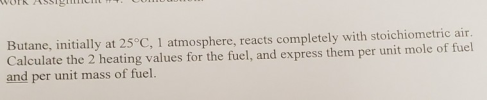 Butane, initially at 25°C, 1 atmosphere, reacts completely with stoichiometric air Calculate the 2 heating values for the fuel, and express them per unit mole of fuel and per unit mass of fuel.
Butane, initially at 25°C, 1 atmosphere, reacts completely with stoichiometric air Calculate the 2 heating values for the fuel, and express them per unit mole of fuel and per unit mass of fuel.
Butane, initially at 25°C, 1 atmosphere, reacts completely with stoichiometric air Calculate the 2 heating values for the fuel, and express them per unit mole of fuel and per unit mass of fuel.
How many moles of O2 are required to burn completely 63.5 g of C6H6, according to...
How many moles of O2 are required to burn completely 63.5 g of C6H6, according to the following equation? 2C6H6 + 15O2 ---> 12CO2 + 6H2O
Exactly 17.550 g of O2 is required to completely burn a 5.000 g mixture of CH4...
Exactly 17.550 g of O2 is required to completely burn a 5.000 g mixture of CH4 and C2H2 yielding only CO2 and H2O. How many grams of C2H2 were in the original mixture? The combustion equations are: CH4(g) + 2 O2(g) ----> CO2(g) + 2 H2O(g) C2H2(g) + 5/2 O2(g) ----> 2 CO2(g) + H20(g)
Calculate the amount of heat required to completely sublime 58.0 g of solid dry ice (CO2)...
Calculate the amount of heat required to completely sublime 58.0 g of solid dry ice (CO2) at its sublimation temperature. The heat of sublimation for carbon dioxide is 32.3 kJmol−1.
Calculate the volume of air at 22 degrees Celcius and 1.05 atmosphere that is needed to...
Calculate the volume of air at 22 degrees Celcius and 1.05 atmosphere that is needed to completely burn 175g of octane. Assume that air is 21% O2 by volume. My answer is 92.736 L of air (441.6 L O2), I don't know what I'm getting wrong. Help?
When butane (C4H10) is burned in air, it reacts with the oxygen (O2) in the air...
When butane (C4H10) is burned in air, it reacts with the oxygen (O2) in the air to produce carbon dioxide (CO2) and water (H2O). The unbalanced equation for the chemical reaction is shown below. C4H10 + O2 à CO2 + H2O Butane is fed to an experimental combustion chamber at the rate of 100 grams per hour. Assuming that the combustion chamber is able to completely burn the butane, what is the required mass flow rate of air? Assume that...
Consider following chemical reaction for the combustion of a fuel such as biodiesel in a diesel...
Consider following chemical reaction for the combustion of a fuel such as biodiesel in a diesel combustion engine: a C8H17COOCH3 + b O2 yields c CO2 + d H2O, where a, b, c, and d are integer stoichiometric coefficients. A) Balance the above chemical reaction using the smallest integer stoichiometric coefficients and clearly write the balanced chemical reaction. B) Using the stoichiometric coefficients determined in part A), calculate the theoretical molar stoichiometric air to fuel ratio, assuming that there is...
The limiting reactant is the chemical substance that determines the amount of product(s) that can ultimately...
 The limiting reactant is the chemical substance that determines the amount of product(s) that can ultimately be formed in a reaction. During the reaction, the limiting reactant is completely consumed or used up, and therefore, causes the reaction to stop The limiting reactant can be identified through stoichiometric calculations. After comparing the results, the reactant that produces the smaller mass of product is identified as the limiting reactant. Determine the excess reactant and calculate the mass of the remaining excess...
An internal combustion engine is running on octane, C8H18 (1) with stoichiometric amount of air. Both...
 An internal combustion engine is running on octane, C8H18 (1) with stoichiometric amount of air. Both the air and fuel enter the engine at room temperature and the exhaust gas leaving the engine contain CO2, CO, H2, N2 and H20. The exhaust temperature is unknown. The brake power is measured and its value is known. It is also estimated that the rate of heat transfer amounts to say, 60% of the brake power; therefore the rate of heat transfer is...
 Assume a rough estimate of MSW composition is as follows: If 15,000 metric tonnes of this material is placed in a landfill, how much methane gas would theoretically be produced by anaerobic decomposition. Express your answer as "Tb gas/lb waste" at tois material is placed in a % by Weight Paper assume all cellose,CHs08)41 Glass Steel Food waste (C4H804) 17 15 27 Calculate the stoichiometric oxygen and stoichiometric air required for the combustion of methane gas calculated in Problem 1....
 Butane, initially at 25°C, 1 atmosphere, reacts completely with stoichiometric air Calculate the 2 heating values for the fuel, and express them per unit mole of fuel and per unit mass of fuel.
Butane, initially at 25°C, 1 atmosphere, reacts completely with stoichiometric air Calculate the 2 heating values for the fuel, and express them per unit mole of fuel and per unit mass of fuel.
Butane, initially at 25°C, 1 atmosphere, reacts completely with stoichiometric air Calculate the 2 heating values for the fuel, and express them per unit mole of fuel and per unit mass of fuel.
 The limiting reactant is the chemical substance that determines the amount of product(s) that can ultimately be formed in a reaction. During the reaction, the limiting reactant is completely consumed or used up, and therefore, causes the reaction to stop The limiting reactant can be identified through stoichiometric calculations. After comparing the results, the reactant that produces the smaller mass of product is identified as the limiting reactant. Determine the excess reactant and calculate the mass of the remaining excess...
 An internal combustion engine is running on octane, C8H18 (1) with stoichiometric amount of air. Both the air and fuel enter the engine at room temperature and the exhaust gas leaving the engine contain CO2, CO, H2, N2 and H20. The exhaust temperature is unknown. The brake power is measured and its value is known. It is also estimated that the rate of heat transfer amounts to say, 60% of the brake power; therefore the rate of heat transfer is...
Most questions answered within 3 hours.
-
Where is the error in this code sequence?
String s1 = "Hello";
String s2 = "ello";...
asked 11 months ago -
Financial data for Joel de Paris, Inc., for last year
follow:
Joel de Paris, Inc.
Balance...
asked 11 months ago -
Consider this reaction:
Al2(SO4)3 (aq)+ BaCl3
(aq) Al2Cl6 (aq)- +
3BaSO4(s) . What is the...
asked 11 months ago -
Suppose that Savneet is considering increasing her
recent random sample from 20 car rentals to 40...
asked 11 months ago -
Trucks arrive at an unloading terminal at an average rate of 120
per hour.
Trucks arrive...
asked 11 months ago -
Why are methanol and ethanol completely soluble in water while
octanol is not very little soluble....
asked 11 months ago -
A facilities manager at a university reads in a research report
that the mean amount of...
asked 11 months ago -
When the CuSO4 is rehydrated by adding water to the anhydrous
compound, is this an endothermic...
asked 11 months ago -
A ray of sunlight is passing from diamond into crown glass; the
angle of incidence is...
asked 11 months ago -
A block of mass 0.249 kg is placed on top of a light, vertical
spring of...
asked 11 months ago -
how do the kidneys compensate in the presences of acidosis
a) trigger hyperventilate
b) reserve acid...
asked 11 months ago -
Question 501 pts
The rental rate of capital to the firm increases. Which of the
following...
asked 11 months ago