Older railroad tracks in the U.S. are made of 12-m-long pieces of steel. When the tracks...
Older railroad tracks in the U.S. are made of 12-m-long pieces of steel. When the tracks are laid, gaps are left between the sections to prevent buckling when the steel thermally expands. Part A If a track is laid at 16∘C, how large should the gaps be if the track is not to buckle when the temperature is as high as 50∘C?
Homework Answers

Add Answer to:
Older railroad tracks in the U.S. are made of 12-m-long pieces
of steel. When the tracks...
Older railroad tracks in the U.S. are made of 12-m-long pieces of steel. When the tracks...
Older railroad tracks in the U.S. are made of 12-m-long pieces of steel. When the tracks are laid, gaps are left between sections to prevent buckling when the steel termally expands. If a track is laid at 16*C, how large should the gaps be if the track is not to buckle when the temperature is as high as 50*C?
During the construction of the LRT railroad track, hot rolled structural steel A36 of 10-m-long rails...
 During the construction of the LRT railroad track, hot rolled structural steel A36 of 10-m-long rails were used. The steel rails were laid on the track with a 5-mm gaps between the rails during the night when the temperature of the steel was 20°C. Determine the normal stress in the steel rails when the temperature of the steel is 40°C. E = 200 GPa and a = 11.7 x 10⁻⁶ m/(m °C)
3. Steel railroad rails 18,2880 m long are laid on a winter day when the temperature...
 3. Steel railroad rails 18,2880 m long are laid on a winter day when the temperature is -6,00 °C. How much space must be left between rails if they are just to touch on a summer day when the temperature is 43 °C? (4)
The steel rails of a railroad track (Es = 200 GPa, αs = 11.7 × 10⁻⁶/°C)...
The steel rails of a railroad track (Es = 200 GPa, αs = 11.7 × 10⁻⁶/°C) were laid at a temperature of 6°C. Determine the normal stress in the rails when the temperature reaches 48°C, assuming that the rails (a) are welded to form a continuous track, (b) are 10 m long with 3-mm gaps between them.
A 1 km steel railroad rail is fastened securely at both ends when the temperature is...
A 1 km steel railroad rail is fastened securely at both ends when the temperature is 20 C. As the temperature increases, the rail begins to buckle. When the temperature is 25 C how high is the buckle assuming it is triangular in shape? (The linear coefficient of expansion for steel is 11 X 10-6 K-1 )
Heat and thermodynamics. Please help with all parts for question 4. Problem4: Railroad tracks are made...
 Heat and thermodynamics.
Please help with all parts for question 4.
Problem4: Railroad tracks are made f om segmentsL=81mlogat7-20°C. whenthe acks are laid, the eng er of width / between adjacent segments to allow for thermal expansion. The coefficient of linear expansion is a - 12x 1 engineers design the tracks to withstand temperatures of Te-39.5 degrees. s leave gaps 0% ec and Part (o) Enter an expression, in terms of given variables, for the minimum gap distance / the...
Heat and thermodynamics.
Please help with all parts for question 4.
Problem4: Railroad tracks are made f om segmentsL=81mlogat7-20°C. whenthe acks are laid, the eng er of width / between adjacent segments to allow for thermal expansion. The coefficient of linear expansion is a - 12x 1 engineers design the tracks to withstand temperatures of Te-39.5 degrees. s leave gaps 0% ec and Part (o) Enter an expression, in terms of given variables, for the minimum gap distance / the...
AL (20) If the gap between railroad tracks closes tight, the tracks will buckle (see images)!...
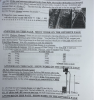 AL (20) If the gap between railroad tracks closes tight, the tracks will buckle (see images)! 20 meter stretches of Iron (Steel) railroad track are laid with a 1-inch (2.54 cm = 0.0254m) gap between them at-30-deg. C. The first hot day afterwards, the rails sat in the hot sun and their temperature rose to 355K A) (10) The gap change between the tracks = B) Based on your answer above, will the tracks buckle OR NOT ?? YES/ NO...
A steel railroad track has a length of 24 m when the temperature is 8◦C. What...
A steel railroad track has a length of 24 m when the temperature is 8◦C. What is the increase in the length of the rail on a hot day when the temperature is 36 ◦C? The linear expansion steel is 11 × 10−6 (◦C)−1. Answer in units of m. 004 (part 2 of 2) 10.0 points Suppose the ends of the rail are rigidly clamped at 8◦C to prevent expansion. Calculate the thermal stress in the rail if its temperature...
A segment of steel railroad track has a length of 30.000 m when the temperature is...
 A segment of steel railroad track has a length of 30.000 m when the temperature is 0.0°C. (a) What is its length when the temperature is 40.0°C? SOLUTION Conceptualize Because the rail is relatively long, we expect to obtain a measurable increase in length for a 40°C temperature increase. problem Categorize We will evaluate a length increase using the discussion of this section, so this part of the example is an analysis Use AL aLAT and the value of the...
C1) If a standard 1850 USA railroad track (11.9m) was made on a hot summer day...
C1) If a standard 1850 USA railroad track (11.9m) was made on a hot summer day 32 °C, how long would it be on a cold night in NY -5 °C? C2) In a NY city skyscraper, there is a steel cable that is 380 m tall. If it was placed there at room temperature 20°C, and the building cooled off to 10°C in winter, how many cm would the 1st floor level be off when the elevator doors opened?...
 During the construction of the LRT railroad track, hot rolled structural steel A36 of 10-m-long rails were used. The steel rails were laid on the track with a 5-mm gaps between the rails during the night when the temperature of the steel was 20°C. Determine the normal stress in the steel rails when the temperature of the steel is 40°C. E = 200 GPa and a = 11.7 x 10⁻⁶ m/(m °C)
 3. Steel railroad rails 18,2880 m long are laid on a winter day when the temperature is -6,00 °C. How much space must be left between rails if they are just to touch on a summer day when the temperature is 43 °C? (4)
 Heat and thermodynamics.
Please help with all parts for question 4.
Problem4: Railroad tracks are made f om segmentsL=81mlogat7-20°C. whenthe acks are laid, the eng er of width / between adjacent segments to allow for thermal expansion. The coefficient of linear expansion is a - 12x 1 engineers design the tracks to withstand temperatures of Te-39.5 degrees. s leave gaps 0% ec and Part (o) Enter an expression, in terms of given variables, for the minimum gap distance / the...
Heat and thermodynamics.
Please help with all parts for question 4.
Problem4: Railroad tracks are made f om segmentsL=81mlogat7-20°C. whenthe acks are laid, the eng er of width / between adjacent segments to allow for thermal expansion. The coefficient of linear expansion is a - 12x 1 engineers design the tracks to withstand temperatures of Te-39.5 degrees. s leave gaps 0% ec and Part (o) Enter an expression, in terms of given variables, for the minimum gap distance / the...
 AL (20) If the gap between railroad tracks closes tight, the tracks will buckle (see images)! 20 meter stretches of Iron (Steel) railroad track are laid with a 1-inch (2.54 cm = 0.0254m) gap between them at-30-deg. C. The first hot day afterwards, the rails sat in the hot sun and their temperature rose to 355K A) (10) The gap change between the tracks = B) Based on your answer above, will the tracks buckle OR NOT ?? YES/ NO...
 A segment of steel railroad track has a length of 30.000 m when the temperature is 0.0°C. (a) What is its length when the temperature is 40.0°C? SOLUTION Conceptualize Because the rail is relatively long, we expect to obtain a measurable increase in length for a 40°C temperature increase. problem Categorize We will evaluate a length increase using the discussion of this section, so this part of the example is an analysis Use AL aLAT and the value of the...
Most questions answered within 3 hours.
-
Where is the error in this code sequence?
String s1 = "Hello";
String s2 = "ello";...
asked 11 months ago -
Financial data for Joel de Paris, Inc., for last year
follow:
Joel de Paris, Inc.
Balance...
asked 11 months ago -
Consider this reaction:
Al2(SO4)3 (aq)+ BaCl3
(aq) Al2Cl6 (aq)- +
3BaSO4(s) . What is the...
asked 11 months ago -
Suppose that Savneet is considering increasing her
recent random sample from 20 car rentals to 40...
asked 11 months ago -
Trucks arrive at an unloading terminal at an average rate of 120
per hour.
Trucks arrive...
asked 11 months ago -
Why are methanol and ethanol completely soluble in water while
octanol is not very little soluble....
asked 11 months ago -
A facilities manager at a university reads in a research report
that the mean amount of...
asked 11 months ago -
When the CuSO4 is rehydrated by adding water to the anhydrous
compound, is this an endothermic...
asked 11 months ago -
A ray of sunlight is passing from diamond into crown glass; the
angle of incidence is...
asked 11 months ago -
A block of mass 0.249 kg is placed on top of a light, vertical
spring of...
asked 11 months ago -
how do the kidneys compensate in the presences of acidosis
a) trigger hyperventilate
b) reserve acid...
asked 11 months ago -
Question 501 pts
The rental rate of capital to the firm increases. Which of the
following...
asked 11 months ago