a flask contains two compartments (A and B) with equal volumes of solution separated by a...
a flask contains two compartments (A and B) with equal volumes of solution separated by a semipermeable membrane. compartment a is filled with 2.0 M NaCl and B is filled with 2.0M glucose. What happens to the volume of the compartments over time? Briefly explain your reasoning
Homework Answers
One NaCl has one Na+ particle and one Cl- particle, that is total two particles per one NaCl. So in compartment A 2.0 M NaCl actually has 2.0 M Na+ and 2.0M Cl-, that is total of 2.0+2.0 = 4.0 M solute particles.
But one glucose has only one solute particle. It can't split like NaCl. Thus compartment B has only 2.0 M concentration of solute particles.
Now the semipermiable membrane allows movement of only solvent water molecules across it, which move from a region of high solvent concentration (low solute concentration), that is compartment B, to a region of low solvent concentration ( high solute concentration) that is compartment A.
Hence over time volume of compartment A increases and that of compartment B decreases.
Comment if still any doubt.
Add Answer to:
a flask contains two compartments (A and B) with equal volumes
of solution separated by a...
4-40 4.40 A rigid, insulated tank consists of two compartments of equal volume separated by a...
 4-40
4.40 A rigid, insulated tank consists of two compartments of equal volume separated by a valve. Initially, one compartment contains air at a pressure of 750 kPa and a temperature of 50°C, while the second compartment is completely empty. The valve is opened and it remains open until the two compartments reach pressure and temperature equilibrium. Determine the final pressure and temperature of the air, assuming each compartment has a volume of 0.65 m'.
4-40
4.40 A rigid, insulated tank consists of two compartments of equal volume separated by a valve. Initially, one compartment contains air at a pressure of 750 kPa and a temperature of 50°C, while the second compartment is completely empty. The valve is opened and it remains open until the two compartments reach pressure and temperature equilibrium. Determine the final pressure and temperature of the air, assuming each compartment has a volume of 0.65 m'.
Solutions A and B are separated by a semipermeable membrane. For each of the following pair,...
Solutions A and B are separated by a semipermeable membrane. For each of the following pair, determine the direction of flow of water (A to B or B to A) a. A: 2.5 % glucose solution. B: 4.0 % glucose solution b. A: 2.0 M NaCl solution. B: 0.9 M NaCl solution
a A rigid, tank contains two compartments, each of volume 1m2, separated by a membrane. Compartment...
 a A rigid, tank contains two compartments, each of volume 1m2, separated by a membrane. Compartment A initially has R-134a at 20C and quality 15%. Compartment B is initially evacuated. The membrane ruptures and the final pressures in both compartments equalize. The temperature is constant throughout at 20 R-134A evacuated VA 1m3Vei 1m Membrane R-134A 20c otal V of tan is constant Ruptures State 1 State 2 a. What is the specific volume in compartment A at state 1? b....
Osmosis-Compare solution level between semipermeable membrane (Pool 1 of 2) A lask conlains two compartments (A...
 Osmosis-Compare solution level between semipermeable membrane (Pool 1 of 2) A lask conlains two compartments (A and B) with equal volumes of solution separaled by a sempemeable membrane. Which dagram represents the final levels of liquid when A and B corlin each of the tollowing solutons7 Dagran 3) 12 1% (w/v) sucrose 0.20 M CaC2 0.25 M Na2SO 2.0 M Na2SO4 a. 3% (w/v) sucrose b. 0.30 M NaCi A B c 0.25 M MgCl2 d. 2.0 M KC
A system is given by two compartments separated by a thin membrane, and solute moves from...
 A system is given by two compartments separated by a thin
membrane, and solute moves from one compartment to the other by
diffusion. The volume of compartment 1 is 0.03 cm^3 and compartment
2 is 0.01 cm^3. Suppose 50 M of solute is dumped into compartment
2, and the concentration response for compartment 1 is c1(t)=
1250(1- e^(-0.01t) u(t) M/cm^3 . (a) Find the transfer
rate. (b) Solve for the concentration in compartment 2.
A system is given by two compartments...
A system is given by two compartments separated by a thin
membrane, and solute moves from one compartment to the other by
diffusion. The volume of compartment 1 is 0.03 cm^3 and compartment
2 is 0.01 cm^3. Suppose 50 M of solute is dumped into compartment
2, and the concentration response for compartment 1 is c1(t)=
1250(1- e^(-0.01t) u(t) M/cm^3 . (a) Find the transfer
rate. (b) Solve for the concentration in compartment 2.
A system is given by two compartments...
A semipermeable membrane separates two compartments containing different ideal, dilute solutions....
A semipermeable membrane separates two compartments containing different ideal, dilute solutions. Compartment 1 contains 150 mL of solution containing 0.02 mol Na+, 0.02 mol K+, and 0.05 mol Cl-. Compartment 2 contains 200 mL of solution containing 0.02 mol Na+, 0.01 mol Ca2+, and 0.01 mol PO43-. In which direction will Na+ diffuse? Explain your answer. (3 points)
Suppose a solution with a high concentration of glucose is separated from a sample of low...
Suppose a solution with a high concentration of glucose is separated from a sample of low concentration of glucose by a semipermeable membrane. Which solution will increase in volume? a. The solution with the high concentration of glucose will increase in volume. b. The solution with the low concentration of glucose will increase in volume. c. The volumes of the solutions will stay the same.
Ilustrated is a completely isolated system comprised of two compartments A & B) containing two monovalent...
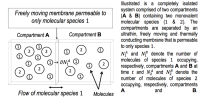 Ilustrated is a completely isolated system comprised of two compartments A & B) containing two monovalent molecular species (1 & 2). The compartments are separated by an ultrathin, freely moving and thermally conducting membrane that is permeable to only species 1. NA and N denote the number of molecules of species 1 occupying, respecively, compartments A and B at time t and NA and NB denote the number of molecules of species 2 occupying, respectively, compartments Freely moving membrane permeable...
Two different solutions are separated by a semi-permeable membrane at 25 degrees Celsius. Solution A contains...
Two different solutions are separated by a semi-permeable membrane at 25 degrees Celsius. Solution A contains 0.30mM NaCl and 0.60mM CaCl2 while solution B contains 1.00mM of glucose and 0.55mM of KBr. In which direction will water flow through the semi-permeable membrane?
Tesm Pre-Lab Study Questions I. In 1 In making pickles, the cucumber making pick les, a cucumber ...
 Tesm Pre-Lab Study Questions I. In 1 In making pickles, the cucumber making pick les, a cucumber is placed in when it is left in the salt solution for some time. a concentrated salt solution. Explain what happens t wso6 osmotic act on hresh the 2. Why is it important that cell membranes are 3. What are the differences between solutions, colloids, and . Indicate the compartment (A or B) that will increase in volume for each of the following...
 4-40
4.40 A rigid, insulated tank consists of two compartments of equal volume separated by a valve. Initially, one compartment contains air at a pressure of 750 kPa and a temperature of 50°C, while the second compartment is completely empty. The valve is opened and it remains open until the two compartments reach pressure and temperature equilibrium. Determine the final pressure and temperature of the air, assuming each compartment has a volume of 0.65 m'.
4-40
4.40 A rigid, insulated tank consists of two compartments of equal volume separated by a valve. Initially, one compartment contains air at a pressure of 750 kPa and a temperature of 50°C, while the second compartment is completely empty. The valve is opened and it remains open until the two compartments reach pressure and temperature equilibrium. Determine the final pressure and temperature of the air, assuming each compartment has a volume of 0.65 m'.
 a A rigid, tank contains two compartments, each of volume 1m2, separated by a membrane. Compartment A initially has R-134a at 20C and quality 15%. Compartment B is initially evacuated. The membrane ruptures and the final pressures in both compartments equalize. The temperature is constant throughout at 20 R-134A evacuated VA 1m3Vei 1m Membrane R-134A 20c otal V of tan is constant Ruptures State 1 State 2 a. What is the specific volume in compartment A at state 1? b....
 Osmosis-Compare solution level between semipermeable membrane (Pool 1 of 2) A lask conlains two compartments (A and B) with equal volumes of solution separaled by a sempemeable membrane. Which dagram represents the final levels of liquid when A and B corlin each of the tollowing solutons7 Dagran 3) 12 1% (w/v) sucrose 0.20 M CaC2 0.25 M Na2SO 2.0 M Na2SO4 a. 3% (w/v) sucrose b. 0.30 M NaCi A B c 0.25 M MgCl2 d. 2.0 M KC
 A system is given by two compartments separated by a thin
membrane, and solute moves from one compartment to the other by
diffusion. The volume of compartment 1 is 0.03 cm^3 and compartment
2 is 0.01 cm^3. Suppose 50 M of solute is dumped into compartment
2, and the concentration response for compartment 1 is c1(t)=
1250(1- e^(-0.01t) u(t) M/cm^3 . (a) Find the transfer
rate. (b) Solve for the concentration in compartment 2.
A system is given by two compartments...
A system is given by two compartments separated by a thin
membrane, and solute moves from one compartment to the other by
diffusion. The volume of compartment 1 is 0.03 cm^3 and compartment
2 is 0.01 cm^3. Suppose 50 M of solute is dumped into compartment
2, and the concentration response for compartment 1 is c1(t)=
1250(1- e^(-0.01t) u(t) M/cm^3 . (a) Find the transfer
rate. (b) Solve for the concentration in compartment 2.
A system is given by two compartments...
 Ilustrated is a completely isolated system comprised of two compartments A & B) containing two monovalent molecular species (1 & 2). The compartments are separated by an ultrathin, freely moving and thermally conducting membrane that is permeable to only species 1. NA and N denote the number of molecules of species 1 occupying, respecively, compartments A and B at time t and NA and NB denote the number of molecules of species 2 occupying, respectively, compartments Freely moving membrane permeable...
 Tesm Pre-Lab Study Questions I. In 1 In making pickles, the cucumber making pick les, a cucumber is placed in when it is left in the salt solution for some time. a concentrated salt solution. Explain what happens t wso6 osmotic act on hresh the 2. Why is it important that cell membranes are 3. What are the differences between solutions, colloids, and . Indicate the compartment (A or B) that will increase in volume for each of the following...
Most questions answered within 3 hours.
-
Where is the error in this code sequence?
String s1 = "Hello";
String s2 = "ello";...
asked 10 months ago -
Financial data for Joel de Paris, Inc., for last year
follow:
Joel de Paris, Inc.
Balance...
asked 10 months ago -
Consider this reaction:
Al2(SO4)3 (aq)+ BaCl3
(aq) Al2Cl6 (aq)- +
3BaSO4(s) . What is the...
asked 10 months ago -
Suppose that Savneet is considering increasing her
recent random sample from 20 car rentals to 40...
asked 10 months ago -
Trucks arrive at an unloading terminal at an average rate of 120
per hour.
Trucks arrive...
asked 10 months ago -
Why are methanol and ethanol completely soluble in water while
octanol is not very little soluble....
asked 10 months ago -
A facilities manager at a university reads in a research report
that the mean amount of...
asked 10 months ago -
When the CuSO4 is rehydrated by adding water to the anhydrous
compound, is this an endothermic...
asked 10 months ago -
A ray of sunlight is passing from diamond into crown glass; the
angle of incidence is...
asked 10 months ago -
A block of mass 0.249 kg is placed on top of a light, vertical
spring of...
asked 10 months ago -
how do the kidneys compensate in the presences of acidosis
a) trigger hyperventilate
b) reserve acid...
asked 10 months ago -
Question 501 pts
The rental rate of capital to the firm increases. Which of the
following...
asked 10 months ago