Solutions A and B are separated by a semipermeable membrane. For each of the following pair,...
Solutions A and B are separated by a semipermeable membrane. For each of the following pair, determine the direction of flow of water (A to B or B to A)
a. A: 2.5 % glucose solution. B: 4.0 % glucose solution
b. A: 2.0 M NaCl solution. B: 0.9 M NaCl solution
Homework Answers
Answer:-
As we know that osmosis is that phenomenon in which spontaneous movement of solvent molecules from lower concentration to higher concentartion through semipermeable membrane takes place.
(a) -
Given:-
A: 2.5 % glucose solution. B: 4.0 % glucose solution
So we know that 2.5 % glucose solution means that 2.5 g glucose dissolved in 100 mL water and 4.0 % glucose solution means that 4.0 g glucose dissolved in 100 mL water.
So the concentartion of glucose would as follows:-
A: 2.5 % glucose solution < B: 4.0 % glucose solution
2.5 g glucose (A) < 4.0 g glucose (B)
therefore
Lower concentration of glucose solution = A: 2.5 % glucose solution
and
Higher concentration of glucose solution = B: 4.0 % glucose solution
So
Spontaneous movement of water molecules from lower concentration (A: 2.5 % glucose solution) to higher concentartion (B: 4.0 % glucose solution) through semipermeable membrane takes place.
A: 2.5 % glucose solution
 B:
4.0 % glucose solution (i.e the answer)
B:
4.0 % glucose solution (i.e the answer)
or
Direction of flow of water A to B (i.e the answer)
(b) -
Given:-
A: 2.0 M NaCl solution. B: 0.9 M NaCl solution
So we know that 2.0 % NaCl solution means that 2.0 g NaCl dissolved in 100 mL water and 0.9 % NaCl solution means that 0.9 g NaCl dissolved in 100 mL water.
So the concentartion of glucose would as follows:-
A: 2.0 M NaCl solution > B: 0.9 M NaCl solution
2.0 g NaCl (A) > 0.9 g NaCl (B)
therefore
Lower concentration of NaCl solution = B: 0.9 M NaCl solution
and
Higher concentration of NaCl solution = A: 2.0 M NaCl solution
Spontaneous movement of water molecules from lower concentration (B: 0.9 M NaCl solution) to higher concentartion (A: 2.0 M NaCl solution) through semipermeable membrane takes place.
B: 0.9 M NaCl solution
A:
2.0 M NaCl solution (i.e the answer)
or
Direction of flow of water B to A (i.e the answer)
Add Answer to:
Solutions A and B are separated by a semipermeable membrane. For
each of the following pair,...
this is my 2nd time uploading this. 1 and 2 were answered, but I did not...
 this is my 2nd time uploading this. 1 and 2 were answered, but I
did not receive help for #3
Lecture Assignment #3 1. Salt can be recovered from salt water through evaporation of water. If a salt water solution is 3.0 % (m/v) salt, how many mL of salt water is required to recover 35.0 g of salt? 2. 1.00 L of 0.875 M solution of HCl is required for an experiment for a whole class. If the stockroom...
this is my 2nd time uploading this. 1 and 2 were answered, but I
did not receive help for #3
Lecture Assignment #3 1. Salt can be recovered from salt water through evaporation of water. If a salt water solution is 3.0 % (m/v) salt, how many mL of salt water is required to recover 35.0 g of salt? 2. 1.00 L of 0.875 M solution of HCl is required for an experiment for a whole class. If the stockroom...
A semipermeable membrane separates two aqueous solutions at 37 °C. For each scenario, determine the solution...
 A semipermeable membrane separates two aqueous solutions at 37 °C. For each scenario, determine the solution into which a net flow of water, if any, will occur. Net flow is toward solution A Net flow is toward solution B No net flow Answer Bank solution A: 5.0% (w/v) glucose solution solution A: 0.20 M KCl solution solution A: 1.0 mM KCl solution solution B: 10.0% (w/v ) glucose solution solution B: pure water solution B: 1.0 mM NaCl solution solution...
If the following 2 aqueous solutions are separated by a semipermeable membrane which of the follo...
If the following 2 aqueous solutions are separated by a semipermeable membrane which of the following statements is true? A = 0.300 M KI B = 0.300 MgCl2 Select one: a. Solvent will flow from A to B. b. The solutions are isotonic and there will be no change c. There is no way to know d. Solvent will flow from B to A
Two different solutions are separated by a semi-permeable membrane at 25 degrees Celsius. Solution A contains...
Two different solutions are separated by a semi-permeable membrane at 25 degrees Celsius. Solution A contains 0.30mM NaCl and 0.60mM CaCl2 while solution B contains 1.00mM of glucose and 0.55mM of KBr. In which direction will water flow through the semi-permeable membrane?
Consider two solutions of a nonelectrolyte separated by a semipermeable membrane that will allow passage of...
Consider two solutions of a nonelectrolyte separated by a semipermeable membrane that will allow passage of water, but not the nonelectrolyte. The molarity of the more concentrated solution is 0.725 M and the molarity of the less concentrated is 0.550 M. What is the minumum pressure that must be applied to stop the osmosis at 25.0 ºC? R = 0.082057 atm L mol–1 K–1
Two aqueous solutions, A and B, are separated by a semipermeable membrane. The osmotic pressure of...
Two aqueous solutions, A and B, are separated by a semipermeable membrane. The osmotic pressure of solution A immediately begins to decrease. Which of the following statements is true? Solvent molecules are moving from solution B into solution A. The initial osmotic pressure of solution B is greater than that of solution A. The solvent molecules are moving from the solution of higher osmotic pressure to that of lower osmotic pressure. Both B and C are true statements.
A semipermeable membrane separates two aqueous solutions at 20 degree C. For each of the following...
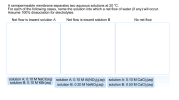 A semipermeable membrane separates two aqueous solutions at 20 degree C. For each of the following cases, name the solution into which a net flow of water (if any) will occur. Assume 100% dissociation for electrolytes.
Consider two solutions with the following molarities, separated by a semi-permeable membrane: Solution A: 0.25 M...
Consider two solutions with the following molarities, separated by a semi-permeable membrane: Solution A: 0.25 M NaCl Solution B: 0.05 M NaCl In which direction will water diffuse?
If two solutions with concentrations of 0.5 M NaCl and 1.0 M NaCl respectively are separated...
If two solutions with concentrations of 0.5 M NaCl and 1.0 M NaCl respectively are separated by a semipermeable membrane, during osmosis there is a net flow of Group of answer choices salt molecules from the concentrated to the dilute solution salt molecules from the dilute to the concentrated solution water molecules from the concentrated to the dilute solution water molecules from the dilute to the concentrated solution
a flask contains two compartments (A and B) with equal volumes of solution separated by a...
a flask contains two compartments (A and B) with equal volumes of solution separated by a semipermeable membrane. compartment a is filled with 2.0 M NaCl and B is filled with 2.0M glucose. What happens to the volume of the compartments over time? Briefly explain your reasoning
 this is my 2nd time uploading this. 1 and 2 were answered, but I
did not receive help for #3
Lecture Assignment #3 1. Salt can be recovered from salt water through evaporation of water. If a salt water solution is 3.0 % (m/v) salt, how many mL of salt water is required to recover 35.0 g of salt? 2. 1.00 L of 0.875 M solution of HCl is required for an experiment for a whole class. If the stockroom...
this is my 2nd time uploading this. 1 and 2 were answered, but I
did not receive help for #3
Lecture Assignment #3 1. Salt can be recovered from salt water through evaporation of water. If a salt water solution is 3.0 % (m/v) salt, how many mL of salt water is required to recover 35.0 g of salt? 2. 1.00 L of 0.875 M solution of HCl is required for an experiment for a whole class. If the stockroom...
 A semipermeable membrane separates two aqueous solutions at 37 °C. For each scenario, determine the solution into which a net flow of water, if any, will occur. Net flow is toward solution A Net flow is toward solution B No net flow Answer Bank solution A: 5.0% (w/v) glucose solution solution A: 0.20 M KCl solution solution A: 1.0 mM KCl solution solution B: 10.0% (w/v ) glucose solution solution B: pure water solution B: 1.0 mM NaCl solution solution...
 A semipermeable membrane separates two aqueous solutions at 20 degree C. For each of the following cases, name the solution into which a net flow of water (if any) will occur. Assume 100% dissociation for electrolytes.
Most questions answered within 3 hours.
-
Where is the error in this code sequence?
String s1 = "Hello";
String s2 = "ello";...
asked 10 months ago -
Financial data for Joel de Paris, Inc., for last year
follow:
Joel de Paris, Inc.
Balance...
asked 10 months ago -
Consider this reaction:
Al2(SO4)3 (aq)+ BaCl3
(aq) Al2Cl6 (aq)- +
3BaSO4(s) . What is the...
asked 10 months ago -
Suppose that Savneet is considering increasing her
recent random sample from 20 car rentals to 40...
asked 10 months ago -
Trucks arrive at an unloading terminal at an average rate of 120
per hour.
Trucks arrive...
asked 10 months ago -
Why are methanol and ethanol completely soluble in water while
octanol is not very little soluble....
asked 10 months ago -
A facilities manager at a university reads in a research report
that the mean amount of...
asked 10 months ago -
When the CuSO4 is rehydrated by adding water to the anhydrous
compound, is this an endothermic...
asked 10 months ago -
A ray of sunlight is passing from diamond into crown glass; the
angle of incidence is...
asked 10 months ago -
A block of mass 0.249 kg is placed on top of a light, vertical
spring of...
asked 10 months ago -
how do the kidneys compensate in the presences of acidosis
a) trigger hyperventilate
b) reserve acid...
asked 10 months ago -
Question 501 pts
The rental rate of capital to the firm increases. Which of the
following...
asked 10 months ago