The pK of the side chain of amino acid X in a polypeptide is normally in...
The pK of the side chain of amino acid X in a polypeptide is normally in the range of 9-10 and carries a positive charge when protonated. Suppose you have a soluble globular protein and you find there is an X that has a pK of 6.5. What is the most likely reason for such a large drop in pK? Circle the correct answer.
a) X is on the surface of the protein where it ion pairs with the carboxylate group of another amino acid side chain.
b) X forms an ion pair with a buffer anion.
c) X is ion paired with a carboxylate group of another amino acid in the hydrophobic interior of the protein.
d) X is buried inside the protein surrounded by hydrophobic groups.
e) X is hydrated thus preventing ion pairing with other groups.
Can you please include an explanation? (The key states the answer is D)
Homework Answers
The hydrophobic amino acids surrounding the amino acid X destabilize the protonated form thereby lowering the pka value. The hydrophobic core is non polar which repels the polar charged molecules. Therefore it will destabilize the protonated form of amino acid X
pka of 9-10 means the side of amino acid X will deprotonate at pH 9-10. Below pH9-10 amino acid X's side chain will remain protonated and would be repel by the hydrophobic core. The drop of pka to 6.5 would cause the amino acid X's side chain to deprotonate at low pH( pH6.5), therefore it will not be repelled by the non polar amino acid residues in the core.
Add Answer to:
The pK of the side chain of amino acid X in a polypeptide is
normally in...
See the side chain of the amino acid isoleucine on page 113 of your textbook. This...
See the side chain of the amino acid isoleucine on page 113 of your textbook. This side chain contains three methyl groups. In a folded protein in aqueous solution, an isoleucine residue is most likely to be found A. On the surface of the protein, forming hydrogen bonds with water molecules B. On the surface of the protein, paired with another amino acid in an ionic bond C. In the interior of the protein, hydrogen bonded to other groups D....
how does the protein environment surrounding an amino acid chain affect its chemical properties?Consider the carboxyl...
how does the protein environment surrounding an amino acid chain affect its chemical properties?Consider the carboxyl group on an asparate side chain in the following environments in a protein. Rank in order these environments from the highest to the lowest proportion of carboxyl groups in the -COO- form.that is in terms of pKas. 1. an aspartate side chain on the surface of protein with no other ionizable groups nearby. 2. an aspartate side chain buried in a hydrophobic pocket on...
Even though hydrophobic amino acids tend to be buried in the interior of a globular protein,...
 Even though hydrophobic amino acids tend to be buried in the interior of a globular protein, polar neutral and polar charged amino acids are found in the interior of a globular protein as well. Recall Figure 4.26 of myoglobin. To see how this can happen, consider a model of a generic globular protein (below). The side chains of only seven of the amino acids are shown. 5. "DH" is a side chain that is a hydrogen bond donor "A" is...
4. Shown below is a segment from a polypeptide chain. Which amino acid in this segment...
 4. Shown below is a segment from a polypeptide chain. Which amino acid in this segment is most likely to be found in the hydrophobic interior of the folded protein? ОН OY H ZI IZ ONH2 A. Isoleucine B. Threonine C. Glutamine
How would the following environment affect the pK-value of the side chain of glutamate, and why?...
How would the following environment affect the pK-value of the side chain of glutamate, and why? A: The side chain of Lys is close to the side chain of Glu B: The side chain of Asp is close to the side chain of Glu C: The side chain of Glu is in the interior of the protein (in the hydrophobic environment)
A non-natural amino acid has been synthesized. The carboxylic acid has a pk = 3.04, the...
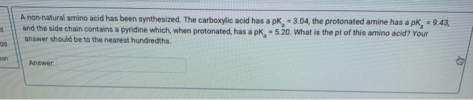 A non-natural amino acid has been synthesized. The carboxylic acid has a pk = 3.04, the protonated amine has a pk, = 9.43, and the side chain contains a pyridine which, when protonated, has a pk, = 5.20. What is the pl of this amino acid? Your answer should be to the nearest hundredths. 00 ton Answer:
The amino group of the lysine side chain has a pKa of 12.5. At pH 7.4,...
The amino group of the lysine side chain has a pKa of 12.5. At pH 7.4, what is the molecular form of the amino group? Can this group exist in a hydrophobic pocket? If so, how would the pKa change? If the amino group were next to carboxylate of glutamate in a hydrophobic pocket how would the pKa change?
True or false? True False Phenylalanine's side chain is more polar than tryptophan's or tyrosine's side chains....
True or false? True False Phenylalanine's side chain is more polar than tryptophan's or tyrosine's side chains. True False Almost all peptide bonds in proteins are in the trans configuration. True False In folded globular proteins, the side chains of hydrophobic amino acids are mostly buried in the interior of the protein. True False The peptides I-A-G-Y-L-S and S-L-Y-G-A-I are different molecules with different properties. True False Poly lysine will tend to form an alpha helix in solution at pH 6.8. True False Amyloidoses such as...
A non-natural amino acid has been synthesized. The carboxylic acid has a pk - 3.21, the...
 A non-natural amino acid has been synthesized. The carboxylic acid has a pk - 3.21, the protonated amine has a pk = 9.59, and the side chain contains an alcohol which has a pk = 16.09. What is the pl of this amino acid? Your answer should be to the nearest hundredths. a Answer:
A non-natural amino acid has been synthesized. The carboxylic acid has a pk - 3.21, the...
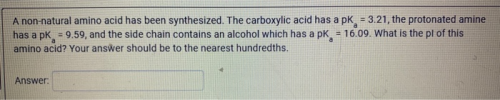 A non-natural amino acid has been synthesized. The carboxylic acid has a pk - 3.21, the protonated amine has a pk = 9.59, and the side chain contains an alcohol which has a pk = 16.09. What is the pl of this amino acid? Your answer should be to the nearest hundredths. a Answer:
 Even though hydrophobic amino acids tend to be buried in the interior of a globular protein, polar neutral and polar charged amino acids are found in the interior of a globular protein as well. Recall Figure 4.26 of myoglobin. To see how this can happen, consider a model of a generic globular protein (below). The side chains of only seven of the amino acids are shown. 5. "DH" is a side chain that is a hydrogen bond donor "A" is...
 4. Shown below is a segment from a polypeptide chain. Which amino acid in this segment is most likely to be found in the hydrophobic interior of the folded protein? ОН OY H ZI IZ ONH2 A. Isoleucine B. Threonine C. Glutamine
 A non-natural amino acid has been synthesized. The carboxylic acid has a pk = 3.04, the protonated amine has a pk, = 9.43, and the side chain contains a pyridine which, when protonated, has a pk, = 5.20. What is the pl of this amino acid? Your answer should be to the nearest hundredths. 00 ton Answer:
 A non-natural amino acid has been synthesized. The carboxylic acid has a pk - 3.21, the protonated amine has a pk = 9.59, and the side chain contains an alcohol which has a pk = 16.09. What is the pl of this amino acid? Your answer should be to the nearest hundredths. a Answer:
 A non-natural amino acid has been synthesized. The carboxylic acid has a pk - 3.21, the protonated amine has a pk = 9.59, and the side chain contains an alcohol which has a pk = 16.09. What is the pl of this amino acid? Your answer should be to the nearest hundredths. a Answer:
Most questions answered within 3 hours.
-
Where is the error in this code sequence?
String s1 = "Hello";
String s2 = "ello";...
asked 11 months ago -
Financial data for Joel de Paris, Inc., for last year
follow:
Joel de Paris, Inc.
Balance...
asked 11 months ago -
Consider this reaction:
Al2(SO4)3 (aq)+ BaCl3
(aq) Al2Cl6 (aq)- +
3BaSO4(s) . What is the...
asked 11 months ago -
Suppose that Savneet is considering increasing her
recent random sample from 20 car rentals to 40...
asked 11 months ago -
Trucks arrive at an unloading terminal at an average rate of 120
per hour.
Trucks arrive...
asked 11 months ago -
Why are methanol and ethanol completely soluble in water while
octanol is not very little soluble....
asked 11 months ago -
A facilities manager at a university reads in a research report
that the mean amount of...
asked 11 months ago -
When the CuSO4 is rehydrated by adding water to the anhydrous
compound, is this an endothermic...
asked 11 months ago -
A ray of sunlight is passing from diamond into crown glass; the
angle of incidence is...
asked 11 months ago -
A block of mass 0.249 kg is placed on top of a light, vertical
spring of...
asked 11 months ago -
how do the kidneys compensate in the presences of acidosis
a) trigger hyperventilate
b) reserve acid...
asked 11 months ago -
Question 501 pts
The rental rate of capital to the firm increases. Which of the
following...
asked 11 months ago