See the side chain of the amino acid isoleucine on page 113 of your textbook. This...
See the side chain of the amino acid isoleucine on page 113 of your textbook. This side chain contains three methyl groups. In a folded protein in aqueous solution, an isoleucine residue is most likely to be found
A. On the surface of the protein, forming hydrogen bonds with water molecules
B. On the surface of the protein, paired with another amino acid in an ionic bond
C. In the interior of the protein, hydrogen bonded to other groups
D. In the interior of the protein, paired with another amino acid in an ionic bond
E. In the interior of the protein due to hydrophobic forces
2.Why do we need hemoglobin to transport oxygen in the bloodstream, but no protein is required to transport carbon dioxide in the blood from the tissues to the lungs?
A. carbon dioxide is hydrophilic, and can interact with water molecules in the blood, but oxygen cannot
B. the bonds in carbon dioxide are nonpolar covalent bonds, but the bonds in oxygen are polar bonds
C. carbon dioxide is surrounded by a shell of sodium ions in the bloodstream, but oxygen is not
D. oxygen is hydrophilic, and can form hydrogen bonds with water molecules in the blood, but carbon dioxide cannot
E. carbon dioxide is amphiphilic, allowing it to form micelles in the blood, but hydrophobic oxygen cannot do this
Homework Answers
Answer 1- The right option is- E. In the interior of the protein due to hydrophobic forces. This is because isoleucine is a nonpolar amino acid, which means that it is hydrophobic.
Answer 2- The right option is- D. Oxygen is hydrophilic and can form hydrogen bonds with water molecules in the blood, but carbon dioxide cannot.
Add Answer to:
See the side chain of the amino acid isoleucine on page 113 of
your textbook. This...
Why do we need hemoglobin to transport oxygen in the bloodstream, but no protein is required...
Why do we need hemoglobin to transport oxygen in the bloodstream, but no protein is required to transport carbon dioxide in the blood from the tissues to the lungs? A. carbon dioxide is hydrophilic, and can interact with water molecules in the blood, but oxygen cannot B. the bonds in carbon dioxide are nonpolar covalent bonds, but the bonds in oxygen are polar bonds C. carbon dioxide is surrounded by a shell of sodium ions in the bloodstream, but oxygen...
Water-soluble proteins, such as myoglobin, tend to fold such that hydrophilic and hydrophobic amino acid R...
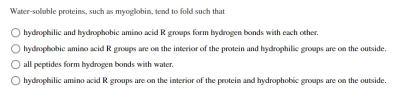 Water-soluble proteins, such as myoglobin, tend to fold such that hydrophilic and hydrophobic amino acid R groups form hydrogen bonds with each other. hydrophobic amino acid R groups are on the interior of the protein and hydrophilic groups are on the outside. all peptides form hydrogen bonds with water. hydrophilic amino acid R groups are on the interior of the protein and hydrophobic groups are on the outside.
The pK of the side chain of amino acid X in a polypeptide is normally in...
The pK of the side chain of amino acid X in a polypeptide is normally in the range of 9-10 and carries a positive charge when protonated. Suppose you have a soluble globular protein and you find there is an X that has a pK of 6.5. What is the most likely reason for such a large drop in pK? Circle the correct answer. a) X is on the surface of the protein where it ion pairs with the carboxylate...
Identify the preferred orientation of amino acid side chains in the tertiary structure of a protein...
Identify the preferred orientation of amino acid side chains in the tertiary structure of a protein in an aqueous environment. A. The hydrophobic side chains will prefer to be on the interior where they can interact with water molecules in the aqueous environment. B. The hydrophilic side chains will prefer to be on the exterior where they can interact with water molecules in the aqueous environment. C. The hydrophilic side chains will prefer to be on the interior where they...
4. Shown below is a segment from a polypeptide chain. Which amino acid in this segment...
 4. Shown below is a segment from a polypeptide chain. Which amino acid in this segment is most likely to be found in the hydrophobic interior of the folded protein? ОН OY H ZI IZ ONH2 A. Isoleucine B. Threonine C. Glutamine
10. A mutation in the DNA that codes for a protein has caused an amino acid...
10. A mutation in the DNA that codes for a protein has caused an amino acid with a polar charged side chain to be replaced with one that has a polar uncharged side chain. What effect should this have? More likely to be hydrophobic More likely to form an ionic bond More likely to form hydrogen bonds More likely to form disulfide bridges
26. Which of the following classification does not match the amino acid side chain A) Contains an basic group/ lysi...
 26. Which of the following classification does not match the amino acid side chain A) Contains an basic group/ lysine B) It is polar C) Forms disulfide bond/ cysteine D) Forms hydrogen bonds with neighbors/ alanine serine 27. All amino acids found in proteins are L-amino acids EXCEPT the achiral. A) glutamate B) Lysine C) glyeine D) Alamine 28. The plH at which the positive and negative charges of an amino acid balance each ofher is called the A) isotonic...
how does the protein environment surrounding an amino acid chain affect its chemical properties?Consider the carboxyl...
how does the protein environment surrounding an amino acid chain affect its chemical properties?Consider the carboxyl group on an asparate side chain in the following environments in a protein. Rank in order these environments from the highest to the lowest proportion of carboxyl groups in the -COO- form.that is in terms of pKas. 1. an aspartate side chain on the surface of protein with no other ionizable groups nearby. 2. an aspartate side chain buried in a hydrophobic pocket on...
THIS IS BIOCHEMISTRY A peptide has a low pI value. Which of the following amino acids...
THIS IS BIOCHEMISTRY A peptide has a low pI value. Which of the following amino acids are likely to be present? Glycine Serine Valine Aspartic aci Arginine The R-groups of which of the following pairs of amino acids could participate in the formation of salt bridge electrostatic interaction? Alanine and valine Valine and lysine Lysine and glutamate Serine and isoleucine Asparagine and glutamine Which of the following interactions does NOT contribute to stabilizing tertiary structure? Hydrophobic interactions Electrostatic interations...
Consider a protein with the acidic side chains, Amino Acid side-chain Arginine pKa = 12.48 Aspartic...
Consider a protein with the acidic side chains, Amino Acid side-chain Arginine pKa = 12.48 Aspartic Acid PKa = 3.90 Cysteine pKa = 8.33 Glutamic acid pKa = 4.07 Histidine pKa = 6.04 Lysine pKa =10.79 Tyrosine pKa =10.13 Given that the pH of blood is about 7.3, how many of the above side chains would be mostly in their ionic form (A-) in blood? 2 3 4 5
 Water-soluble proteins, such as myoglobin, tend to fold such that hydrophilic and hydrophobic amino acid R groups form hydrogen bonds with each other. hydrophobic amino acid R groups are on the interior of the protein and hydrophilic groups are on the outside. all peptides form hydrogen bonds with water. hydrophilic amino acid R groups are on the interior of the protein and hydrophobic groups are on the outside.
 4. Shown below is a segment from a polypeptide chain. Which amino acid in this segment is most likely to be found in the hydrophobic interior of the folded protein? ОН OY H ZI IZ ONH2 A. Isoleucine B. Threonine C. Glutamine
 26. Which of the following classification does not match the amino acid side chain A) Contains an basic group/ lysine B) It is polar C) Forms disulfide bond/ cysteine D) Forms hydrogen bonds with neighbors/ alanine serine 27. All amino acids found in proteins are L-amino acids EXCEPT the achiral. A) glutamate B) Lysine C) glyeine D) Alamine 28. The plH at which the positive and negative charges of an amino acid balance each ofher is called the A) isotonic...
Most questions answered within 3 hours.
-
Where is the error in this code sequence?
String s1 = "Hello";
String s2 = "ello";...
asked 11 months ago -
Financial data for Joel de Paris, Inc., for last year
follow:
Joel de Paris, Inc.
Balance...
asked 11 months ago -
Consider this reaction:
Al2(SO4)3 (aq)+ BaCl3
(aq) Al2Cl6 (aq)- +
3BaSO4(s) . What is the...
asked 11 months ago -
Suppose that Savneet is considering increasing her
recent random sample from 20 car rentals to 40...
asked 11 months ago -
Trucks arrive at an unloading terminal at an average rate of 120
per hour.
Trucks arrive...
asked 11 months ago -
Why are methanol and ethanol completely soluble in water while
octanol is not very little soluble....
asked 11 months ago -
A facilities manager at a university reads in a research report
that the mean amount of...
asked 11 months ago -
When the CuSO4 is rehydrated by adding water to the anhydrous
compound, is this an endothermic...
asked 11 months ago -
A ray of sunlight is passing from diamond into crown glass; the
angle of incidence is...
asked 11 months ago -
A block of mass 0.249 kg is placed on top of a light, vertical
spring of...
asked 11 months ago -
how do the kidneys compensate in the presences of acidosis
a) trigger hyperventilate
b) reserve acid...
asked 11 months ago -
Question 501 pts
The rental rate of capital to the firm increases. Which of the
following...
asked 11 months ago