What is the mass (calculate both in kg and unified mass units, u) of the α...
What is the mass (calculate both in kg and unified mass units, u) of the α - particle? What is the mass (calculate both in kg and unified mass units, u) of the β -particle? Which particle (α or β) is more massive? Which particle has a greater amount of charge (α or β)? Which particle (α or β) would you expect to penetrate further into a piece of lead?
Homework Answers

 please
rate it positively
please
rate it positivelyAdd Answer to:
What is the mass (calculate both in kg and unified
mass units, u) of the α...
A magnesium-lead alloy of mass 9.7 kg consists of a solid α phase that has a...
 A magnesium-lead alloy of mass 9.7 kg consists of a solid
α phase that has a composition just slightly below the
solubility limit at 300°C (570°F). The magnesium-lead phase diagram
is shown in Animated Figure 10.20.
(a) What mass of lead is in the alloy?
kg
(b) If the alloy is heated to 400°C (750°F), how much more lead may
be dissolved in the α phase without exceeding the
solubility limit of this phase?
wt%Pb = (m_Pb + m_add /...
A magnesium-lead alloy of mass 9.7 kg consists of a solid
α phase that has a composition just slightly below the
solubility limit at 300°C (570°F). The magnesium-lead phase diagram
is shown in Animated Figure 10.20.
(a) What mass of lead is in the alloy?
kg
(b) If the alloy is heated to 400°C (750°F), how much more lead may
be dissolved in the α phase without exceeding the
solubility limit of this phase?
wt%Pb = (m_Pb + m_add /...
An α-particle has a charge of +2e and a mass of 6.64 × 10⁻²⁷ kg. It...
An α-particle has a charge of +2e and a mass of 6.64 × 10⁻²⁷ kg. It is accelerated from rest through a potential difference that has a value of 1.09 × 10⁶ V and then enters a uniform magnetic field whose magnitude is 2.63 T. The α-particle moves perpendicular to the magnetic field at all times. What is (a) the speed of the α-particle, (b) the magnitude of the magnetic force on it, and (c) the radius of its circular...
An α-particle has a charge of +2e and a mass of 6.64 10-27 kg. It is...
An α-particle has a charge of +2e and a mass of 6.64 10-27 kg. It is accelerated from rest through a potential difference that has a value of 1.08 106 V and then enters a uniform magnetic field whose magnitude is 2.30 T. The α-particle moves perpendicular to the magnetic field at all times. (a) What is the speed of the α-particle? m/s (b) What is the magnitude of the magnetic force on it? N (c) What is the radius...
An α-particle has a charge of +2e and a mass of 6.64 × 10⁻²⁷ kg. It...
 An α-particle has a charge of +2e and a mass of 6.64 × 10⁻²⁷ kg.
It is accelerated from rest through a potential difference that has
a value of 1.30 × 10⁶ V and then enters a uniform magnetic field
whose magnitude is 1.14 T. The α-particle moves perpendicular to
the magnetic field at all times. What is (a) the speed of the
α-particle, (b) the magnitude of the magnetic force on it, and (c)
the radius of its circular...
An α-particle has a charge of +2e and a mass of 6.64 × 10⁻²⁷ kg.
It is accelerated from rest through a potential difference that has
a value of 1.30 × 10⁶ V and then enters a uniform magnetic field
whose magnitude is 1.14 T. The α-particle moves perpendicular to
the magnetic field at all times. What is (a) the speed of the
α-particle, (b) the magnitude of the magnetic force on it, and (c)
the radius of its circular...
A. An α-particle has a charge of +2e and a mass of 6.64 × 10⁻²⁷ kg....
 A. An α-particle has a charge of +2e and a mass of 6.64
× 10-27 kg. It is accelerated from rest through a
potential difference that has a value of 1.67 × 10⁶ V
and then enters a uniform magnetic field whose magnitude is 2.49 T.
The α-particle moves perpendicular to the magnetic field at all
times. What is (a) the speed of the α-particle,
(b) the magnitude of the magnetic force on it, and
(c) the radius of its...
A. An α-particle has a charge of +2e and a mass of 6.64
× 10-27 kg. It is accelerated from rest through a
potential difference that has a value of 1.67 × 10⁶ V
and then enters a uniform magnetic field whose magnitude is 2.49 T.
The α-particle moves perpendicular to the magnetic field at all
times. What is (a) the speed of the α-particle,
(b) the magnitude of the magnetic force on it, and
(c) the radius of its...
What is the mass of the water in the tub in units of kg?
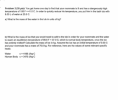 Problem 2 (20 pts): You get home one day to find that your roommate is ill and has a dangerously high temperature of 106 F # 41.0 C. In order to quickly reduce his temperature, you put him in the bath tub with 8.00 L of water at 25.0C.a) What is the mass of the water in the tub in units of kg? b) What is the mass of ice that you would need to add to the tub in order...
A positron has a mass of 9.11 x 10^-31 kg, and charge qp = +e =...
A positron has a mass of 9.11 x 10^-31 kg, and charge qp = +e = +1.60 x 10^-19 C. It is moving towards an α particle (qα = +2e, mα = 6.66 x 10^-27 kg) with a speed of 3.00 x 10^6 m/s. At this instant the separation between the two is 2.00 x 10^-10 m. Assume α particle stays at rest. (a) Calculate the speed of positron at 1.00 x 10^-10 m from α particle. (b) What is...
ne particle has a mass of 3.96 x 10⁻³ kg and a charge of +6.16 HC....
 ne particle has a mass of 3.96 x 10⁻³ kg and a charge of +6.16 HC. A second particle has a mass of 6.35 x 10⁻³ kg and the same charge. The two particles re initially held in place and then released. The particles fly apart, and when the separation between them is 0.112 m, the speed of the 3.96 x 10⁻³ kg-particle s 192 m/s. Find the initial separation between the particles. "2,в V1,в 2 41 TB Numbe he...
Given: a mass (50) kg is on the edge of a rough horizontal turntable with radius...
 Given: a mass (50) kg is on the edge of a rough horizontal
turntable with radius R = 2.00 m Friction coefficients between the
mass and the table are μs = 0.50 and μk = 0.40. The table starts to
rotate (rotate) around the vertical axis of symmetry with a
constant angular acceleration α = 0.60 rad / s2.
It has been asked to calculate the time at which the mass just
will not shift. Can you help me further?
Given: a mass (50) kg is on the edge of a rough horizontal
turntable with radius R = 2.00 m Friction coefficients between the
mass and the table are μs = 0.50 and μk = 0.40. The table starts to
rotate (rotate) around the vertical axis of symmetry with a
constant angular acceleration α = 0.60 rad / s2.
It has been asked to calculate the time at which the mass just
will not shift. Can you help me further?
Given: a mass (50) kg is on the edge of a rough horizontal turntable with radius...
 Given:
a mass (50) kg is on the edge of a rough horizontal turntable with radius R = 2.00 m
Friction coefficients between the mass and the table are μs = 0.50 and μk = 0.40.
The table starts to rotate (rotate) around the vertical axis of symmetry with a constant angular acceleration α = 0.60 rad / s2.
It has been requested to calculate the labour that has delivered the frictional force from the start to the time t*...
Given:
a mass (50) kg is on the edge of a rough horizontal turntable with radius R = 2.00 m
Friction coefficients between the mass and the table are μs = 0.50 and μk = 0.40.
The table starts to rotate (rotate) around the vertical axis of symmetry with a constant angular acceleration α = 0.60 rad / s2.
It has been requested to calculate the labour that has delivered the frictional force from the start to the time t*...
 A magnesium-lead alloy of mass 9.7 kg consists of a solid
α phase that has a composition just slightly below the
solubility limit at 300°C (570°F). The magnesium-lead phase diagram
is shown in Animated Figure 10.20.
(a) What mass of lead is in the alloy?
kg
(b) If the alloy is heated to 400°C (750°F), how much more lead may
be dissolved in the α phase without exceeding the
solubility limit of this phase?
wt%Pb = (m_Pb + m_add /...
A magnesium-lead alloy of mass 9.7 kg consists of a solid
α phase that has a composition just slightly below the
solubility limit at 300°C (570°F). The magnesium-lead phase diagram
is shown in Animated Figure 10.20.
(a) What mass of lead is in the alloy?
kg
(b) If the alloy is heated to 400°C (750°F), how much more lead may
be dissolved in the α phase without exceeding the
solubility limit of this phase?
wt%Pb = (m_Pb + m_add /...
 An α-particle has a charge of +2e and a mass of 6.64 × 10⁻²⁷ kg.
It is accelerated from rest through a potential difference that has
a value of 1.30 × 10⁶ V and then enters a uniform magnetic field
whose magnitude is 1.14 T. The α-particle moves perpendicular to
the magnetic field at all times. What is (a) the speed of the
α-particle, (b) the magnitude of the magnetic force on it, and (c)
the radius of its circular...
An α-particle has a charge of +2e and a mass of 6.64 × 10⁻²⁷ kg.
It is accelerated from rest through a potential difference that has
a value of 1.30 × 10⁶ V and then enters a uniform magnetic field
whose magnitude is 1.14 T. The α-particle moves perpendicular to
the magnetic field at all times. What is (a) the speed of the
α-particle, (b) the magnitude of the magnetic force on it, and (c)
the radius of its circular...
 A. An α-particle has a charge of +2e and a mass of 6.64
× 10-27 kg. It is accelerated from rest through a
potential difference that has a value of 1.67 × 10⁶ V
and then enters a uniform magnetic field whose magnitude is 2.49 T.
The α-particle moves perpendicular to the magnetic field at all
times. What is (a) the speed of the α-particle,
(b) the magnitude of the magnetic force on it, and
(c) the radius of its...
A. An α-particle has a charge of +2e and a mass of 6.64
× 10-27 kg. It is accelerated from rest through a
potential difference that has a value of 1.67 × 10⁶ V
and then enters a uniform magnetic field whose magnitude is 2.49 T.
The α-particle moves perpendicular to the magnetic field at all
times. What is (a) the speed of the α-particle,
(b) the magnitude of the magnetic force on it, and
(c) the radius of its...
 Problem 2 (20 pts): You get home one day to find that your roommate is ill and has a dangerously high temperature of 106 F # 41.0 C. In order to quickly reduce his temperature, you put him in the bath tub with 8.00 L of water at 25.0C.a) What is the mass of the water in the tub in units of kg? b) What is the mass of ice that you would need to add to the tub in order...
 ne particle has a mass of 3.96 x 10⁻³ kg and a charge of +6.16 HC. A second particle has a mass of 6.35 x 10⁻³ kg and the same charge. The two particles re initially held in place and then released. The particles fly apart, and when the separation between them is 0.112 m, the speed of the 3.96 x 10⁻³ kg-particle s 192 m/s. Find the initial separation between the particles. "2,в V1,в 2 41 TB Numbe he...
 Given: a mass (50) kg is on the edge of a rough horizontal
turntable with radius R = 2.00 m Friction coefficients between the
mass and the table are μs = 0.50 and μk = 0.40. The table starts to
rotate (rotate) around the vertical axis of symmetry with a
constant angular acceleration α = 0.60 rad / s2.
It has been asked to calculate the time at which the mass just
will not shift. Can you help me further?
Given: a mass (50) kg is on the edge of a rough horizontal
turntable with radius R = 2.00 m Friction coefficients between the
mass and the table are μs = 0.50 and μk = 0.40. The table starts to
rotate (rotate) around the vertical axis of symmetry with a
constant angular acceleration α = 0.60 rad / s2.
It has been asked to calculate the time at which the mass just
will not shift. Can you help me further?
 Given:
a mass (50) kg is on the edge of a rough horizontal turntable with radius R = 2.00 m
Friction coefficients between the mass and the table are μs = 0.50 and μk = 0.40.
The table starts to rotate (rotate) around the vertical axis of symmetry with a constant angular acceleration α = 0.60 rad / s2.
It has been requested to calculate the labour that has delivered the frictional force from the start to the time t*...
Given:
a mass (50) kg is on the edge of a rough horizontal turntable with radius R = 2.00 m
Friction coefficients between the mass and the table are μs = 0.50 and μk = 0.40.
The table starts to rotate (rotate) around the vertical axis of symmetry with a constant angular acceleration α = 0.60 rad / s2.
It has been requested to calculate the labour that has delivered the frictional force from the start to the time t*...
Most questions answered within 3 hours.
-
Where is the error in this code sequence?
String s1 = "Hello";
String s2 = "ello";...
asked 11 months ago -
Financial data for Joel de Paris, Inc., for last year
follow:
Joel de Paris, Inc.
Balance...
asked 11 months ago -
Consider this reaction:
Al2(SO4)3 (aq)+ BaCl3
(aq) Al2Cl6 (aq)- +
3BaSO4(s) . What is the...
asked 11 months ago -
Suppose that Savneet is considering increasing her
recent random sample from 20 car rentals to 40...
asked 11 months ago -
Trucks arrive at an unloading terminal at an average rate of 120
per hour.
Trucks arrive...
asked 11 months ago -
Why are methanol and ethanol completely soluble in water while
octanol is not very little soluble....
asked 11 months ago -
A facilities manager at a university reads in a research report
that the mean amount of...
asked 11 months ago -
When the CuSO4 is rehydrated by adding water to the anhydrous
compound, is this an endothermic...
asked 11 months ago -
A ray of sunlight is passing from diamond into crown glass; the
angle of incidence is...
asked 11 months ago -
A block of mass 0.249 kg is placed on top of a light, vertical
spring of...
asked 11 months ago -
how do the kidneys compensate in the presences of acidosis
a) trigger hyperventilate
b) reserve acid...
asked 11 months ago -
Question 501 pts
The rental rate of capital to the firm increases. Which of the
following...
asked 11 months ago