Given v = (2πr)/T and G = (v^2• r )/ ms Substitute the first equation for...
Given v = (2πr)/T and G = (v^2• r )/ ms Substitute the first equation for velocity into the second and solve for the equation for slope.
v = velocity
T = period
r = radius
G= Gravitational Constant
ms= mass sun
Homework Answers

Add Answer to:
Given v = (2πr)/T and G = (v^2• r )/ ms Substitute the first
equation for...
Use Greens theorem (b) Let r(t) = X(t)i+Y(t)j be the position of the planet at the...
 Use Greens theorem
(b) Let r(t) = X(t)i+Y(t)j be the position of the planet at the instant t and we suppose that the sun is located at the origin (0,0). Between the times t; and t2, the line joining the sun and the planet sweeps out an area Altı, t2) (see the blue region). Express A(t1, t2) in terms of X(t), Y(t), X(t)' and Y (t)'. (c) We denote by F(t) the force exerted on the planet by the sun...
Use Greens theorem
(b) Let r(t) = X(t)i+Y(t)j be the position of the planet at the instant t and we suppose that the sun is located at the origin (0,0). Between the times t; and t2, the line joining the sun and the planet sweeps out an area Altı, t2) (see the blue region). Express A(t1, t2) in terms of X(t), Y(t), X(t)' and Y (t)'. (c) We denote by F(t) the force exerted on the planet by the sun...
2. Consider a charged particle in a magnetic field. Let -e = -1.60 x 10-191C) be...
 2. Consider a charged particle in a magnetic field. Let -e = -1.60 x 10-191C) be an electron, under B=0.1T) of a uniform magnetic field directed out of the page direction (o-direction). At t = 0[sec] the particle is at the origin, and the initial velocity is toward positive y direction. (a) Sketch the initial configuration of this electron (-e at the origin) into (x,y)-plane. Applying the right hand rule, indicate the magnetic force on this moving electron. Note that...
Given the formula of the kinetic energy of a particle m with speed v: KE =...
 Given the formula of the kinetic energy of a particle m
with
speed v:
KE = 1⁄2mv2 ,
and the formula of the gravitational potential energy:
PE = -GMEm/R,
where G is gravitational constant and ME and R=6378 km are the
mass and the radius of Earth. Now the particle is shot from Earth
surface to space. Find the minimum required initial speed for this
particle to completely escape the influence of Earth gravity (i.e.
PE=0). Notice that the gravitational...
Given the formula of the kinetic energy of a particle m
with
speed v:
KE = 1⁄2mv2 ,
and the formula of the gravitational potential energy:
PE = -GMEm/R,
where G is gravitational constant and ME and R=6378 km are the
mass and the radius of Earth. Now the particle is shot from Earth
surface to space. Find the minimum required initial speed for this
particle to completely escape the influence of Earth gravity (i.e.
PE=0). Notice that the gravitational...
Centripetal Acceleration and Newton’s 2nd Law Lab Q1. Starting with ar = v ^2 /r, show...
 Centripetal Acceleration and Newton’s 2nd Law Lab
Q1. Starting with ar = v ^2 /r, show that for any object moving
in a circle with constant centripetal acceleration ar pulling
inwards, the theoretical rotation period is given by Pth = 2πr v =
2π r ar .
Q2. Does the rotation period change with increased tension in
the way you would expect from theoretical grounds? If you increase
the tension by pulling down on the hanging mass while the rubber...
Centripetal Acceleration and Newton’s 2nd Law Lab
Q1. Starting with ar = v ^2 /r, show that for any object moving
in a circle with constant centripetal acceleration ar pulling
inwards, the theoretical rotation period is given by Pth = 2πr v =
2π r ar .
Q2. Does the rotation period change with increased tension in
the way you would expect from theoretical grounds? If you increase
the tension by pulling down on the hanging mass while the rubber...
8. The position vector r of a point P is a function of the time t...
 8. The position vector r of a point P is a function of the time t and r satisfies the vector differential equation d2r dr 2k (k2 n2)r g, dr2 where k and n are constants and g is a constant vector. Solve dr a and dt this differential equation given that r v when t = 0, a and v being constant vectors Show that P moves in a plane and write down the vector equation of this plane...
Analyse the given equation below and state if by the principle of homogeneity, the equation is...
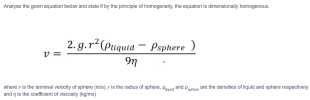 Analyse the given equation below and state if by the principle of homogeneity, the equation is dimensionally homogenous. 2.g.r(Pliquid Psphere ) V = 9η where v is the terminal velocity of sphere (m/s), r is the radius of sphere, Pliquid and Psphere are the densities of liquid and sphere respectively and n is the coefficient of viscosity (kg/ms)
A physical quantity hf is determined from the equation hf = (fLv^2) / 2Dg. We are...
A physical quantity hf is determined from the equation hf = (fLv^2) / 2Dg. We are given that f is a dimensionless constant, L is the length, v is the velocity, D is the diameter, and g is the gravitational constant. Analyze hf in terms of fundamental dimensions (mass, length, etc).
Only A and B please :) The equation mgy for gravitational potential energy is valid only...
 Only A and B please :)
The equation mgy for gravitational potential energy is valid only for objects near the surface of a planet. Consider two very large objects of mass m_1 and m_2, such as stars or planets, whose centers are separated by the large distance r. These two large objects exert gravitational forces on each other. The gravitational potential energy is U = -Gm_1 m_2/r where G = 6.67 times 10^-11 Nm^2/kg^2 is the gravitational constant. (a) Sketch...
Only A and B please :)
The equation mgy for gravitational potential energy is valid only for objects near the surface of a planet. Consider two very large objects of mass m_1 and m_2, such as stars or planets, whose centers are separated by the large distance r. These two large objects exert gravitational forces on each other. The gravitational potential energy is U = -Gm_1 m_2/r where G = 6.67 times 10^-11 Nm^2/kg^2 is the gravitational constant. (a) Sketch...
P lease show step by step and unit conversions! P3. A spacecraft speed v 5.12 km/s....
 P
lease show step by step and unit conversions!
P3. A spacecraft speed v 5.12 km/s. [Given: Mass of Earth M 5.98 x10 kg, radius of Earth R 6.37 x 10 m, gravitational constant G 6.67 x101 N m/kg.] of unknown mass is moving on a circular orbit about Earth at a orbit earth (a) Determine the radius r of the circular orbit. |2 points] (b) What is the period T of the orbit? 12 pointsl (c) The satellite, by...
P
lease show step by step and unit conversions!
P3. A spacecraft speed v 5.12 km/s. [Given: Mass of Earth M 5.98 x10 kg, radius of Earth R 6.37 x 10 m, gravitational constant G 6.67 x101 N m/kg.] of unknown mass is moving on a circular orbit about Earth at a orbit earth (a) Determine the radius r of the circular orbit. |2 points] (b) What is the period T of the orbit? 12 pointsl (c) The satellite, by...
please solve 2 QUESTION 2 a) (5 p) Interpret the rocket equation dv(t)M(1)=-udMO [EQ.1) within the...
 please solve 2
QUESTION 2 a) (5 p) Interpret the rocket equation dv(t)M(1)=-udMO [EQ.1) within the framework of the law of momentan conservation, written in a closed system here M(t) is the rocket mass, at time t, whereas dMt) is by definition, dM(t)-M(t+dt)-M(t): -SM(t)-M(!), is the mass of the gas thrown by the rocket through the infinitely small period of time dt; on the other hand, dv(t) is still by definition, dy(t){t+dt)-v(t), i.e. the increase in the velocity of the...
please solve 2
QUESTION 2 a) (5 p) Interpret the rocket equation dv(t)M(1)=-udMO [EQ.1) within the framework of the law of momentan conservation, written in a closed system here M(t) is the rocket mass, at time t, whereas dMt) is by definition, dM(t)-M(t+dt)-M(t): -SM(t)-M(!), is the mass of the gas thrown by the rocket through the infinitely small period of time dt; on the other hand, dv(t) is still by definition, dy(t){t+dt)-v(t), i.e. the increase in the velocity of the...
 Use Greens theorem
(b) Let r(t) = X(t)i+Y(t)j be the position of the planet at the instant t and we suppose that the sun is located at the origin (0,0). Between the times t; and t2, the line joining the sun and the planet sweeps out an area Altı, t2) (see the blue region). Express A(t1, t2) in terms of X(t), Y(t), X(t)' and Y (t)'. (c) We denote by F(t) the force exerted on the planet by the sun...
Use Greens theorem
(b) Let r(t) = X(t)i+Y(t)j be the position of the planet at the instant t and we suppose that the sun is located at the origin (0,0). Between the times t; and t2, the line joining the sun and the planet sweeps out an area Altı, t2) (see the blue region). Express A(t1, t2) in terms of X(t), Y(t), X(t)' and Y (t)'. (c) We denote by F(t) the force exerted on the planet by the sun...
 2. Consider a charged particle in a magnetic field. Let -e = -1.60 x 10-191C) be an electron, under B=0.1T) of a uniform magnetic field directed out of the page direction (o-direction). At t = 0[sec] the particle is at the origin, and the initial velocity is toward positive y direction. (a) Sketch the initial configuration of this electron (-e at the origin) into (x,y)-plane. Applying the right hand rule, indicate the magnetic force on this moving electron. Note that...
 Given the formula of the kinetic energy of a particle m
with
speed v:
KE = 1⁄2mv2 ,
and the formula of the gravitational potential energy:
PE = -GMEm/R,
where G is gravitational constant and ME and R=6378 km are the
mass and the radius of Earth. Now the particle is shot from Earth
surface to space. Find the minimum required initial speed for this
particle to completely escape the influence of Earth gravity (i.e.
PE=0). Notice that the gravitational...
Given the formula of the kinetic energy of a particle m
with
speed v:
KE = 1⁄2mv2 ,
and the formula of the gravitational potential energy:
PE = -GMEm/R,
where G is gravitational constant and ME and R=6378 km are the
mass and the radius of Earth. Now the particle is shot from Earth
surface to space. Find the minimum required initial speed for this
particle to completely escape the influence of Earth gravity (i.e.
PE=0). Notice that the gravitational...
 Centripetal Acceleration and Newton’s 2nd Law Lab
Q1. Starting with ar = v ^2 /r, show that for any object moving
in a circle with constant centripetal acceleration ar pulling
inwards, the theoretical rotation period is given by Pth = 2πr v =
2π r ar .
Q2. Does the rotation period change with increased tension in
the way you would expect from theoretical grounds? If you increase
the tension by pulling down on the hanging mass while the rubber...
Centripetal Acceleration and Newton’s 2nd Law Lab
Q1. Starting with ar = v ^2 /r, show that for any object moving
in a circle with constant centripetal acceleration ar pulling
inwards, the theoretical rotation period is given by Pth = 2πr v =
2π r ar .
Q2. Does the rotation period change with increased tension in
the way you would expect from theoretical grounds? If you increase
the tension by pulling down on the hanging mass while the rubber...
 8. The position vector r of a point P is a function of the time t and r satisfies the vector differential equation d2r dr 2k (k2 n2)r g, dr2 where k and n are constants and g is a constant vector. Solve dr a and dt this differential equation given that r v when t = 0, a and v being constant vectors Show that P moves in a plane and write down the vector equation of this plane...
 Analyse the given equation below and state if by the principle of homogeneity, the equation is dimensionally homogenous. 2.g.r(Pliquid Psphere ) V = 9η where v is the terminal velocity of sphere (m/s), r is the radius of sphere, Pliquid and Psphere are the densities of liquid and sphere respectively and n is the coefficient of viscosity (kg/ms)
 Only A and B please :)
The equation mgy for gravitational potential energy is valid only for objects near the surface of a planet. Consider two very large objects of mass m_1 and m_2, such as stars or planets, whose centers are separated by the large distance r. These two large objects exert gravitational forces on each other. The gravitational potential energy is U = -Gm_1 m_2/r where G = 6.67 times 10^-11 Nm^2/kg^2 is the gravitational constant. (a) Sketch...
Only A and B please :)
The equation mgy for gravitational potential energy is valid only for objects near the surface of a planet. Consider two very large objects of mass m_1 and m_2, such as stars or planets, whose centers are separated by the large distance r. These two large objects exert gravitational forces on each other. The gravitational potential energy is U = -Gm_1 m_2/r where G = 6.67 times 10^-11 Nm^2/kg^2 is the gravitational constant. (a) Sketch...
 P
lease show step by step and unit conversions!
P3. A spacecraft speed v 5.12 km/s. [Given: Mass of Earth M 5.98 x10 kg, radius of Earth R 6.37 x 10 m, gravitational constant G 6.67 x101 N m/kg.] of unknown mass is moving on a circular orbit about Earth at a orbit earth (a) Determine the radius r of the circular orbit. |2 points] (b) What is the period T of the orbit? 12 pointsl (c) The satellite, by...
P
lease show step by step and unit conversions!
P3. A spacecraft speed v 5.12 km/s. [Given: Mass of Earth M 5.98 x10 kg, radius of Earth R 6.37 x 10 m, gravitational constant G 6.67 x101 N m/kg.] of unknown mass is moving on a circular orbit about Earth at a orbit earth (a) Determine the radius r of the circular orbit. |2 points] (b) What is the period T of the orbit? 12 pointsl (c) The satellite, by...
 please solve 2
QUESTION 2 a) (5 p) Interpret the rocket equation dv(t)M(1)=-udMO [EQ.1) within the framework of the law of momentan conservation, written in a closed system here M(t) is the rocket mass, at time t, whereas dMt) is by definition, dM(t)-M(t+dt)-M(t): -SM(t)-M(!), is the mass of the gas thrown by the rocket through the infinitely small period of time dt; on the other hand, dv(t) is still by definition, dy(t){t+dt)-v(t), i.e. the increase in the velocity of the...
please solve 2
QUESTION 2 a) (5 p) Interpret the rocket equation dv(t)M(1)=-udMO [EQ.1) within the framework of the law of momentan conservation, written in a closed system here M(t) is the rocket mass, at time t, whereas dMt) is by definition, dM(t)-M(t+dt)-M(t): -SM(t)-M(!), is the mass of the gas thrown by the rocket through the infinitely small period of time dt; on the other hand, dv(t) is still by definition, dy(t){t+dt)-v(t), i.e. the increase in the velocity of the...
Most questions answered within 3 hours.
-
Where is the error in this code sequence?
String s1 = "Hello";
String s2 = "ello";...
asked 10 months ago -
Financial data for Joel de Paris, Inc., for last year
follow:
Joel de Paris, Inc.
Balance...
asked 10 months ago -
Consider this reaction:
Al2(SO4)3 (aq)+ BaCl3
(aq) Al2Cl6 (aq)- +
3BaSO4(s) . What is the...
asked 10 months ago -
Suppose that Savneet is considering increasing her
recent random sample from 20 car rentals to 40...
asked 10 months ago -
Trucks arrive at an unloading terminal at an average rate of 120
per hour.
Trucks arrive...
asked 10 months ago -
Why are methanol and ethanol completely soluble in water while
octanol is not very little soluble....
asked 10 months ago -
A facilities manager at a university reads in a research report
that the mean amount of...
asked 10 months ago -
When the CuSO4 is rehydrated by adding water to the anhydrous
compound, is this an endothermic...
asked 10 months ago -
A ray of sunlight is passing from diamond into crown glass; the
angle of incidence is...
asked 10 months ago -
A block of mass 0.249 kg is placed on top of a light, vertical
spring of...
asked 10 months ago -
how do the kidneys compensate in the presences of acidosis
a) trigger hyperventilate
b) reserve acid...
asked 10 months ago -
Question 501 pts
The rental rate of capital to the firm increases. Which of the
following...
asked 10 months ago