In its active form it turns of gene expression. a.) Transcriptional repressor b.) Transcriptional activator c.)...
In its active form it turns of gene expression.
a.) Transcriptional repressor
b.) Transcriptional activator
c.) miRNA
d.) tRNA
e.) terminator
Homework Answers
Transcriptional repressor
Repressors are proteins which bind to DNA sequences called as insulators or silencer and turn off gene expression.
Activators are proteins which bind to DNA sequences called as enhancers and turn on gene expression.
Transfer RNA is involved in translation. It carries anti codon and amino acid which is to be added in the growing peptide chain. This is not involved in the regulation of gene expression.
Terminator is a DNA sequence which binds to proteins that stop the transcription of messenger RNA.
miRNA is micro RNA which is involved in degradation of foreign genes entering a cell.
Please rate.
Add Answer to:
In its active form it turns of gene expression.
a.) Transcriptional repressor
b.) Transcriptional activator
c.)...
Which is the factor(s) involved in the regulation of gene activity? Select one: a. Transcriptional repressor/activator...
Which is the factor(s) involved in the regulation of gene activity? Select one: a. Transcriptional repressor/activator proteins, which bind to the operator/enhancer sequence regions. b. SAM binding to a riboswitch mRNA. c. Alterations in mRNA conformations by SAM during the transcription. d. All of these. e. None of these.
3. NF-kB is a transcriptional activator. In its active form, it binds to DNA and helps...
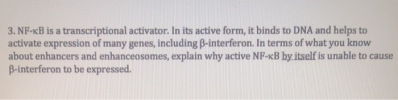 3. NF-kB is a transcriptional activator. In its active form, it binds to DNA and helps to activate expression of many genes, including B-interferon. In terms of what you know about enhancers and enhanceosomes, explain why active NF-kB by itself is unable to cause B-interferon to be expressed.
TRANSCRIPTIONAL CONTROL OF GENE EXPRESSION CAN INVOLVE A. BINDING OF HORMONE-RECEPTOR COMPLEXES TO ENHANCERS B. REPRESSOR-MRNA...
TRANSCRIPTIONAL CONTROL OF GENE EXPRESSION CAN INVOLVE A. BINDING OF HORMONE-RECEPTOR COMPLEXES TO ENHANCERS B. REPRESSOR-MRNA BINDING C. EXON MUTATIONS D. ALTERNATIVE POLYADENYLATION AND SPLICING PATHWAYS
Can you identify all the component of gene expression (regulatory sequences, operator, promoter, repressor, activator coding,...
Can you identify all the component of gene expression (regulatory sequences, operator, promoter, repressor, activator coding, noncoding, sequences)? I need an explanation of what each component does in a gene expression.
a gene that's expression is turned off by a repressor which is inactive when it doesn't...
a gene that's expression is turned off by a repressor which is inactive when it doesn't have its small effector molecule is : inducible and under negative control inducible and under positive control repressible and under negative control repressible and under positive control QUESTION 2 a gene that's expression is turned on by an activator which is inactive when it doesn't have its small effector molecule is : inducible and under negative control inducible and under positive control repressible and...
Which of the following statements is correct concerning operon gene control? Positive control requires an activator...
 Which of the following statements is correct concerning operon gene control? Positive control requires an activator protein to stimulate transcription of the structural genes within an operon. In negative control, a repressor protein inhibits or turns off transcription of the structural genes within the operon. An inducible operon normally is not transcribed. It requires an inducer molecule to stimulate transcription either by inactivating a repressor protein in a negative inducible operon or by stimulating the activator protein in a positive...
Match each term associated with genes and control of gene expression with the appropriate description. A...
 Match each term associated with genes and control of gene expression with the appropriate description. A transcriptional unit" that consists of promoter multiple genes under the control of a single regulatory element. A transcriptional regulatory protein (prokaryotic or eukaryotic) which works by turning on or increasing gene transcription. activator The region of a gene to which RNA polymerase binds. Enhancer A transcriptional regulatory protein prokaryotic or eukaryotic) which works by turning off or decreasing gene transcription. repressor A molecule that...
A) An Operon is:? 1- A gene that affect another gene transcription. 2. A gene coding...
A) An Operon is:? 1- A gene that affect another gene transcription. 2. A gene coding for a metabolic pathway. 3. A protein that blockgene expression. 4. A set of genes under the control of one promoter. B )- In bacteria the Lac Operon genes code for proteins that break down.? 1- Arabinose 2- Lactose 3- Galactose 4- Glucose C )mRNA processing involves removal of .......? 1- Introns 2- The poly-A tail 3- The 5' cap 4- Exons D )...
Consider what you know about the lac operon, and predict whether the repressor and the activator...
 Consider what you know about the lac operon, and predict whether the repressor and the activator is active (able to bind to DNA) or inactive (unable to bind to DNA), and the level of transcription in the following scenarios. Options for transcription levels include high, medium, leaky and off. a. When lactose is present but glucose is not, the repressor is and the activator is leading to levels of transcription. and the activator is b. When lactose and glucose are...
Gene A is regulated by DNA binding transcription factors encoded by genes B, C, and D....
 Gene A is regulated by DNA binding transcription factors
encoded by genes B, C, and D. Genes B and C encode transcriptional
repressors and gene D encodes a transcriptional activator.
1) Diagram what the expression pattern of gene A would
be:
a) in embryos that are homozygous for a null mutation in gene
B.
b) in embryos that are homozygous for a null mutation in gene
C.
c) in embryos that are homozygous for a null mutation in gene
D.
Gene A is regulated by DNA binding transcription factors
encoded by genes B, C, and D. Genes B and C encode transcriptional
repressors and gene D encodes a transcriptional activator.
1) Diagram what the expression pattern of gene A would
be:
a) in embryos that are homozygous for a null mutation in gene
B.
b) in embryos that are homozygous for a null mutation in gene
C.
c) in embryos that are homozygous for a null mutation in gene
D.
 3. NF-kB is a transcriptional activator. In its active form, it binds to DNA and helps to activate expression of many genes, including B-interferon. In terms of what you know about enhancers and enhanceosomes, explain why active NF-kB by itself is unable to cause B-interferon to be expressed.
 Which of the following statements is correct concerning operon gene control? Positive control requires an activator protein to stimulate transcription of the structural genes within an operon. In negative control, a repressor protein inhibits or turns off transcription of the structural genes within the operon. An inducible operon normally is not transcribed. It requires an inducer molecule to stimulate transcription either by inactivating a repressor protein in a negative inducible operon or by stimulating the activator protein in a positive...
 Match each term associated with genes and control of gene expression with the appropriate description. A transcriptional unit" that consists of promoter multiple genes under the control of a single regulatory element. A transcriptional regulatory protein (prokaryotic or eukaryotic) which works by turning on or increasing gene transcription. activator The region of a gene to which RNA polymerase binds. Enhancer A transcriptional regulatory protein prokaryotic or eukaryotic) which works by turning off or decreasing gene transcription. repressor A molecule that...
 Consider what you know about the lac operon, and predict whether the repressor and the activator is active (able to bind to DNA) or inactive (unable to bind to DNA), and the level of transcription in the following scenarios. Options for transcription levels include high, medium, leaky and off. a. When lactose is present but glucose is not, the repressor is and the activator is leading to levels of transcription. and the activator is b. When lactose and glucose are...
 Gene A is regulated by DNA binding transcription factors
encoded by genes B, C, and D. Genes B and C encode transcriptional
repressors and gene D encodes a transcriptional activator.
1) Diagram what the expression pattern of gene A would
be:
a) in embryos that are homozygous for a null mutation in gene
B.
b) in embryos that are homozygous for a null mutation in gene
C.
c) in embryos that are homozygous for a null mutation in gene
D.
Gene A is regulated by DNA binding transcription factors
encoded by genes B, C, and D. Genes B and C encode transcriptional
repressors and gene D encodes a transcriptional activator.
1) Diagram what the expression pattern of gene A would
be:
a) in embryos that are homozygous for a null mutation in gene
B.
b) in embryos that are homozygous for a null mutation in gene
C.
c) in embryos that are homozygous for a null mutation in gene
D.
Most questions answered within 3 hours.
-
Where is the error in this code sequence?
String s1 = "Hello";
String s2 = "ello";...
asked 10 months ago -
Financial data for Joel de Paris, Inc., for last year
follow:
Joel de Paris, Inc.
Balance...
asked 10 months ago -
Consider this reaction:
Al2(SO4)3 (aq)+ BaCl3
(aq) Al2Cl6 (aq)- +
3BaSO4(s) . What is the...
asked 10 months ago -
Suppose that Savneet is considering increasing her
recent random sample from 20 car rentals to 40...
asked 10 months ago -
Trucks arrive at an unloading terminal at an average rate of 120
per hour.
Trucks arrive...
asked 10 months ago -
Why are methanol and ethanol completely soluble in water while
octanol is not very little soluble....
asked 10 months ago -
A facilities manager at a university reads in a research report
that the mean amount of...
asked 10 months ago -
When the CuSO4 is rehydrated by adding water to the anhydrous
compound, is this an endothermic...
asked 10 months ago -
A ray of sunlight is passing from diamond into crown glass; the
angle of incidence is...
asked 10 months ago -
A block of mass 0.249 kg is placed on top of a light, vertical
spring of...
asked 10 months ago -
how do the kidneys compensate in the presences of acidosis
a) trigger hyperventilate
b) reserve acid...
asked 10 months ago -
Question 501 pts
The rental rate of capital to the firm increases. Which of the
following...
asked 10 months ago