How far is the Fermi level above the intrinsic Fermi level in meV in a piece...
How far is the Fermi level above the intrinsic Fermi level in meV in a piece of silicon at 300°K that is doped with phosphorus at a concentration of 3.2 x 10^17/cm^3? Assume kT = 26meV.
Homework Answers


Add Answer to:
How far is the Fermi level above the intrinsic Fermi level in
meV in a piece...
P3. (a) Determine the position of the Fermi level with respect to the intrinsic Fermi level in silicon at T = 300&#...
 P3. (a) Determine the position of the Fermi level with respect to the intrinsic Fermi level in silicon at T = 300'K that is doped with phosphors atoms at a concentration of 1015 cm. (b) Repeat (a) if the silicon is doped with boron atoms at a concentration of 10'5 cm3. (c) Calculate the electron concentration in the silicon for parts (a) and (b)
P3. (a) Determine the position of the Fermi level with respect to the intrinsic Fermi level...
P3. (a) Determine the position of the Fermi level with respect to the intrinsic Fermi level in silicon at T = 300'K that is doped with phosphors atoms at a concentration of 1015 cm. (b) Repeat (a) if the silicon is doped with boron atoms at a concentration of 10'5 cm3. (c) Calculate the electron concentration in the silicon for parts (a) and (b)
P3. (a) Determine the position of the Fermi level with respect to the intrinsic Fermi level...
P3. (a) Determine the position of the Fermi level with respect to the intrinsic Fermi level in silicon at T =...
 P3. (a) Determine the position of the Fermi level with respect to the intrinsic Fermi level in silicon at T = 300'K that is doped with phosphors atoms at a concentration of 1015 cm. (b) Repeat (a) if the silicon is doped with boron atoms at a concentration of 10'5 cm3. (c) Calculate the electron concentration in the silicon for parts (a) and (b) P1. For the Boltzmann approximation to be valid for a semiconductor, the Fermi level must be...
7. Find the position of the intrinsic Fermi level with respect to Emidgap for silicon, germanium,...
 7. Find the position of the intrinsic Fermi level with respect to Emidgap for silicon, germanium, gallium arsenide, and indium arsenide. Use the effective density of states values from problem 5. 8. a. Draw a band diagram for silicon doped 107/cmp-type and label the band gap and the position of the Fermi level. b. Draw a band diagram for gallium arsenide doped 10/cmn-type and label the band gap and the position of the Fermi level. c. Draw a band diagram...
(a) Assuming that the Fermi level is at the midgap in the intrinsic silicon, calculate the...
(a) Assuming that the Fermi level is at the midgap in the intrinsic silicon, calculate the probability of finding an electron at the bottom of the conduction band (E=Ec) for three different temperatures: 0K, 20C, 100C? (b) How are these probabilities related to the probabilities of finding a hole at E=Ev, which is the top of the valence band? (c) A sample of silicon is doped with 1016 cm-3 of arsenic and 3x1016 cm-3 of boron. Calculate n, p, and...
A piece of p-type GaAs is doped with a net impurity concentration of N Na-5 × 10¹⁸ m-3. Is it deg...
 A piece of p-type GaAs is doped with a net impurity concentration of N Na-5 × 10¹⁸ m-3. Is it degenerate or nondegenerate? Find its electron and hole concentrations and its Fermi level at 300 K. How much is the shift of the Fermi level, measured from the intrinsic Fermi level, caused by the doping of the impurity? Compare the results obtained in this problem for the p-type GaAs with those found in Example 12.3 for the n-type GaAs of...
2. A piece of silicon is doped with Na5x1015cm-3. Below is a table for the intrinsic...
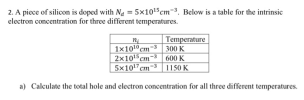 2. A piece of silicon is doped with Na5x1015cm-3. Below is a table for the intrinsic electron concentration for three different temperatures. Temperature 1x 1010cm1-3 | 300 K 2x101"qn-3 | 600K | 5x1017cm-3 | 1150 K a) Calculate the total hole and electron concentration for all three different temperatures.
If a silicon diffusion is doped with boron at a concentration of 5.0 x 10^17/cm^3, what...
 If a silicon diffusion is doped with boron at a concentration of 5.0 x 10^17/cm^3, what is the concentration of electrons in this piece of silicon per cm^3? Assume ni = 1.5 x 10^10/cm^3 at 300°K Answer:
Silicon at at T-300 K contains acceptor atoms at a concentration of Na-5x10A15 cmA-3. Donor atoms are added forming an n type compensated(counter doped) semiconductor such that the fermi level is 0.2...
 Silicon at at T-300 K contains acceptor atoms at a concentration of Na-5x10A15 cmA-3. Donor atoms are added forming an n type compensated(counter doped) semiconductor such that the fermi level is 0.215 eV below the conduction band edge 4. a. What concentration of donor atoms were added. b. What were the concentration of holes and electrons before the silicon was counterdoped c. What are the electron and hole concentrations after the silicon was counter doped.
Silicon at at T-300 K...
Silicon at at T-300 K contains acceptor atoms at a concentration of Na-5x10A15 cmA-3. Donor atoms are added forming an n type compensated(counter doped) semiconductor such that the fermi level is 0.215 eV below the conduction band edge 4. a. What concentration of donor atoms were added. b. What were the concentration of holes and electrons before the silicon was counterdoped c. What are the electron and hole concentrations after the silicon was counter doped.
Silicon at at T-300 K...
Silicon at at T-300 K contains acceptor atoms at a concentration of Na-5x10A15 cmA-3. Donor atoms are added forming an n type compensated(counter doped) semiconductor such that the fermi level is 0.2...
 Silicon at at T-300 K contains acceptor atoms at a concentration of Na-5x10A15 cmA-3. Donor atoms are added forming an n type compensated(counter doped) semiconductor such that the fermi level is 0.215 eV below the conduction band edge 4. a. What concentration of donor atoms were added. b. What were the concentration of holes and electrons before the silicon was counterdoped c. What are the electron and hole concentrations after the silicon was counter doped.
Silicon at at T-300 K...
Silicon at at T-300 K contains acceptor atoms at a concentration of Na-5x10A15 cmA-3. Donor atoms are added forming an n type compensated(counter doped) semiconductor such that the fermi level is 0.215 eV below the conduction band edge 4. a. What concentration of donor atoms were added. b. What were the concentration of holes and electrons before the silicon was counterdoped c. What are the electron and hole concentrations after the silicon was counter doped.
Silicon at at T-300 K...
Find the electron and hole concentrations and Fermi level in silicon at 300 K (a) for...
Find the electron and hole concentrations and Fermi level in silicon at 300 K (a) for 1 x 10^15 boron atoms/cm^3 and (b) for 3 x 10^16 boron atoms/cm^3 and 2/9 x 10^16 arsenic atoms/cm^3. The first two are acceptor concentrations, and the third one is an donor concentration.
 P3. (a) Determine the position of the Fermi level with respect to the intrinsic Fermi level in silicon at T = 300'K that is doped with phosphors atoms at a concentration of 1015 cm. (b) Repeat (a) if the silicon is doped with boron atoms at a concentration of 10'5 cm3. (c) Calculate the electron concentration in the silicon for parts (a) and (b)
P3. (a) Determine the position of the Fermi level with respect to the intrinsic Fermi level...
P3. (a) Determine the position of the Fermi level with respect to the intrinsic Fermi level in silicon at T = 300'K that is doped with phosphors atoms at a concentration of 1015 cm. (b) Repeat (a) if the silicon is doped with boron atoms at a concentration of 10'5 cm3. (c) Calculate the electron concentration in the silicon for parts (a) and (b)
P3. (a) Determine the position of the Fermi level with respect to the intrinsic Fermi level...
 P3. (a) Determine the position of the Fermi level with respect to the intrinsic Fermi level in silicon at T = 300'K that is doped with phosphors atoms at a concentration of 1015 cm. (b) Repeat (a) if the silicon is doped with boron atoms at a concentration of 10'5 cm3. (c) Calculate the electron concentration in the silicon for parts (a) and (b) P1. For the Boltzmann approximation to be valid for a semiconductor, the Fermi level must be...
 7. Find the position of the intrinsic Fermi level with respect to Emidgap for silicon, germanium, gallium arsenide, and indium arsenide. Use the effective density of states values from problem 5. 8. a. Draw a band diagram for silicon doped 107/cmp-type and label the band gap and the position of the Fermi level. b. Draw a band diagram for gallium arsenide doped 10/cmn-type and label the band gap and the position of the Fermi level. c. Draw a band diagram...
 A piece of p-type GaAs is doped with a net impurity concentration of N Na-5 × 10¹⁸ m-3. Is it degenerate or nondegenerate? Find its electron and hole concentrations and its Fermi level at 300 K. How much is the shift of the Fermi level, measured from the intrinsic Fermi level, caused by the doping of the impurity? Compare the results obtained in this problem for the p-type GaAs with those found in Example 12.3 for the n-type GaAs of...
 2. A piece of silicon is doped with Na5x1015cm-3. Below is a table for the intrinsic electron concentration for three different temperatures. Temperature 1x 1010cm1-3 | 300 K 2x101"qn-3 | 600K | 5x1017cm-3 | 1150 K a) Calculate the total hole and electron concentration for all three different temperatures.
 If a silicon diffusion is doped with boron at a concentration of 5.0 x 10^17/cm^3, what is the concentration of electrons in this piece of silicon per cm^3? Assume ni = 1.5 x 10^10/cm^3 at 300°K Answer:
 Silicon at at T-300 K contains acceptor atoms at a concentration of Na-5x10A15 cmA-3. Donor atoms are added forming an n type compensated(counter doped) semiconductor such that the fermi level is 0.215 eV below the conduction band edge 4. a. What concentration of donor atoms were added. b. What were the concentration of holes and electrons before the silicon was counterdoped c. What are the electron and hole concentrations after the silicon was counter doped.
Silicon at at T-300 K...
Silicon at at T-300 K contains acceptor atoms at a concentration of Na-5x10A15 cmA-3. Donor atoms are added forming an n type compensated(counter doped) semiconductor such that the fermi level is 0.215 eV below the conduction band edge 4. a. What concentration of donor atoms were added. b. What were the concentration of holes and electrons before the silicon was counterdoped c. What are the electron and hole concentrations after the silicon was counter doped.
Silicon at at T-300 K...
 Silicon at at T-300 K contains acceptor atoms at a concentration of Na-5x10A15 cmA-3. Donor atoms are added forming an n type compensated(counter doped) semiconductor such that the fermi level is 0.215 eV below the conduction band edge 4. a. What concentration of donor atoms were added. b. What were the concentration of holes and electrons before the silicon was counterdoped c. What are the electron and hole concentrations after the silicon was counter doped.
Silicon at at T-300 K...
Silicon at at T-300 K contains acceptor atoms at a concentration of Na-5x10A15 cmA-3. Donor atoms are added forming an n type compensated(counter doped) semiconductor such that the fermi level is 0.215 eV below the conduction band edge 4. a. What concentration of donor atoms were added. b. What were the concentration of holes and electrons before the silicon was counterdoped c. What are the electron and hole concentrations after the silicon was counter doped.
Silicon at at T-300 K...
Most questions answered within 3 hours.
-
Where is the error in this code sequence?
String s1 = "Hello";
String s2 = "ello";...
asked 10 months ago -
Financial data for Joel de Paris, Inc., for last year
follow:
Joel de Paris, Inc.
Balance...
asked 10 months ago -
Consider this reaction:
Al2(SO4)3 (aq)+ BaCl3
(aq) Al2Cl6 (aq)- +
3BaSO4(s) . What is the...
asked 10 months ago -
Suppose that Savneet is considering increasing her
recent random sample from 20 car rentals to 40...
asked 10 months ago -
Trucks arrive at an unloading terminal at an average rate of 120
per hour.
Trucks arrive...
asked 10 months ago -
Why are methanol and ethanol completely soluble in water while
octanol is not very little soluble....
asked 10 months ago -
A facilities manager at a university reads in a research report
that the mean amount of...
asked 10 months ago -
When the CuSO4 is rehydrated by adding water to the anhydrous
compound, is this an endothermic...
asked 10 months ago -
A ray of sunlight is passing from diamond into crown glass; the
angle of incidence is...
asked 10 months ago -
A block of mass 0.249 kg is placed on top of a light, vertical
spring of...
asked 10 months ago -
how do the kidneys compensate in the presences of acidosis
a) trigger hyperventilate
b) reserve acid...
asked 10 months ago -
Question 501 pts
The rental rate of capital to the firm increases. Which of the
following...
asked 10 months ago