The effusion rate of a certain ideal gas at temperature 25 ◦C is 1.23×10^−5 mols/m2 s....
The effusion rate of a certain ideal gas at temperature 25 ◦C is 1.23×10^−5 mols/m2 s. Determine the effusion rate at T = 100 ◦C.
Homework Answers

Add Answer to:
The effusion rate of a certain ideal gas at temperature 25 ◦C is
1.23×10^−5 mols/m2 s....
Rate of Effusion Problems The average molecular speed in a sample of He gas at a...
 Rate of Effusion Problems
The average molecular speed in a sample of He gas at a certain temperature is 1.37x10 m/s. The average molecular speed in a sample of Kr gas is m/s at the same temperature. The rate of effusion of CH4 gas through a porous barrier is observed to be 3.73 x 10⁻⁴ mol/h. Under the same conditions, the rate of effusion of N2 gas would be mol/h.
Rate of Effusion Problems
The average molecular speed in a sample of He gas at a certain temperature is 1.37x10 m/s. The average molecular speed in a sample of Kr gas is m/s at the same temperature. The rate of effusion of CH4 gas through a porous barrier is observed to be 3.73 x 10⁻⁴ mol/h. Under the same conditions, the rate of effusion of N2 gas would be mol/h.
The average molecular speed in a sample of He gas at a certain temperature is 1.37x10 m/s. m/s at the same temperature....
 The average molecular speed in a sample of He gas at a certain temperature is 1.37x10 m/s. m/s at the same temperature. The average molecular speed in a sample of Kr gas is The rate of effusion of CH4 gas through a porous barrier is observed to be 3.73 x 10 mol/h Under the same conditions, the rate of effusion of N2 gas would be mol/h
(25 pts) We have a tank of volume V which contains an ideal gas at constant temperature T and initial pressure Po. There is a small hole in the tank and gas leaks out at a velocity of (RT)5, We c...
 (25 pts) We have a tank of volume V which contains an ideal gas at constant temperature T and initial pressure Po. There is a small hole in the tank and gas leaks out at a velocity of (RT)5, We can use a molar density 1. Recall that mols in tanke ρν and molar rate out-pud where u-velocity and A - area of hole. Derive the differential equation for P vs t (hint it's a simple exponential) a. drop in...
Question 1 10 pts 14.5 mols CO2 at 31.7°C, 14.9 mols O2 at 130.2°C and 18.5...
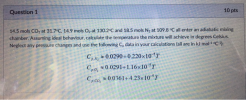 Question 1 10 pts 14.5 mols CO2 at 31.7°C, 14.9 mols O2 at 130.2°C and 18.5 mols N2 at 109.8 °C all enter an adiabatic mixing chamber. Assuming ideal behaviour, calculate the temperature the mixture will achieve in degrees Celsius. Neglect any pressure changes and use the following Co data in your calculations (all are in kJ mol 1 c): C,M2 ~ 0.0290 + 0.220 x10⁻⁵T Cpo 0.0291+1.16x10 T Cco 0.0361+4.23x 10 T P.N
The rate of effusion of a certain volume of O, through an orifice at 298 K...
 The rate of effusion of a certain volume of O, through an orifice at 298 K is 0.0500 s.The rate of effusion (in s) of cl, gas, that has the same volume as the O, gas, through the same orifice at 298 Kis Select one a. 0.0336 sil b. 0.0744 s c. 0.0238 s d. 0.105 s Ne
DE the score for the find (25 pts) We have a tank of volume V which contains an ideal gas at constant temperature T and initial pressure Po. There is a small hole in the tank and gas leaks...
 DE the score for the find (25 pts) We have a tank of volume V which contains an ideal gas at constant temperature T and initial pressure Po. There is a small hole in the tank and gas leaks out at a velocity of (RT)05. We can use a molar density of p T ocity and molar rate out - puA where u - vel Recall that mols in tank- pV and A = area of hole. Derive the differential...
Calculate the ratio of the effusion rate of oxygen (O2) to that of carbon dioxide gas...
 Calculate the ratio of the effusion rate of oxygen (O2) to that of carbon dioxide gas (CO2). Express your answer in decimal form and calculate your answer to at least four sig figs. 4.690 Graham's Law of Effusion is: rate/ratez - (M/M)2 where M - molar mass A cylinder with a moveable piston contains 92g of Nitrogen. The external pressure is constant at 1.00 atm. The initial temperature is 200K. When the temperature is decreased by 70 K, by putting...
Problem 4.024 SI Nitrogen, modeled as an ideal gas, flows at a rate of 3 kg/s...
Problem 4.024 SI Nitrogen, modeled as an ideal gas, flows at a rate of 3 kg/s through a well-insulated horizontal nozzle operating at steady state. The nitrogen enters the nozzle with a velocity of 20 m/s at 500 K, 400 kPa and exits the nozzle at 100 kPa. To achieve an exit velocity of 500 m/s, determine: (a) the exit temperature, in K. (b) the exit area, in m2.
Homework 5 The rate of effusion of a particular gas was measured and found to be...
 Homework 5 The rate of effusion of a particular gas was measured and found to be 25.2 mL/min. Under the same conditions, the rate of effusion of pure methane (CH4) gas is 47.8 mL/min. What is the molar mass of the unknown gas? Question 1 Question 2 1 pt Question 3 Mass- g/mol Question 4 1 pt Question 5 1 pt Submit Answer Try Another Version Question 6 3 item attempts remaining 1 pt 1 pt 1 pt 1 pt...
In a gas turbine, gas enters the turbine at a temperature of 600'C and 5 bar...
In a gas turbine, gas enters the turbine at a temperature of 600'C and 5 bar of pressure and exit at a pressure of 1 bar. This process is an adiabatic process but the change in entropy is 0.250 kJ/kg K. Determine the temperature of exit gas. Assumed that the gas is an ideal gas and take the value of y=1.3 and cp = 1.11 kJ/kg K. Sketch the process on a T-s diagram. Determine the temperature of the exit...
 Rate of Effusion Problems
The average molecular speed in a sample of He gas at a certain temperature is 1.37x10 m/s. The average molecular speed in a sample of Kr gas is m/s at the same temperature. The rate of effusion of CH4 gas through a porous barrier is observed to be 3.73 x 10⁻⁴ mol/h. Under the same conditions, the rate of effusion of N2 gas would be mol/h.
Rate of Effusion Problems
The average molecular speed in a sample of He gas at a certain temperature is 1.37x10 m/s. The average molecular speed in a sample of Kr gas is m/s at the same temperature. The rate of effusion of CH4 gas through a porous barrier is observed to be 3.73 x 10⁻⁴ mol/h. Under the same conditions, the rate of effusion of N2 gas would be mol/h.
 The average molecular speed in a sample of He gas at a certain temperature is 1.37x10 m/s. m/s at the same temperature. The average molecular speed in a sample of Kr gas is The rate of effusion of CH4 gas through a porous barrier is observed to be 3.73 x 10 mol/h Under the same conditions, the rate of effusion of N2 gas would be mol/h
 (25 pts) We have a tank of volume V which contains an ideal gas at constant temperature T and initial pressure Po. There is a small hole in the tank and gas leaks out at a velocity of (RT)5, We can use a molar density 1. Recall that mols in tanke ρν and molar rate out-pud where u-velocity and A - area of hole. Derive the differential equation for P vs t (hint it's a simple exponential) a. drop in...
 Question 1 10 pts 14.5 mols CO2 at 31.7°C, 14.9 mols O2 at 130.2°C and 18.5 mols N2 at 109.8 °C all enter an adiabatic mixing chamber. Assuming ideal behaviour, calculate the temperature the mixture will achieve in degrees Celsius. Neglect any pressure changes and use the following Co data in your calculations (all are in kJ mol 1 c): C,M2 ~ 0.0290 + 0.220 x10⁻⁵T Cpo 0.0291+1.16x10 T Cco 0.0361+4.23x 10 T P.N
 The rate of effusion of a certain volume of O, through an orifice at 298 K is 0.0500 s.The rate of effusion (in s) of cl, gas, that has the same volume as the O, gas, through the same orifice at 298 Kis Select one a. 0.0336 sil b. 0.0744 s c. 0.0238 s d. 0.105 s Ne
 DE the score for the find (25 pts) We have a tank of volume V which contains an ideal gas at constant temperature T and initial pressure Po. There is a small hole in the tank and gas leaks out at a velocity of (RT)05. We can use a molar density of p T ocity and molar rate out - puA where u - vel Recall that mols in tank- pV and A = area of hole. Derive the differential...
 Calculate the ratio of the effusion rate of oxygen (O2) to that of carbon dioxide gas (CO2). Express your answer in decimal form and calculate your answer to at least four sig figs. 4.690 Graham's Law of Effusion is: rate/ratez - (M/M)2 where M - molar mass A cylinder with a moveable piston contains 92g of Nitrogen. The external pressure is constant at 1.00 atm. The initial temperature is 200K. When the temperature is decreased by 70 K, by putting...
 Homework 5 The rate of effusion of a particular gas was measured and found to be 25.2 mL/min. Under the same conditions, the rate of effusion of pure methane (CH4) gas is 47.8 mL/min. What is the molar mass of the unknown gas? Question 1 Question 2 1 pt Question 3 Mass- g/mol Question 4 1 pt Question 5 1 pt Submit Answer Try Another Version Question 6 3 item attempts remaining 1 pt 1 pt 1 pt 1 pt...
Most questions answered within 3 hours.
-
Where is the error in this code sequence?
String s1 = "Hello";
String s2 = "ello";...
asked 11 months ago -
Financial data for Joel de Paris, Inc., for last year
follow:
Joel de Paris, Inc.
Balance...
asked 11 months ago -
Consider this reaction:
Al2(SO4)3 (aq)+ BaCl3
(aq) Al2Cl6 (aq)- +
3BaSO4(s) . What is the...
asked 11 months ago -
Suppose that Savneet is considering increasing her
recent random sample from 20 car rentals to 40...
asked 11 months ago -
Trucks arrive at an unloading terminal at an average rate of 120
per hour.
Trucks arrive...
asked 11 months ago -
Why are methanol and ethanol completely soluble in water while
octanol is not very little soluble....
asked 11 months ago -
A facilities manager at a university reads in a research report
that the mean amount of...
asked 11 months ago -
When the CuSO4 is rehydrated by adding water to the anhydrous
compound, is this an endothermic...
asked 11 months ago -
A ray of sunlight is passing from diamond into crown glass; the
angle of incidence is...
asked 11 months ago -
A block of mass 0.249 kg is placed on top of a light, vertical
spring of...
asked 11 months ago -
how do the kidneys compensate in the presences of acidosis
a) trigger hyperventilate
b) reserve acid...
asked 11 months ago -
Question 501 pts
The rental rate of capital to the firm increases. Which of the
following...
asked 11 months ago