Negate each of the following mathematical statements and “move” the ¬ symbol as far to the...
Negate each of the following mathematical statements and “move” the ¬ symbol as far to the right as possible. Then rewrite the negated statements in English.
• ∃x ∈ Z,∀y ∈ Z, x > y
• ∀x ∈ N, ∃y ∈ N, (x^2 < y) ⇒ (x < y)
Homework Answers

Add Answer to:
Negate each of the following mathematical statements and “move”
the ¬ symbol as far to the...
1. Convert the following statement to a quantified expression, negate it, and convert the answer back...
1. Convert the following statement to a quantified expression, negate it, and convert the answer back to English. You will end up with the exact opposite concept. All cats are asleep. 2. Convert the following statement into a quantified expression: Everyone, who has seen Deadpool, likes chimichangas . 3. Simplify the following Quantified Statement. The result should have no negation symbols. ¬ ?x ?x (¬G(x) ? H(x) ) 4. Prove the following using induction (show your work- both steps): If...
7.3 Practice Problems Prove each of the following statements using mathematical induction. 1. Show that 2...
 7.3 Practice Problems Prove each of the following statements using mathematical induction. 1. Show that 2 + 4 +8+ ... +2n = 20+1 -2 for all natural numbers n = 1,2,3,... y lo 2. Show that 12 +22+32 + ... + n2 = n(n+1)(2+1) for all natural numbers n = 1,2,3,...
1. Express in the language of the FOL the following mathematical statement: If S is a...
1. Express in the language of the FOL the following mathematical statement: If S is a set of elements and * is a binary operation in S for which the following four assumptions hold, where = is an equivalence relation: a. S is closed under * ( if x and y are in S then x * y is also in S) b. * is associative (x, y, and z in S (x * y) * z = x *...
Part I Two gliders, Y and Z, move toward each other on a level, frictionless track....
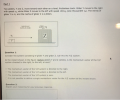 Part I Two gliders, Y and Z, move toward each other on a level, frictionless track. Glider Y moves to the right with speed vo, while Glider Z moves to the left with speed .001vo (one-thousandth vo). The inertia of glider Y is m, and the inertia of glider Z is 2,000m. (aurows not (.001) n to scale) Question 1. Consider the system consisting of glider Y and glider Z. Call this the Y/Z system. At the instant shown in...
Consider the following context-free grammar with terminals {a, b, c, d} and start symbol S. S...
Consider the following context-free grammar with terminals {a, b, c, d} and start symbol S. S → W | X | Y | Z W → AW D | X | Y | Z X → BXD | Z Y → AY C | Z Z → BZC | ε A → a B → b C → c D → d (a) Give a derivation tree with input string: aaaabccddd (b) What language does this CFG recognize? Give a...
I. Ifx-5.y-6,z 4, and w -2.5, evaluate each of the following statements, if possible. If it...
 I. Ifx-5.y-6,z 4, and w -2.5, evaluate each of the following statements, if possible. If it is not possible, state the reason. (20 Points) (X + y) % w (x90 y) % z (x "y) 'w)z a) c) e)
You are given an array of N unsigned chars (symbols) where each symbol is represented by...
You are given an array of N unsigned chars (symbols) where each symbol is represented by 8-bits Design a Huffman Coder in C++ that returns the length of the codeword for each of the possible 256 symbols and the total number of bits required to encode this data Requirements: After computing the frequency of occurrence of each symbol, you must implement a min-heap (priority queue) to implement the Huffman coder. The function to fill in C++: int HuffmanCoder(vector<unsigned char> &data,...
Please provide explanation to each step as I need to study for exam. I will upvote....
 Please provide explanation to each step as I need to study for
exam. I will upvote. Thanks!
Write down the negations of the following expressions, so that the symbol does not arise to the left of any quantifier. Indicate whether the negated statement is true a) Vx E N, x2 e N and - eN 2x b) Vx E R,3n E Z, x" < 0.
Please provide explanation to each step as I need to study for
exam. I will upvote. Thanks!
Write down the negations of the following expressions, so that the symbol does not arise to the left of any quantifier. Indicate whether the negated statement is true a) Vx E N, x2 e N and - eN 2x b) Vx E R,3n E Z, x" < 0.
Prove each of the following statements is true for all positive integers using mathematical induction. Please...
 Prove each of the following statements is true for all positive integers using mathematical induction. Please utilize the structure, steps, and terminology demonstrated in class. 5. n!<n"
Problem #5 [30 Points) Prove each of the following statements by Mathematical Induction. Make sure you...
 Problem #5 [30 Points) Prove each of the following statements by Mathematical Induction. Make sure you check P(1), state P(n+1), and give a complete proof of P(n) = P(n+1), n > 1. A. n.(n+1)(n+2) n 1. P(n): 1. 2+2-3+3.4+...+n·(n + 1) = - to od to be used B. P(n): (1 + a)" > 1+na, a>0,,n>1. ) han de stem
 7.3 Practice Problems Prove each of the following statements using mathematical induction. 1. Show that 2 + 4 +8+ ... +2n = 20+1 -2 for all natural numbers n = 1,2,3,... y lo 2. Show that 12 +22+32 + ... + n2 = n(n+1)(2+1) for all natural numbers n = 1,2,3,...
 Part I Two gliders, Y and Z, move toward each other on a level, frictionless track. Glider Y moves to the right with speed vo, while Glider Z moves to the left with speed .001vo (one-thousandth vo). The inertia of glider Y is m, and the inertia of glider Z is 2,000m. (aurows not (.001) n to scale) Question 1. Consider the system consisting of glider Y and glider Z. Call this the Y/Z system. At the instant shown in...
 I. Ifx-5.y-6,z 4, and w -2.5, evaluate each of the following statements, if possible. If it is not possible, state the reason. (20 Points) (X + y) % w (x90 y) % z (x "y) 'w)z a) c) e)
 Please provide explanation to each step as I need to study for
exam. I will upvote. Thanks!
Write down the negations of the following expressions, so that the symbol does not arise to the left of any quantifier. Indicate whether the negated statement is true a) Vx E N, x2 e N and - eN 2x b) Vx E R,3n E Z, x" < 0.
Please provide explanation to each step as I need to study for
exam. I will upvote. Thanks!
Write down the negations of the following expressions, so that the symbol does not arise to the left of any quantifier. Indicate whether the negated statement is true a) Vx E N, x2 e N and - eN 2x b) Vx E R,3n E Z, x" < 0.
 Prove each of the following statements is true for all positive integers using mathematical induction. Please utilize the structure, steps, and terminology demonstrated in class. 5. n!<n"
 Problem #5 [30 Points) Prove each of the following statements by Mathematical Induction. Make sure you check P(1), state P(n+1), and give a complete proof of P(n) = P(n+1), n > 1. A. n.(n+1)(n+2) n 1. P(n): 1. 2+2-3+3.4+...+n·(n + 1) = - to od to be used B. P(n): (1 + a)" > 1+na, a>0,,n>1. ) han de stem
Most questions answered within 3 hours.
-
Where is the error in this code sequence?
String s1 = "Hello";
String s2 = "ello";...
asked 11 months ago -
Financial data for Joel de Paris, Inc., for last year
follow:
Joel de Paris, Inc.
Balance...
asked 11 months ago -
Consider this reaction:
Al2(SO4)3 (aq)+ BaCl3
(aq) Al2Cl6 (aq)- +
3BaSO4(s) . What is the...
asked 11 months ago -
Suppose that Savneet is considering increasing her
recent random sample from 20 car rentals to 40...
asked 11 months ago -
Trucks arrive at an unloading terminal at an average rate of 120
per hour.
Trucks arrive...
asked 11 months ago -
Why are methanol and ethanol completely soluble in water while
octanol is not very little soluble....
asked 11 months ago -
A facilities manager at a university reads in a research report
that the mean amount of...
asked 11 months ago -
When the CuSO4 is rehydrated by adding water to the anhydrous
compound, is this an endothermic...
asked 11 months ago -
A ray of sunlight is passing from diamond into crown glass; the
angle of incidence is...
asked 11 months ago -
A block of mass 0.249 kg is placed on top of a light, vertical
spring of...
asked 11 months ago -
how do the kidneys compensate in the presences of acidosis
a) trigger hyperventilate
b) reserve acid...
asked 11 months ago -
Question 501 pts
The rental rate of capital to the firm increases. Which of the
following...
asked 11 months ago