Assume the following rules of associativity and precedence for expressions: Precedence Highest *, /, not +,...
Assume the following rules of associativity and precedence for expressions:
| Precedence | Highest | *, /, not |
| +, -, &, mod | ||
| - (unary) | ||
| =, /=, <, <=, >=, > | ||
| and | ||
| Lowest | or, xor | |
| Associativity | Left to right |
Show the order of evaluation of the following expressions by parenthesizing all subexpressions and placing a superscript on the right parenthesis to indicate order. For example, for the expression
a + b * c + d
the order of evaluation would be represented as
((a + (b * c)1)2 + d)3
-
a * b - 1 + c
-
a * (b - 1) / c mod d
-
(a - b) / c & (d * e / a - 3)
-
-a or c = d and e
-
a > b xor c or d <= 17
-
-a + b
Homework Answers


Add Answer to:
Assume the following rules of associativity and precedence for
expressions:
Precedence
Highest
*, /, not
+,...
4. Assume the following rules of associativity and precedence for expressions: Precedence Highest *, /, not...
4. Assume the following rules of associativity and precedence for expressions: Precedence Highest *, /, not +,-,&, mod - (unary) =,/=,<,<=,>=,> and or, xor Lowest Associativity Left to right Show the order of evaluation of the following expressions by parenthesizing all sub expressions and placing a superscript on the right parenthesis to indicate order. For example, for the expression a+b*c+d the order of evaluation would be represented as ((a+(b*c)1)2 +d)3 a * b - 1 + c a * (b...
1. Write a BNF description of the logical expressions and the relational expressions in C++. Make...
 1. Write a BNF description of the logical expressions and the relational expressions in C++. Make sure that the BNF reflects the order of precedence of the operators, as well as, the associativity rules. 2. Using the BNF rules in 1., give a rightmost derivation and show a parse tree for the expression below. 3. Prove that the following grammar is ambiguous and rewrite the grammar to remove ambiguity «newexp> → «newexp> @ <newexp> ulvl w I <other> <other> →
Using ADT Stack: Evaluating infix expressions by converting them to postfix expressions Postfix notation: In a...
Using ADT Stack: Evaluating infix expressions by converting them to postfix expressions Postfix notation: In a postfix expression, a binary operation follows its two opperands. The order of the operands in a infix expression is the same as in the corresponding postfix expression but the order of the operators might change based on the precedence of the operators and the existing of paranthses. Infix Postfix a + b a b + (a + b) * c a b + c...
Stacks are used by compilers to help in the process of evaluating expressions and generating machine...
 Stacks are used by compilers to help in the process of
evaluating expressions and generating machine language code.In this
exercise, we investigate how compilers evaluate arithmetic
expressions consisting only of constants, operators and
parentheses. Humans generally write expressions like 3 + 4and 7 /
9in which the operator (+ or / here) is written between its
operands—this is called infix notation. Computers “prefer” postfix
notation in which the operator is written to the right of its two
operands. The preceding...
Stacks are used by compilers to help in the process of
evaluating expressions and generating machine language code.In this
exercise, we investigate how compilers evaluate arithmetic
expressions consisting only of constants, operators and
parentheses. Humans generally write expressions like 3 + 4and 7 /
9in which the operator (+ or / here) is written between its
operands—this is called infix notation. Computers “prefer” postfix
notation in which the operator is written to the right of its two
operands. The preceding...
Q#2 (6 points) Assume following precedence levels 1. parentheses 2. unary operators 3. **(exponentiation: if the...
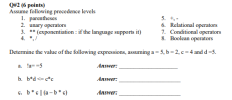 Q#2 (6 points) Assume following precedence levels 1. parentheses 2. unary operators 3. **(exponentiation: if the language supports it) 6. Relational operators 7. Conditional operators 8. Boolean operators Determine the value of the following expressions, assuming a 5, b 2, c 4 and d-5. a. a5 Answer: Answer: Answer: c. b* a-b*c)
1. (p. 2-3.) Which of the following is NOT a reason for studying concepts of programming...
1. (p. 2-3.) Which of the following is NOT a reason for studying concepts of programming languages according to Sebesta? a. Increased capacity to express ideas. b. Improved background for choosing appropriate languages. c. Increased ability to design new languages. d. Increased ability to learn new languages. 2. (p. 5-6.) What programming language has dominated scientific computing over the past 50 years? a. FORTRAN b. ALGOL c. SNOBOL d. PL/I 3. (p. 6.) What programming language has dominated artificial intelligence...
This BNF grammar defines expressions with three operations, *, -, and +, and the variables “a”, “b”, “c”, and “d”. <e...
This BNF grammar defines expressions with three operations, *, -, and +, and the variables “a”, “b”, “c”, and “d”. <expr> ::= <thing> | <thing> * <expr> <object> ::= <element> | <element> – <object> <thing> ::= <object> | <thing> + <object> <element> ::= a|b|c|d|(<object>) a) Give the order of precedence among the three operations. b) Give the order (left-to-right or right-to-left) of execution for each operation. c) Explain how the parentheses defined for the nonterminal <element> may be used in...
EVALUATING GENERAL INFIX EXPRESSIONS INTRODUCTION The notation in which we usually write arithmetic expressions is called infix notation;...
EVALUATING GENERAL INFIX EXPRESSIONS INTRODUCTION The notation in which we usually write arithmetic expressions is called infix notation; in it, operators are written between their operands: X + Y. Such expressions can be ambiguous; do we add or multiply first in the expression 5 + 3 * 2? Parentheses and rules of precedence and association clarify such ambiguities: multiplication and division take precedence over addition and subtraction, and operators associate from left to right. This project implements and exercises a stack-based algorithm that evaluates...
Given typical operator precedence rules, what would be printed to the console if operands were evaluated...
Given typical operator precedence rules, what would be printed to the console if operands were evaluated from left to right, and all operands had an equivalent precedence level? int no_se (int n1, int n2) { return n1 + n2; } int se (int *n1, int * n2) { return *n1 += *n2; } int main() { int x = 2, y = 2; int result = se(&x,&y) + x + no_se(x,y); printf(“%d\n”, result); } A. 10 B. 16 C. 14...
The questions in this section are based on the grammar given as the following: prog ->...
The questions in this section are based on the grammar given as the following: prog -> assign | expr assign -> id = expr expr -> expr + term | expr - term | term term -> factor | factor * term factor -> ( expr ) | id | num id -> A | B | C num -> 0 | 1 | 2 | 3 (2a) What is the associativity of the * operator? (5 points) (2b) What...
 1. Write a BNF description of the logical expressions and the relational expressions in C++. Make sure that the BNF reflects the order of precedence of the operators, as well as, the associativity rules. 2. Using the BNF rules in 1., give a rightmost derivation and show a parse tree for the expression below. 3. Prove that the following grammar is ambiguous and rewrite the grammar to remove ambiguity «newexp> → «newexp> @ <newexp> ulvl w I <other> <other> →
 Stacks are used by compilers to help in the process of
evaluating expressions and generating machine language code.In this
exercise, we investigate how compilers evaluate arithmetic
expressions consisting only of constants, operators and
parentheses. Humans generally write expressions like 3 + 4and 7 /
9in which the operator (+ or / here) is written between its
operands—this is called infix notation. Computers “prefer” postfix
notation in which the operator is written to the right of its two
operands. The preceding...
Stacks are used by compilers to help in the process of
evaluating expressions and generating machine language code.In this
exercise, we investigate how compilers evaluate arithmetic
expressions consisting only of constants, operators and
parentheses. Humans generally write expressions like 3 + 4and 7 /
9in which the operator (+ or / here) is written between its
operands—this is called infix notation. Computers “prefer” postfix
notation in which the operator is written to the right of its two
operands. The preceding...
 Q#2 (6 points) Assume following precedence levels 1. parentheses 2. unary operators 3. **(exponentiation: if the language supports it) 6. Relational operators 7. Conditional operators 8. Boolean operators Determine the value of the following expressions, assuming a 5, b 2, c 4 and d-5. a. a5 Answer: Answer: Answer: c. b* a-b*c)
Most questions answered within 3 hours.
-
Where is the error in this code sequence?
String s1 = "Hello";
String s2 = "ello";...
asked 11 months ago -
Financial data for Joel de Paris, Inc., for last year
follow:
Joel de Paris, Inc.
Balance...
asked 11 months ago -
Consider this reaction:
Al2(SO4)3 (aq)+ BaCl3
(aq) Al2Cl6 (aq)- +
3BaSO4(s) . What is the...
asked 11 months ago -
Suppose that Savneet is considering increasing her
recent random sample from 20 car rentals to 40...
asked 11 months ago -
Trucks arrive at an unloading terminal at an average rate of 120
per hour.
Trucks arrive...
asked 11 months ago -
Why are methanol and ethanol completely soluble in water while
octanol is not very little soluble....
asked 11 months ago -
A facilities manager at a university reads in a research report
that the mean amount of...
asked 11 months ago -
When the CuSO4 is rehydrated by adding water to the anhydrous
compound, is this an endothermic...
asked 11 months ago -
A ray of sunlight is passing from diamond into crown glass; the
angle of incidence is...
asked 11 months ago -
A block of mass 0.249 kg is placed on top of a light, vertical
spring of...
asked 11 months ago -
how do the kidneys compensate in the presences of acidosis
a) trigger hyperventilate
b) reserve acid...
asked 11 months ago -
Question 501 pts
The rental rate of capital to the firm increases. Which of the
following...
asked 11 months ago