A GC separation of the two compounds shown above (question 3)) is performed at a GC...
A GC separation of the two compounds shown above (question 3)) is performed at a GC column temperature of 100 °C. The resulting chromatogram shows only one peak. Would the GC separation potentially be better if you were to run another GC at a higher temperature? Please explain.
Homework Answers
Answer:
- By and large gas chromatography is altogether influenced by temperature.
- In the event that the temperature is high, at that point the ideal opportunity for association of gas stage with stationary stage is extremely low and partition by adsorption is troublesome and in other hand in the event that temperature is exceptionally low, at that point the connections of the considerable number of segments are high and all adsorbed on stationary stage extremely near one another and detachment become troublesome .
- so in the two cases chromatography isn't appropriate for detachment of segments and because of this reason temperature ought to be progress among buildup and vaporization or kept up 40-50 degree lower than breaking point.
- In the event that if there is temperature low, at that point increment in temperature improves the partition quality however on the off chance that if the temperature is high and breaking point isn't exceptionally high then the expansion in temperature lessen the detachment.
Add Answer to:
A GC separation of the two compounds shown above (question 3))
is performed at a GC...
Pd/C + H2 Br A GC separation of the two compounds shown above (question 3)) is...
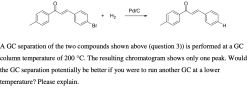 Pd/C + H2 Br A GC separation of the two compounds shown above (question 3)) is performed at a GC column temperature of 200 °C. The resulting chromatogram shows only one peak. Would the GC separation potentially be better if you were to run another GC at a lower temperature? Please explain.
4. The compounds in a mixture separated by GC can be identified by their retention times....
 4. The compounds in a mixture separated by GC can be identified by their retention times. If you Suructor nad not told you which peak in the GC chromatogram corresponded to which alker you didn't know the boiling points of the alkenes, how could you determine the identity or each peak by its retention time? Identities of the components in a mixture separated by GC can also be determined by the technique called "spiking". Suppose you had run a chromatogram...
10000 page 6 9.10 Two chromatograms are shown. Both chromatograms show the separation of the same...
 10000 page 6 9.10 Two chromatograms are shown. Both chromatograms show the separation of the same mixture using the same chromatography column with the same flow rate, but under different conditions Chromatogram #1 Chromatogram #2 compound (a) If the chromatograms were obtained by gas chromatography, which one used the higher column temperature? Explain briefly, showing that you understand the effect of temperature on retention in gas chromatography (b) If the chromatograms were obtained by liquid chromatography, which one used the...
Please explain the concept of chromatographic separation and formulas in the above question. 2) If a...
 Please explain the concept of chromatographic separation and
formulas in the above question.
2) If a big centrifuge with the bowl diameter of 1m rotates at
60 rpm, at what speed (rpm) does a smaller centrifuge with a
diameter of 0.5 m need to be operated for achieving the same
separation factor?
(a) 85
(b) 120
(c) 30
(d) 42
3) What is the linear flow rate (superficial velocity in cm/h)
in a chromatographic column of 1.0 cm inner diameter...
Please explain the concept of chromatographic separation and
formulas in the above question.
2) If a big centrifuge with the bowl diameter of 1m rotates at
60 rpm, at what speed (rpm) does a smaller centrifuge with a
diameter of 0.5 m need to be operated for achieving the same
separation factor?
(a) 85
(b) 120
(c) 30
(d) 42
3) What is the linear flow rate (superficial velocity in cm/h)
in a chromatographic column of 1.0 cm inner diameter...
9 VII. Gas Chromatography 1. The organic mixture to be separated on the GC is injected...
 9 VII. Gas Chromatography 1. The organic mixture to be separated on the GC is injected into the GC as a (gas, liquid, or solid). 2. The typical volume of mixture injected into a GC is 1-10 (microliters, milliliters, or deciliters). 3. Immediately upon entering the injection port the mixture is_ _(solidified, condensed, or vaporized). (heated, cooled, maintained at room 4. The event described in #3 occurs because the injection port is temperature). 5. An inert gas, referred to as...
5. Using the GC mentioned in question 4 and the values listed on the chromatogram for...
 5. Using the GC mentioned in question 4 and the values listed on the chromatogram for the height and width (at half height) of each peak, calculate the percent composition for each product (A, B and C). Be sure to show your work. (8 points) 6. The products corresponding to each peak on the GC are the ortho, meta, and para isomers of the nitrated product shown in the scheme for reaction 1. These isomers were isolated, and a proton...
1. Explain how a fractionating column increases the separation of two liquids. 2. What is an...
1. Explain how a fractionating column increases the separation of two liquids. 2. What is an azeotrope? Do you think the mixture used in the lab is an example of an azeotrope? Explain. 3. Explain how the boiling point of a liquid is affected by the addition of a non-volatile solute (hint: it is a colligative property). Is the temperature above such solution lower, higher or the same as the pure liquid? Explain why. 4. You were asked to record...
Procedure for Virtual Lab 3: Dehydration of an alcohol and GC analysisDehydration of 2-methylcyclohexanol 1. Observe...
 Procedure for Virtual Lab 3: Dehydration of an alcohol and GC
analysisDehydration of 2-methylcyclohexanol
1. Observe the equipment and chemicals that will be used for the
reaction.2. The aluminum block is placed on thehot plate and 2-3
boiling chips are added to a conical vial. 3. The vial is placed
into one of the openings on the aluminum block. 4. 1mL of
2-methylcyclohexanol is added to the conical vial. 5. 2mL of 85%
phosphoric acid is added to the conical...
Procedure for Virtual Lab 3: Dehydration of an alcohol and GC
analysisDehydration of 2-methylcyclohexanol
1. Observe the equipment and chemicals that will be used for the
reaction.2. The aluminum block is placed on thehot plate and 2-3
boiling chips are added to a conical vial. 3. The vial is placed
into one of the openings on the aluminum block. 4. 1mL of
2-methylcyclohexanol is added to the conical vial. 5. 2mL of 85%
phosphoric acid is added to the conical...
1. Select an appropriate type of column for separating these steroids and give the rationale for...
 1. Select an appropriate type of column for separating these steroids and give the rationale for your selection. HO HO ОН OH Prednisolone Prednisone 2. You are using a C18 Reverse Phase column and the parameters shown below to separate Acetaminophen, Caffeine, and Benzoic Acid. You observe three peaks in your chromatogram (Huzzah!). Which corresponds to which compound? Explain the rationale behind your assignment. OH C18 REVERSED PHASE COLUMN Acetaminophen HC N H, O Caffeine Column: Legacy L1 Size: 4.6...
answer for question b c,d and e only please. a) b) c) Explain why the affinity...
 answer for question b c,d and e
only please.
a) b) c) Explain why the affinity of alkali metal ions for a cation exchange resin increases from Lit to Nat to K. [6 marks] Explain the physical basis for the separation of molecules in size exclusion chromatography. [6 marks) When a mixture of ethanol, n-propanol, n-butanol and n-pentanol (see Figure 5) is analysed by capillary gas-liquid chromatography, what order would you expect the compounds to elute? [2 marks] Explain your...
answer for question b c,d and e
only please.
a) b) c) Explain why the affinity of alkali metal ions for a cation exchange resin increases from Lit to Nat to K. [6 marks] Explain the physical basis for the separation of molecules in size exclusion chromatography. [6 marks) When a mixture of ethanol, n-propanol, n-butanol and n-pentanol (see Figure 5) is analysed by capillary gas-liquid chromatography, what order would you expect the compounds to elute? [2 marks] Explain your...
 Pd/C + H2 Br A GC separation of the two compounds shown above (question 3)) is performed at a GC column temperature of 200 °C. The resulting chromatogram shows only one peak. Would the GC separation potentially be better if you were to run another GC at a lower temperature? Please explain.
 4. The compounds in a mixture separated by GC can be identified by their retention times. If you Suructor nad not told you which peak in the GC chromatogram corresponded to which alker you didn't know the boiling points of the alkenes, how could you determine the identity or each peak by its retention time? Identities of the components in a mixture separated by GC can also be determined by the technique called "spiking". Suppose you had run a chromatogram...
 10000 page 6 9.10 Two chromatograms are shown. Both chromatograms show the separation of the same mixture using the same chromatography column with the same flow rate, but under different conditions Chromatogram #1 Chromatogram #2 compound (a) If the chromatograms were obtained by gas chromatography, which one used the higher column temperature? Explain briefly, showing that you understand the effect of temperature on retention in gas chromatography (b) If the chromatograms were obtained by liquid chromatography, which one used the...
 Please explain the concept of chromatographic separation and
formulas in the above question.
2) If a big centrifuge with the bowl diameter of 1m rotates at
60 rpm, at what speed (rpm) does a smaller centrifuge with a
diameter of 0.5 m need to be operated for achieving the same
separation factor?
(a) 85
(b) 120
(c) 30
(d) 42
3) What is the linear flow rate (superficial velocity in cm/h)
in a chromatographic column of 1.0 cm inner diameter...
Please explain the concept of chromatographic separation and
formulas in the above question.
2) If a big centrifuge with the bowl diameter of 1m rotates at
60 rpm, at what speed (rpm) does a smaller centrifuge with a
diameter of 0.5 m need to be operated for achieving the same
separation factor?
(a) 85
(b) 120
(c) 30
(d) 42
3) What is the linear flow rate (superficial velocity in cm/h)
in a chromatographic column of 1.0 cm inner diameter...
 9 VII. Gas Chromatography 1. The organic mixture to be separated on the GC is injected into the GC as a (gas, liquid, or solid). 2. The typical volume of mixture injected into a GC is 1-10 (microliters, milliliters, or deciliters). 3. Immediately upon entering the injection port the mixture is_ _(solidified, condensed, or vaporized). (heated, cooled, maintained at room 4. The event described in #3 occurs because the injection port is temperature). 5. An inert gas, referred to as...
 5. Using the GC mentioned in question 4 and the values listed on the chromatogram for the height and width (at half height) of each peak, calculate the percent composition for each product (A, B and C). Be sure to show your work. (8 points) 6. The products corresponding to each peak on the GC are the ortho, meta, and para isomers of the nitrated product shown in the scheme for reaction 1. These isomers were isolated, and a proton...
 Procedure for Virtual Lab 3: Dehydration of an alcohol and GC
analysisDehydration of 2-methylcyclohexanol
1. Observe the equipment and chemicals that will be used for the
reaction.2. The aluminum block is placed on thehot plate and 2-3
boiling chips are added to a conical vial. 3. The vial is placed
into one of the openings on the aluminum block. 4. 1mL of
2-methylcyclohexanol is added to the conical vial. 5. 2mL of 85%
phosphoric acid is added to the conical...
Procedure for Virtual Lab 3: Dehydration of an alcohol and GC
analysisDehydration of 2-methylcyclohexanol
1. Observe the equipment and chemicals that will be used for the
reaction.2. The aluminum block is placed on thehot plate and 2-3
boiling chips are added to a conical vial. 3. The vial is placed
into one of the openings on the aluminum block. 4. 1mL of
2-methylcyclohexanol is added to the conical vial. 5. 2mL of 85%
phosphoric acid is added to the conical...
 1. Select an appropriate type of column for separating these steroids and give the rationale for your selection. HO HO ОН OH Prednisolone Prednisone 2. You are using a C18 Reverse Phase column and the parameters shown below to separate Acetaminophen, Caffeine, and Benzoic Acid. You observe three peaks in your chromatogram (Huzzah!). Which corresponds to which compound? Explain the rationale behind your assignment. OH C18 REVERSED PHASE COLUMN Acetaminophen HC N H, O Caffeine Column: Legacy L1 Size: 4.6...
 answer for question b c,d and e
only please.
a) b) c) Explain why the affinity of alkali metal ions for a cation exchange resin increases from Lit to Nat to K. [6 marks] Explain the physical basis for the separation of molecules in size exclusion chromatography. [6 marks) When a mixture of ethanol, n-propanol, n-butanol and n-pentanol (see Figure 5) is analysed by capillary gas-liquid chromatography, what order would you expect the compounds to elute? [2 marks] Explain your...
answer for question b c,d and e
only please.
a) b) c) Explain why the affinity of alkali metal ions for a cation exchange resin increases from Lit to Nat to K. [6 marks] Explain the physical basis for the separation of molecules in size exclusion chromatography. [6 marks) When a mixture of ethanol, n-propanol, n-butanol and n-pentanol (see Figure 5) is analysed by capillary gas-liquid chromatography, what order would you expect the compounds to elute? [2 marks] Explain your...
Most questions answered within 3 hours.
-
Where is the error in this code sequence?
String s1 = "Hello";
String s2 = "ello";...
asked 10 months ago -
Financial data for Joel de Paris, Inc., for last year
follow:
Joel de Paris, Inc.
Balance...
asked 10 months ago -
Consider this reaction:
Al2(SO4)3 (aq)+ BaCl3
(aq) Al2Cl6 (aq)- +
3BaSO4(s) . What is the...
asked 10 months ago -
Suppose that Savneet is considering increasing her
recent random sample from 20 car rentals to 40...
asked 10 months ago -
Trucks arrive at an unloading terminal at an average rate of 120
per hour.
Trucks arrive...
asked 10 months ago -
Why are methanol and ethanol completely soluble in water while
octanol is not very little soluble....
asked 10 months ago -
A facilities manager at a university reads in a research report
that the mean amount of...
asked 10 months ago -
When the CuSO4 is rehydrated by adding water to the anhydrous
compound, is this an endothermic...
asked 10 months ago -
A ray of sunlight is passing from diamond into crown glass; the
angle of incidence is...
asked 10 months ago -
A block of mass 0.249 kg is placed on top of a light, vertical
spring of...
asked 10 months ago -
how do the kidneys compensate in the presences of acidosis
a) trigger hyperventilate
b) reserve acid...
asked 10 months ago -
Question 501 pts
The rental rate of capital to the firm increases. Which of the
following...
asked 10 months ago