
Homework Answers
a)
Evaporation is the process in which a liquid slowly transfers from the condensed (liquid) phase to the gas phase—like the peaceful scene pictured above. If temperature is increased, heat transfers more energy to the liquid—giving molecules the power to escape from the liquid’s surface. This rise in temperature therefore increases the transfer from liquid into the vapor phase.
This equilibrium has a direct impact on temperatures in gas chromatography. If the oven temperature is too cool, a compound will spend most of its time condensed in the stationary phase. Only a very small amount that can evaporate will transfer down the column.
Conversely, if the temperature is very high then the equilibrium will shift in the opposite direction. The compound will spend all of its time in the vapor phase and not condense into the stationary phase.
Very volatile compounds will not interact with the column phase if the temperature is too high above the boiling point. Therefore, the temperature needs to be lowered to get favorable interactions with the phase. Obviously, too low a temperature will cause the entire amount of compound to be condensed. That doesn’t work well because it is the transition from the liquid phase to the gas phase and back which is responsible for the separation.
Chromatogram 1 used higher temperature as the retention time is less for all components in it.
b) Retention time (RT) is a measure of the time taken for a solute to pass through a chromatography column. It is calculated as the time from injection to detection. The RT for a compound is not fixed as many factors can influence it even if the same GC and column are used.
For polar supports (silica/alumina), the weak mobile phase is a non-polar solvent (hexane, benzene, etc.) and the strong mobile phase is a polar solvent (water, methanol, etc.) For non-polar supports (charcoal), the weak mobile phase is a polar solvent and the strong mobile phase is a non-polar solvent.
Chromatogram 2 used stronger mobile phase as the retention time is more for components in chromatogram 2.
Add Answer to:
10000 page 6 9.10 Two chromatograms are shown. Both chromatograms show the separation of the same...
help needed with this problem set Refer to the HPLC chromatograms below for a 5-component mixture of organic acids for the following questions. The specific HPLC parameters for chromatogram A (...
 help needed with this problem set
Refer to the HPLC chromatograms below for a 5-component mixture of organic acids for the following questions. The specific HPLC parameters for chromatogram A (top) are described in the figure title and the insert. You only need the lecture notes and/or your personal experience to answer those questions. Mobile phase: 30 % MeCN, 70 % TFA, 0.1 M (pH 2.0) low rate: 1.0 mL/min 2Benzok Acid Maleic Aci 1. (a) Which component has the...
help needed with this problem set
Refer to the HPLC chromatograms below for a 5-component mixture of organic acids for the following questions. The specific HPLC parameters for chromatogram A (top) are described in the figure title and the insert. You only need the lecture notes and/or your personal experience to answer those questions. Mobile phase: 30 % MeCN, 70 % TFA, 0.1 M (pH 2.0) low rate: 1.0 mL/min 2Benzok Acid Maleic Aci 1. (a) Which component has the...
Table 2: Alcohol and Ketone Standards GC Retention Times GC#: Retention time Alcohol Standard Mixture Phent...
 Table 2: Alcohol and Ketone Standards GC Retention Times GC#: Retention time Alcohol Standard Mixture Phent ion= 2.05Smin low Peak 1 Compound Name: athanol Rapesnal utanal aclapeatanal 4.755min oilng 6.895min .230 min Peak 2 Compound Name: Peak 3 Compound Name: Peak 4 Compound Name: GC#:1 Ketone Standard Mixture Retention time 2.575un Peak 1 Compound Name: Acclono Butanon a Pentanone 2tHex anon Peak 2 Compound Name: min Peak 3 Compound Name: 615 min 1D. 307 min Peak 4 Compound Name: Part...
2. If two different compounds have the same Rr value, how might they be identified using paper chromatography?...
 2. If two different compounds have the same Rr value, how might they be identified using paper chromatography? 3. Why is it important to keep the spots on the paper as small as possible? 4. If the solvent pool at the bottom of the beaker touched the spots on the 1.5cm line, what would happen to the spots? How would you address this error? 5. If you were teaching a student how to do paper chromatography, what three pieces of...
need help with number 2 HW #3 for Chem 318 Due: April 29, 2019 1. Solute A has a K 2.5 for an extraction between water (phase 1) and chloroform (phase 2). If 100 mL of a 0.01 fraction will be extr...
 need help with number 2
HW #3 for Chem 318 Due: April 29, 2019 1. Solute A has a K 2.5 for an extraction between water (phase 1) and chloroform (phase 2). If 100 mL of a 0.01 fraction will be extracted? For the same solute and, what fraction will be extracted if 5 extractions wi 80 mL chloroform each are used (instead of one 400 ml extraction)? M solution containing solute A in water is extracted one time with...
need help with number 2
HW #3 for Chem 318 Due: April 29, 2019 1. Solute A has a K 2.5 for an extraction between water (phase 1) and chloroform (phase 2). If 100 mL of a 0.01 fraction will be extracted? For the same solute and, what fraction will be extracted if 5 extractions wi 80 mL chloroform each are used (instead of one 400 ml extraction)? M solution containing solute A in water is extracted one time with...
A GC separation of the two compounds shown above (question 3)) is performed at a GC...
A GC separation of the two compounds shown above (question 3)) is performed at a GC column temperature of 100 °C. The resulting chromatogram shows only one peak. Would the GC separation potentially be better if you were to run another GC at a higher temperature? Please explain.
Background In this lab, we are going to learn how to use a powerful separation technique...
Background In this lab, we are going to learn how to use a powerful separation technique called chromatography which can separate compounds that are quite similar to one another. Chromatography is a general type of separation in which a mixture of compounds passes through a stationary phase. Different compounds have different relative affinities for the mixture traveling along the stationary phase, or the mobile phase, and the stationary phase, causing these compounds to separate from one another. More specifically, we’re...
Pd/C + H2 Br A GC separation of the two compounds shown above (question 3)) is...
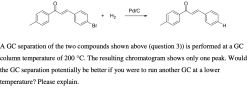 Pd/C + H2 Br A GC separation of the two compounds shown above (question 3)) is performed at a GC column temperature of 200 °C. The resulting chromatogram shows only one peak. Would the GC separation potentially be better if you were to run another GC at a lower temperature? Please explain.
1. Select an appropriate type of column for separating these steroids and give the rationale for...
 1. Select an appropriate type of column for separating these steroids and give the rationale for your selection. HO HO ОН OH Prednisolone Prednisone 2. You are using a C18 Reverse Phase column and the parameters shown below to separate Acetaminophen, Caffeine, and Benzoic Acid. You observe three peaks in your chromatogram (Huzzah!). Which corresponds to which compound? Explain the rationale behind your assignment. OH C18 REVERSED PHASE COLUMN Acetaminophen HC N H, O Caffeine Column: Legacy L1 Size: 4.6...
1. Explain how a fractionating column increases the separation of two liquids. 2. What is an...
1. Explain how a fractionating column increases the separation of two liquids. 2. What is an azeotrope? Do you think the mixture used in the lab is an example of an azeotrope? Explain. 3. Explain how the boiling point of a liquid is affected by the addition of a non-volatile solute (hint: it is a colligative property). Is the temperature above such solution lower, higher or the same as the pure liquid? Explain why. 4. You were asked to record...
9 VII. Gas Chromatography 1. The organic mixture to be separated on the GC is injected...
 9 VII. Gas Chromatography 1. The organic mixture to be separated on the GC is injected into the GC as a (gas, liquid, or solid). 2. The typical volume of mixture injected into a GC is 1-10 (microliters, milliliters, or deciliters). 3. Immediately upon entering the injection port the mixture is_ _(solidified, condensed, or vaporized). (heated, cooled, maintained at room 4. The event described in #3 occurs because the injection port is temperature). 5. An inert gas, referred to as...
 help needed with this problem set
Refer to the HPLC chromatograms below for a 5-component mixture of organic acids for the following questions. The specific HPLC parameters for chromatogram A (top) are described in the figure title and the insert. You only need the lecture notes and/or your personal experience to answer those questions. Mobile phase: 30 % MeCN, 70 % TFA, 0.1 M (pH 2.0) low rate: 1.0 mL/min 2Benzok Acid Maleic Aci 1. (a) Which component has the...
help needed with this problem set
Refer to the HPLC chromatograms below for a 5-component mixture of organic acids for the following questions. The specific HPLC parameters for chromatogram A (top) are described in the figure title and the insert. You only need the lecture notes and/or your personal experience to answer those questions. Mobile phase: 30 % MeCN, 70 % TFA, 0.1 M (pH 2.0) low rate: 1.0 mL/min 2Benzok Acid Maleic Aci 1. (a) Which component has the...
 Table 2: Alcohol and Ketone Standards GC Retention Times GC#: Retention time Alcohol Standard Mixture Phent ion= 2.05Smin low Peak 1 Compound Name: athanol Rapesnal utanal aclapeatanal 4.755min oilng 6.895min .230 min Peak 2 Compound Name: Peak 3 Compound Name: Peak 4 Compound Name: GC#:1 Ketone Standard Mixture Retention time 2.575un Peak 1 Compound Name: Acclono Butanon a Pentanone 2tHex anon Peak 2 Compound Name: min Peak 3 Compound Name: 615 min 1D. 307 min Peak 4 Compound Name: Part...
 2. If two different compounds have the same Rr value, how might they be identified using paper chromatography? 3. Why is it important to keep the spots on the paper as small as possible? 4. If the solvent pool at the bottom of the beaker touched the spots on the 1.5cm line, what would happen to the spots? How would you address this error? 5. If you were teaching a student how to do paper chromatography, what three pieces of...
 need help with number 2
HW #3 for Chem 318 Due: April 29, 2019 1. Solute A has a K 2.5 for an extraction between water (phase 1) and chloroform (phase 2). If 100 mL of a 0.01 fraction will be extracted? For the same solute and, what fraction will be extracted if 5 extractions wi 80 mL chloroform each are used (instead of one 400 ml extraction)? M solution containing solute A in water is extracted one time with...
need help with number 2
HW #3 for Chem 318 Due: April 29, 2019 1. Solute A has a K 2.5 for an extraction between water (phase 1) and chloroform (phase 2). If 100 mL of a 0.01 fraction will be extracted? For the same solute and, what fraction will be extracted if 5 extractions wi 80 mL chloroform each are used (instead of one 400 ml extraction)? M solution containing solute A in water is extracted one time with...
 Pd/C + H2 Br A GC separation of the two compounds shown above (question 3)) is performed at a GC column temperature of 200 °C. The resulting chromatogram shows only one peak. Would the GC separation potentially be better if you were to run another GC at a lower temperature? Please explain.
 1. Select an appropriate type of column for separating these steroids and give the rationale for your selection. HO HO ОН OH Prednisolone Prednisone 2. You are using a C18 Reverse Phase column and the parameters shown below to separate Acetaminophen, Caffeine, and Benzoic Acid. You observe three peaks in your chromatogram (Huzzah!). Which corresponds to which compound? Explain the rationale behind your assignment. OH C18 REVERSED PHASE COLUMN Acetaminophen HC N H, O Caffeine Column: Legacy L1 Size: 4.6...
 9 VII. Gas Chromatography 1. The organic mixture to be separated on the GC is injected into the GC as a (gas, liquid, or solid). 2. The typical volume of mixture injected into a GC is 1-10 (microliters, milliliters, or deciliters). 3. Immediately upon entering the injection port the mixture is_ _(solidified, condensed, or vaporized). (heated, cooled, maintained at room 4. The event described in #3 occurs because the injection port is temperature). 5. An inert gas, referred to as...
Most questions answered within 3 hours.
-
Where is the error in this code sequence?
String s1 = "Hello";
String s2 = "ello";...
asked 10 months ago -
Financial data for Joel de Paris, Inc., for last year
follow:
Joel de Paris, Inc.
Balance...
asked 10 months ago -
Consider this reaction:
Al2(SO4)3 (aq)+ BaCl3
(aq) Al2Cl6 (aq)- +
3BaSO4(s) . What is the...
asked 10 months ago -
Suppose that Savneet is considering increasing her
recent random sample from 20 car rentals to 40...
asked 10 months ago -
Trucks arrive at an unloading terminal at an average rate of 120
per hour.
Trucks arrive...
asked 10 months ago -
Why are methanol and ethanol completely soluble in water while
octanol is not very little soluble....
asked 10 months ago -
A facilities manager at a university reads in a research report
that the mean amount of...
asked 10 months ago -
When the CuSO4 is rehydrated by adding water to the anhydrous
compound, is this an endothermic...
asked 10 months ago -
A ray of sunlight is passing from diamond into crown glass; the
angle of incidence is...
asked 10 months ago -
A block of mass 0.249 kg is placed on top of a light, vertical
spring of...
asked 10 months ago -
how do the kidneys compensate in the presences of acidosis
a) trigger hyperventilate
b) reserve acid...
asked 10 months ago -
Question 501 pts
The rental rate of capital to the firm increases. Which of the
following...
asked 10 months ago