20.45g of a substance, initially at 97.20C was poured into 10.08 g of water in a...
Homework Answers
Answer
0.444 J/g ℃
Explanation
Heat change of the substance ( qs) = -( heat change of water(qw) + heat change of calorimeter(qc))
qs = m × ∆T × Cs
= 20.45g × ( 32.66℃ - 97.20℃) × Cs
= -1319.84g℃ × Cs
qw =m × ∆T × Cs
=10.08g × ( 32.66℃ - 21.37℃) × 4.184J/g℃
= 476.15J
qc = ∆T × Cs
= ( 32.66℃ - 21.37℃ ) × 9.76J/℃
= 110.19J
qs = - ( qw + qc)
-1319.84 g℃ × Cs = - ( 476.15J + 110.19J)
-1319.84 g℃ × Cs = -586.34J
Cs = 0.444J/g℃
Add Answer to:
20.45g of a substance, initially at 97.20C was poured into 10.08 g
of water in a...
A 36.2-g sample of metal at 94.7oC is mixed with water (initially at 25.4oC) in a...
A 36.2-g sample of metal at 94.7oC is mixed with water (initially at 25.4oC) in a calorimeter. If the calorimeter constant is 46.2 J/K, final temperature is found to be 28.8oC, and the amount of heat absorbed by the water was determined to be 943 J, calculate the specific heat of the metal.
1. A 110.4 g110.4 g sample of a substance is initially at 20.1 °C20.1 °C ....
1. A 110.4 g110.4 g sample of a substance is initially at 20.1 °C20.1 °C . After absorbing 335 cal335 cal of heat, the temperature of the substance increases to 67.6 °C67.6 °C . What is the specific heat (SH)(SH) of the substance? 2. When 165.0165.0 J of heat are added to a 15.015.0 g sample of mercury the final temperature of the mercury is recorded as 63.063.0 °C. The metal has a specific heat of 0.13950.1395 J/(g·°C). 3. A...
A 59.16 g sample of a substance is initially at 27.0 °C. After absorbing 1969 J...
 A 59.16 g sample of a substance is initially at 27.0 °C. After absorbing 1969 J of heat, the temperature of the substance is 175.1 °C. What is the specific heat (c) of the substance? When 1521 J of heat energy is added to 38.2 g of hexane, CH4, the temperature increases by 17.6°C. Calculate the molar heat capacity of CH4 Cp = J/(mol·°C)
What mass of this substance must evaporate to freeze 210 g of water initially at 24...
What mass of this substance must evaporate to freeze 210 g of water initially at 24 ∘C? (The heat of fusion of water is 334 J/g; the specific heat of water is 4.18 J/(g⋅K).)
1. A 31.6 g wafer of pure gold initially at 69.4 ∘C is submerged into 63.8...
1. A 31.6 g wafer of pure gold initially at 69.4 ∘C is submerged into 63.8 g of water at 27.7 ∘C in an insulated container. What is the final temperature of both substances at thermal equilibrium? 2.Two substances, A and B, initially at different temperatures, come into contact and reach thermal equilibrium. The mass of substance A is 6.04 gand its initial temperature is 21.0 ∘C . The mass of substance B is 25.5 gand its initial temperature is...
Question 8 of 28 > A 59.75 g sample of a substance is initially at 21.2...
 Question 8 of 28 > A 59.75 g sample of a substance is initially at 21.2 °C. After absorbing 2711 J of heat, the temperature of the substance is 138.2 C. What is the specific heat (c) of the substance?
cion 4 of 13 > A 59.59 g sample of a substance is initially at 29.4...
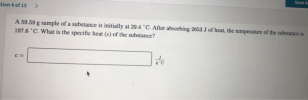 cion 4 of 13 > A 59.59 g sample of a substance is initially at 29.4 °C. After absorbing 2653 J of heat, the temperature of the substance is 197.6 °C. What is the specific heat (c) of the substance?
A piece of copper metal is initially at 83.0°C. It is dropped into a coffee cup...
 A piece of copper metal is initially at 83.0°C. It is dropped into a coffee cup calorimeter containing 30.0 9 of water at a temperature of 10.0°c. After stirring, the final temperature of both copper and water is 25.0°c. Assuming no heat losses, and that the specific heat (capacity) of water is 4.18 J/(g.), what is the heat capacity of the copper in J/K?
A coffee cup calorimeter is prepared, containing 100.000 g of water (specific heat capacity = 4.184 J/g K) at initial te...
A coffee cup calorimeter is prepared, containing 100.000 g of water (specific heat capacity = 4.184 J/g K) at initial temperature 80.000 C. A salt weighing 7.228 g is quickly added. The salt has a molar mass of 211.503 g/mol. The final temperature of the solution is 8.795 C. Assume no heat loss to the surroundings. Assume the specific heat capacity of the solution is equal to that of pure water, and that the mass of the solution is equal...
PART A: A student constructs a coffee cup calorimeter and places 50.0 mL of water into...
PART A: A student constructs a coffee cup calorimeter and places 50.0 mL of water into it. After a brief period of stabilization, the temperature of the water in calorimeter is determined to be 19.6 °C. To this is added 50.0 mL of water that was originally a temperature of 54.5 °C. A careful plot of the recorded temperature established T0 as 31.1 °C. What is the calorimeter constant (J/°C)? DensityH2O = 1.00 g/mL Specific HeatH2O = 4.184 J/g·°C PART...
 A 59.16 g sample of a substance is initially at 27.0 °C. After absorbing 1969 J of heat, the temperature of the substance is 175.1 °C. What is the specific heat (c) of the substance? When 1521 J of heat energy is added to 38.2 g of hexane, CH4, the temperature increases by 17.6°C. Calculate the molar heat capacity of CH4 Cp = J/(mol·°C)
 Question 8 of 28 > A 59.75 g sample of a substance is initially at 21.2 °C. After absorbing 2711 J of heat, the temperature of the substance is 138.2 C. What is the specific heat (c) of the substance?
 cion 4 of 13 > A 59.59 g sample of a substance is initially at 29.4 °C. After absorbing 2653 J of heat, the temperature of the substance is 197.6 °C. What is the specific heat (c) of the substance?
 A piece of copper metal is initially at 83.0°C. It is dropped into a coffee cup calorimeter containing 30.0 9 of water at a temperature of 10.0°c. After stirring, the final temperature of both copper and water is 25.0°c. Assuming no heat losses, and that the specific heat (capacity) of water is 4.18 J/(g.), what is the heat capacity of the copper in J/K?
Most questions answered within 3 hours.
-
Where is the error in this code sequence?
String s1 = "Hello";
String s2 = "ello";...
asked 11 months ago -
Financial data for Joel de Paris, Inc., for last year
follow:
Joel de Paris, Inc.
Balance...
asked 11 months ago -
Consider this reaction:
Al2(SO4)3 (aq)+ BaCl3
(aq) Al2Cl6 (aq)- +
3BaSO4(s) . What is the...
asked 11 months ago -
Suppose that Savneet is considering increasing her
recent random sample from 20 car rentals to 40...
asked 11 months ago -
Trucks arrive at an unloading terminal at an average rate of 120
per hour.
Trucks arrive...
asked 11 months ago -
Why are methanol and ethanol completely soluble in water while
octanol is not very little soluble....
asked 11 months ago -
A facilities manager at a university reads in a research report
that the mean amount of...
asked 11 months ago -
When the CuSO4 is rehydrated by adding water to the anhydrous
compound, is this an endothermic...
asked 11 months ago -
A ray of sunlight is passing from diamond into crown glass; the
angle of incidence is...
asked 11 months ago -
A block of mass 0.249 kg is placed on top of a light, vertical
spring of...
asked 11 months ago -
how do the kidneys compensate in the presences of acidosis
a) trigger hyperventilate
b) reserve acid...
asked 11 months ago -
Question 501 pts
The rental rate of capital to the firm increases. Which of the
following...
asked 11 months ago