Discuss Diffusion vs. Osmosis give example
- Discuss Diffusion vs. Osmosis give example
Homework Answers
Diffusion refers to the movement of solute and solvent molecules from high concentration to their low concentration across the membrane. It depends upon concentration gradient, temperature, pressure, wall permeability etc. Example: movement of ions across plasma membrane.
Osmosis: It specifically refers to the movement of water molecules from low solute concentration medium to high solute concentration medium through the semi permeable membrane. For example. Movement of water in roots from the soil.
Air flow into and out of the lungs is an example of what? Diffusion Osmosis Bulk...
Air flow into and out of the lungs is an example of what? Diffusion Osmosis Bulk flow Active Transport Facilitated Diffusion
Discuss the concepts of diffusion and osmosis. Provide examples of how these two forces interact with...
Discuss the concepts of diffusion and osmosis. Provide examples of how these two forces interact with the body’s cells
give one example of why it would be important to understand the clinical significance of diffusion...
give one example of why it would be important to understand the clinical significance of diffusion or osmosis?
Compare and Contrast Diffusion and Osmosis Diffusion Osmosis Is a gradient needed? Direction of movement in...
 Compare and Contrast Diffusion and Osmosis Diffusion Osmosis Is a gradient needed? Direction of movement in relation to the solute) Is a membrane required? Source of energy for movement What is moved
Ethics 5. Give an example of a gift VS Bribe and discuss.
 Ethics
5. Give an example of a gift VS Bribe and discuss.
Ethics
5. Give an example of a gift VS Bribe and discuss.
Discuss the following aspects in detail and give an example: Issuing banks vs Confirming banks and...
Discuss the following aspects in detail and give an example: Issuing banks vs Confirming banks and global business
Compare osmosis, simple diffusion, facilitated diffusion and active transport: A) describe their differences and B) explain...
Compare osmosis, simple diffusion, facilitated diffusion and active transport: A) describe their differences and B) explain when cells have to use each one.
how do i study for diffusion and osmosis in Anatomy and physiology
how do i study for diffusion and osmosis in Anatomy and physiology
Osmosis refers to the diffusion of water small molecules solute molecules. gaseous particles.
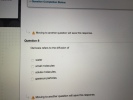 Osmosis refers to the diffusion of water small molecules solute molecules. gaseous particles.
Which of the following is false regarding osmosis and diffusion? a) A single glycogen molecule will...
Which of the following is false regarding osmosis and diffusion? a) A single glycogen molecule will cause a higher rate of osmosis into an animal cell than the equivalent mass of free glucose molecules. b) Some cells that are specialized to take up water rapidly need a special protein to accomplish this c) Plant cells will perform best in a slightly hypotonic solution while most animal cells perform best in an isotonic solution d) After net diffusion, once solute concentration...
 Compare and Contrast Diffusion and Osmosis Diffusion Osmosis Is a gradient needed? Direction of movement in relation to the solute) Is a membrane required? Source of energy for movement What is moved
 Ethics
5. Give an example of a gift VS Bribe and discuss.
Ethics
5. Give an example of a gift VS Bribe and discuss.
 Osmosis refers to the diffusion of water small molecules solute molecules. gaseous particles.
Most questions answered within 3 hours.
-
Where is the error in this code sequence?
String s1 = "Hello";
String s2 = "ello";...
asked 11 months ago -
Financial data for Joel de Paris, Inc., for last year
follow:
Joel de Paris, Inc.
Balance...
asked 11 months ago -
Consider this reaction:
Al2(SO4)3 (aq)+ BaCl3
(aq) Al2Cl6 (aq)- +
3BaSO4(s) . What is the...
asked 11 months ago -
Suppose that Savneet is considering increasing her
recent random sample from 20 car rentals to 40...
asked 11 months ago -
Trucks arrive at an unloading terminal at an average rate of 120
per hour.
Trucks arrive...
asked 11 months ago -
Why are methanol and ethanol completely soluble in water while
octanol is not very little soluble....
asked 11 months ago -
A facilities manager at a university reads in a research report
that the mean amount of...
asked 11 months ago -
When the CuSO4 is rehydrated by adding water to the anhydrous
compound, is this an endothermic...
asked 11 months ago -
A ray of sunlight is passing from diamond into crown glass; the
angle of incidence is...
asked 11 months ago -
A block of mass 0.249 kg is placed on top of a light, vertical
spring of...
asked 11 months ago -
how do the kidneys compensate in the presences of acidosis
a) trigger hyperventilate
b) reserve acid...
asked 11 months ago -
Question 501 pts
The rental rate of capital to the firm increases. Which of the
following...
asked 11 months ago