The processes for ketone body formation and consumption as an alternative fuel. What metabolic conditions promote...
The processes for ketone body formation and consumption as an alternative fuel.
-
What metabolic conditions promote ketone body formation?
-
Describe the reactions that convert acetyl-CoA to acetoacetate and β-
hydroxybutryate. Be able to recognize the intermediates in this pathway.
-
Describe how β-hydroxybutyrate is converted to acetyl-CoA in non-liver
peripheral tissues.
-
Describe the condition known as ketoacidosis. Why is it potentially life-
threatening?
Homework Answers
Ketone bodies are a group of three ketone conrtaining molecules namely, acetoacetate, beta-hydroxybutyrate, and their spontaneous breakdown product, acetone. The maybe called ketone bodies. These are water soluble molecules. Such ketone bodies are produced by the liver from fatty acids during situations of low food intake or fasting or food intake with low carbohydrates and also starvation.
Metabolic conditions promoting ketone body formation:
Ketone bodies are produced from acetyl-CoA in the liver when carbohydrates are so scarce that energy must be obtained from breaking down of fatty acids. This state is called ketosis. Without insulin to extract the glucose from the blood, tissues the levels of malonyl-CoA are reduced, and it becomes easier for fatty acids to be transported into mitochondria, this causes the accumulation of excess acetyl-CoA. The accumulation of acetyl-CoA in turn produces excess ketone bodies through ketogenesis.
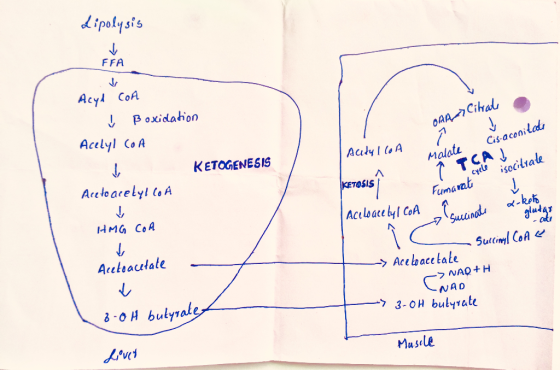
β-hydroxybutyrate is converted to acetyl-CoA in non-liver
peripheral tissues whein it NAD is added causing it to form to acetoacetate. Addition of succinyl CoA produces acetoacetyl CoA. This product upon ketosis produce Acetyl CoA.
Diabetic ketoacidosis
It is a serious complication of diabetes that occurs when your body produces high levels of blood acids called ketones. The condition develops when your body can't produce enough insulin. Sugar is a main source of energy for the cells. Normally, insulin helps sugar enter your cells. Without insulin, body can't use sugar properly for. This release hormones that break down fat as fuel, which produces acids known as ketones. Excess ketones build up in the blood and eventually "spill over" into the urine.
The risk of diabetic ketoacidosis is highest if you have type 1 diabetes and you frequently miss insulin doses.
The reactions:
The ketone bodies produced are energy rich molecules that
transfer energy between liver and body tissues. Ketogenesis is the
process through which ketone bodies are formed.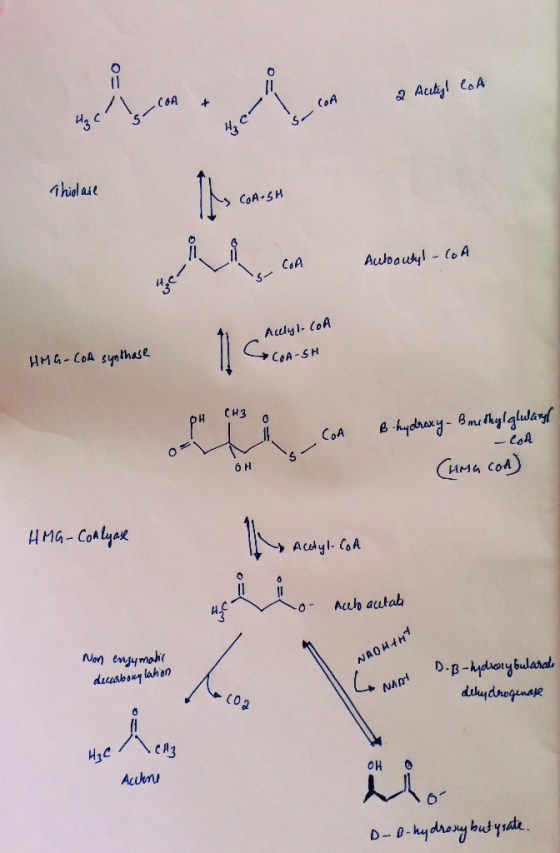
Processes for ketone body formation:
Add Answer to:
The processes for ketone body formation and consumption as an
alternative fuel.
What metabolic conditions promote...
Chapter 18Ketogenesis and Ketone Bodies Resouroa x previous 22 of 24 Ketogenesis and Ketone Bodies Part...
 Chapter 18Ketogenesis and Ketone Bodies Resouroa x previous 22 of 24 Ketogenesis and Ketone Bodies Part B When the body runs out of glucose, the brain, heart, and skeletal muscle can use ketone bodies for their metabolic needs. When this happens, the body switches over to a metabolic state known as ketosis. Ketone bodies are made in the liver by combining acetyl CoA groups together Sort the following molecules based on whether or not they are biologically occurring ketone bodies...
When the body runs out of glucose, the brain, heart, and skeletal muscle can use ketone...
When the body runs out of glucose, the brain, heart, and skeletal muscle can use ketone bodies for their metabolic needs. When this happens, the body switches over to a metabolic state known as ketosis. Ketone bodies are made in the liver by combining acetyl CoA groups together. Sort the following molecules based on whether or not they are biologically occurring ketone bodies. Drag each item to the appropriate bin. Bin #1: Biological Ketone Bodies Bin #2: Nonbiological ketones A....
1. If the body heats up, acts as the integrating center, and the following are effector...
 1. If the body heats up, acts as the integrating center, and the following are effector actions 2. If glucose levels are low, excess acetyl-CoA can be used to make ketone bodies in a process called The body's major ketone body is In aerobic cellular respiration, acetyl-CoA enters 3. 4. Inorganic compounds required for metabolic processes are 5. The building blocks of proteins are and these can be used to or 6. deliver excess cholesterol to the liver for elimination....
1. Describe the processes by which fatty acids are transported in the blood, activated and transported...
1. Describe the processes by which fatty acids are transported in the blood, activated and transported into the matrix of the mitochondria for breakdown to obtain energy. (Specifically, determine the role of carnitine palmitoyl transferase in the oxidation of fatty acids.) 2. Explain the processes by which fatty acids are released from triacylglycerol stored in adipose tissue. 3. Outline the β-oxidation pathway by which fatty acids are metabolized to acetyl-CoA and explain how this leads to the production of large...
Investigate short-chain (12 carbons or less) fatty acid metabolism: Monitor ketone body formation in the blood...
Investigate short-chain (12 carbons or less) fatty acid metabolism: Monitor ketone body formation in the blood Results: Interestingly, when Jessie was fed a solution containing short-chain fatty acids and again fasted, plasma acetoacetate and γ-hydroxybutyrate concentrations increased. 15. What does this result tell you about Jessie? A. Nothing B. Something, but not clear what C. One of the enzymes of the β-oxidation pathway must be deficient D. There must be a problem with specifically long-chain fatty acid transport, not with...
Which of the following metabolic changes will occur in a typical human after a meal balanced...
Which of the following metabolic changes will occur in a typical human after a meal balanced in carbohydrates, protein, and fat is consumed? (Select ALL that apply!) Liver glycogen synthesis increases Muscle glycogenolysis (glycogen breakdown) increases Liver gluconeogenesis decreases Insulin levels in the blood decrease Ketone body production in the liver is increased ..... Which of the following metabolic changes will occur in a typical human during 12 hours of fasting? (Select ALL that apply.) Liver glycogen synthesis decreases Liver...
Questions on Metabolic Pathways & Energy balance 81 Match the items. #2 What can be said...
 Questions on Metabolic Pathways & Energy balance
81 Match the items. #2 What can be said about the glycolysis pathway? a. Initial breakdown of carbohydrate b. Initial breakdown of fat C. Made by all three energy nutrients d. Removal of nitrogen from an amino acid e. Most ATP is produced a. requires oxygen. b. is the breakdown of pyruvate to acetyl COA. C. converts acetyl CoA into pantothenic acid. od results in the formation of pyruvate. 1. Electron Transport Chain...
Questions on Metabolic Pathways & Energy balance
81 Match the items. #2 What can be said about the glycolysis pathway? a. Initial breakdown of carbohydrate b. Initial breakdown of fat C. Made by all three energy nutrients d. Removal of nitrogen from an amino acid e. Most ATP is produced a. requires oxygen. b. is the breakdown of pyruvate to acetyl COA. C. converts acetyl CoA into pantothenic acid. od results in the formation of pyruvate. 1. Electron Transport Chain...
1. What is happening in a healthy individual about an hour into a glucose tolerance test? (Note: At this early time-poin...
1. What is happening in a healthy individual about an hour into a glucose tolerance test? (Note: At this early time-point, blood glucose levels are still high. Also, remember that a person who is taking a glucose tolerance test was fasting for 12 hours prior to the test!) (Select ALL that apply!) Hint: Review pages 319-325, 462-467 and 489-491 of Tymoczko 3E before attempting this question. A. Glucose is being exported by the liver B. Glucose is being taken up...
1. According to the paper, what does lactate dehydrogenase (LDH) do and what does it allow...
 1. According to the paper, what does lactate dehydrogenase
(LDH) do and what does it allow to happen within the myofiber? (5
points)
2. According to the paper, what is the major disadvantage of
relying on glycolysis during high-intensity exercise? (5
points)
3. Using Figure 1 in the paper, briefly describe the different
sources of ATP production at 50% versus 90% AND explain whether you
believe this depiction of ATP production applies to a Type IIX
myofiber in a human....
1. According to the paper, what does lactate dehydrogenase
(LDH) do and what does it allow to happen within the myofiber? (5
points)
2. According to the paper, what is the major disadvantage of
relying on glycolysis during high-intensity exercise? (5
points)
3. Using Figure 1 in the paper, briefly describe the different
sources of ATP production at 50% versus 90% AND explain whether you
believe this depiction of ATP production applies to a Type IIX
myofiber in a human....
 Chapter 18Ketogenesis and Ketone Bodies Resouroa x previous 22 of 24 Ketogenesis and Ketone Bodies Part B When the body runs out of glucose, the brain, heart, and skeletal muscle can use ketone bodies for their metabolic needs. When this happens, the body switches over to a metabolic state known as ketosis. Ketone bodies are made in the liver by combining acetyl CoA groups together Sort the following molecules based on whether or not they are biologically occurring ketone bodies...
 1. If the body heats up, acts as the integrating center, and the following are effector actions 2. If glucose levels are low, excess acetyl-CoA can be used to make ketone bodies in a process called The body's major ketone body is In aerobic cellular respiration, acetyl-CoA enters 3. 4. Inorganic compounds required for metabolic processes are 5. The building blocks of proteins are and these can be used to or 6. deliver excess cholesterol to the liver for elimination....
 Questions on Metabolic Pathways & Energy balance
81 Match the items. #2 What can be said about the glycolysis pathway? a. Initial breakdown of carbohydrate b. Initial breakdown of fat C. Made by all three energy nutrients d. Removal of nitrogen from an amino acid e. Most ATP is produced a. requires oxygen. b. is the breakdown of pyruvate to acetyl COA. C. converts acetyl CoA into pantothenic acid. od results in the formation of pyruvate. 1. Electron Transport Chain...
Questions on Metabolic Pathways & Energy balance
81 Match the items. #2 What can be said about the glycolysis pathway? a. Initial breakdown of carbohydrate b. Initial breakdown of fat C. Made by all three energy nutrients d. Removal of nitrogen from an amino acid e. Most ATP is produced a. requires oxygen. b. is the breakdown of pyruvate to acetyl COA. C. converts acetyl CoA into pantothenic acid. od results in the formation of pyruvate. 1. Electron Transport Chain...
 1. According to the paper, what does lactate dehydrogenase
(LDH) do and what does it allow to happen within the myofiber? (5
points)
2. According to the paper, what is the major disadvantage of
relying on glycolysis during high-intensity exercise? (5
points)
3. Using Figure 1 in the paper, briefly describe the different
sources of ATP production at 50% versus 90% AND explain whether you
believe this depiction of ATP production applies to a Type IIX
myofiber in a human....
1. According to the paper, what does lactate dehydrogenase
(LDH) do and what does it allow to happen within the myofiber? (5
points)
2. According to the paper, what is the major disadvantage of
relying on glycolysis during high-intensity exercise? (5
points)
3. Using Figure 1 in the paper, briefly describe the different
sources of ATP production at 50% versus 90% AND explain whether you
believe this depiction of ATP production applies to a Type IIX
myofiber in a human....
Most questions answered within 3 hours.
-
Where is the error in this code sequence?
String s1 = "Hello";
String s2 = "ello";...
asked 10 months ago -
Financial data for Joel de Paris, Inc., for last year
follow:
Joel de Paris, Inc.
Balance...
asked 10 months ago -
Consider this reaction:
Al2(SO4)3 (aq)+ BaCl3
(aq) Al2Cl6 (aq)- +
3BaSO4(s) . What is the...
asked 10 months ago -
Suppose that Savneet is considering increasing her
recent random sample from 20 car rentals to 40...
asked 10 months ago -
Trucks arrive at an unloading terminal at an average rate of 120
per hour.
Trucks arrive...
asked 10 months ago -
Why are methanol and ethanol completely soluble in water while
octanol is not very little soluble....
asked 10 months ago -
A facilities manager at a university reads in a research report
that the mean amount of...
asked 10 months ago -
When the CuSO4 is rehydrated by adding water to the anhydrous
compound, is this an endothermic...
asked 10 months ago -
A ray of sunlight is passing from diamond into crown glass; the
angle of incidence is...
asked 10 months ago -
A block of mass 0.249 kg is placed on top of a light, vertical
spring of...
asked 10 months ago -
how do the kidneys compensate in the presences of acidosis
a) trigger hyperventilate
b) reserve acid...
asked 10 months ago -
Question 501 pts
The rental rate of capital to the firm increases. Which of the
following...
asked 10 months ago