Can rotary evaporation be used to help recrystallize dilute solutions? Explain.
Can rotary evaporation be used to help recrystallize dilute solutions? Explain.
Homework Answers
Rotatory evaporation is a process of separation that works by removing the solvent present in the sample.
Evaporation is done in rotatory evaporation by:
By rotating the bath which increase the effective surface area.
By heating the sample.
By increasing the pressure in order to lower down the boiling point of the solvent. So that solvent evaporate fast and is collected in the solvent flask leaving behind the crystals.
Hope this helps you
Add Answer to:
Can rotary evaporation be used to help recrystallize dilute
solutions? Explain.
Hydrogen peroxide is a strong oxidizing agent. It I used in dilute solutions for bleaching hair...
Hydrogen peroxide is a strong oxidizing agent. It I used in dilute solutions for bleaching hair and used in concentrated solution as a rocket fuel. A concentrated solution of hydrogen peroxide is 3.3% by mass or the density of 1.11 g/M oh leaders. Calculate a mole fraction of H202, molarity, and molality.
Explain how we can obtain the electromagnetic torque of a triply - excited rotary actuator supplied...
Explain how we can obtain the electromagnetic torque of a triply - excited rotary actuator supplied by current i1, i2, i3.
1. Describe how serial dilutions can be a more accurate form of preparing dilute solutions. 2....
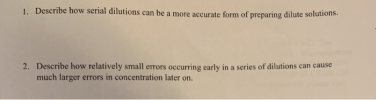 1. Describe how serial dilutions can be a more accurate form of preparing dilute solutions. 2. Describe how relatively small errors occurring early in a series of dilutions can cause much larger errors in concentration later on.
When can the M1V1=M2V2 equation be used? To dilute a solution AND in a titration when...
When can the M1V1=M2V2 equation be used? To dilute a solution AND in a titration when there is the same ratio between H+ and OH- To dilute a solution AND in a titration when there is stoichiometric ratio between H+ and OH- To dilute a solution AND in a titration when there is a 1:1 ratio between acid and base To dilute a solution AND in a titration when there is the same ratio between acid and base
6. Oxalic acid H2C2O4 is a diprotic acid and can be used, in dilute form, as...
 6. Oxalic acid H2C2O4 is a diprotic acid and can be used, in
dilute form, as wood bleach. pKa1 = 1.237 and pKa2=4.187
A. How many milliliters of 0.0500 M NaOH would be required to
completely neutralize 10.0 mL of 0.100 M H2C2O4? (5 pts)
B. Estimate the pH at the first equivalence point of the
titration. (6 pts)
C. What is the pH at the second equivalence point of the
titration. (8 pts)
Please help with work shown, especially...
6. Oxalic acid H2C2O4 is a diprotic acid and can be used, in
dilute form, as wood bleach. pKa1 = 1.237 and pKa2=4.187
A. How many milliliters of 0.0500 M NaOH would be required to
completely neutralize 10.0 mL of 0.100 M H2C2O4? (5 pts)
B. Estimate the pH at the first equivalence point of the
titration. (6 pts)
C. What is the pH at the second equivalence point of the
titration. (8 pts)
Please help with work shown, especially...
-Step coverage is a unique feature in thermal evaporation that can be used for MEMS design....
 -Step coverage is a unique feature in thermal evaporation that can be used for MEMS design. Please draw the metal deposited on the two devices below and indicate which one is better for the lift-off process. Arrows indicate the direction of the incoming evaporated metal. (3') ||||||||||| |||||||| PR PR SIO2 SiO2 si Si ) Which one is better for the lift-off process? (
1. Why is it necessary to protect dilute standard solutions of NaOH(aq) from CO2? 2. Why...
1. Why is it necessary to protect dilute standard solutions of NaOH(aq) from CO2? 2. Why is it not necessary to protect a 50% NaOH(aq) solution from CO2? some prelab questions i need help with, thank you :)
A semipermeable membrane separates two compartments containing different ideal, dilute solutions....
A semipermeable membrane separates two compartments containing different ideal, dilute solutions. Compartment 1 contains 150 mL of solution containing 0.02 mol Na+, 0.02 mol K+, and 0.05 mol Cl-. Compartment 2 contains 200 mL of solution containing 0.02 mol Na+, 0.01 mol Ca2+, and 0.01 mol PO43-. In which direction will Na+ diffuse? Explain your answer. (3 points)
During the work-up of the reaction, aqueous sodium bicarbonate is used to wash the organic layer...
During the work-up of the reaction, aqueous sodium bicarbonate is used to wash the organic layer to remove impurities. What two compounds are removed from the organic layer during this process? Oil of wintergreen (methyl salicylate) is a liquid. How can you determine when most of the methylene chloride has been evaporated via rotary evaporation?
Hi can anyone help explain these problems? A9 Pgwi. MarBook Pro SE Gas Laws & Solutions...
 Hi can anyone help explain these problems?
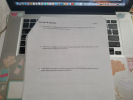
A9 Pgwi. MarBook Pro SE Gas Laws & Solutions MORNS 1 3. In the reaction of AgNO, with Na S, assume 20.0 mL of 0.15 M AgNO, was used. How many grams of the precipitate formed in this reaction? delete fobi 1 caps return shift shift 4. In the reaction of AgNO, with Naci, assume 1.48 g of precipitate formed. How many mL of 0.30 M NaCl would be needed for the reaction?...
Hi can anyone help explain these problems?
A9 Pgwi. MarBook Pro SE Gas Laws & Solutions MORNS 1 3. In the reaction of AgNO, with Na S, assume 20.0 mL of 0.15 M AgNO, was used. How many grams of the precipitate formed in this reaction? delete fobi 1 caps return shift shift 4. In the reaction of AgNO, with Naci, assume 1.48 g of precipitate formed. How many mL of 0.30 M NaCl would be needed for the reaction?...
 1. Describe how serial dilutions can be a more accurate form of preparing dilute solutions. 2. Describe how relatively small errors occurring early in a series of dilutions can cause much larger errors in concentration later on.
 6. Oxalic acid H2C2O4 is a diprotic acid and can be used, in
dilute form, as wood bleach. pKa1 = 1.237 and pKa2=4.187
A. How many milliliters of 0.0500 M NaOH would be required to
completely neutralize 10.0 mL of 0.100 M H2C2O4? (5 pts)
B. Estimate the pH at the first equivalence point of the
titration. (6 pts)
C. What is the pH at the second equivalence point of the
titration. (8 pts)
Please help with work shown, especially...
6. Oxalic acid H2C2O4 is a diprotic acid and can be used, in
dilute form, as wood bleach. pKa1 = 1.237 and pKa2=4.187
A. How many milliliters of 0.0500 M NaOH would be required to
completely neutralize 10.0 mL of 0.100 M H2C2O4? (5 pts)
B. Estimate the pH at the first equivalence point of the
titration. (6 pts)
C. What is the pH at the second equivalence point of the
titration. (8 pts)
Please help with work shown, especially...
 -Step coverage is a unique feature in thermal evaporation that can be used for MEMS design. Please draw the metal deposited on the two devices below and indicate which one is better for the lift-off process. Arrows indicate the direction of the incoming evaporated metal. (3') ||||||||||| |||||||| PR PR SIO2 SiO2 si Si ) Which one is better for the lift-off process? (
 Hi can anyone help explain these problems?
A9 Pgwi. MarBook Pro SE Gas Laws & Solutions MORNS 1 3. In the reaction of AgNO, with Na S, assume 20.0 mL of 0.15 M AgNO, was used. How many grams of the precipitate formed in this reaction? delete fobi 1 caps return shift shift 4. In the reaction of AgNO, with Naci, assume 1.48 g of precipitate formed. How many mL of 0.30 M NaCl would be needed for the reaction?...
Hi can anyone help explain these problems?
A9 Pgwi. MarBook Pro SE Gas Laws & Solutions MORNS 1 3. In the reaction of AgNO, with Na S, assume 20.0 mL of 0.15 M AgNO, was used. How many grams of the precipitate formed in this reaction? delete fobi 1 caps return shift shift 4. In the reaction of AgNO, with Naci, assume 1.48 g of precipitate formed. How many mL of 0.30 M NaCl would be needed for the reaction?...
Most questions answered within 3 hours.
-
Where is the error in this code sequence?
String s1 = "Hello";
String s2 = "ello";...
asked 10 months ago -
Financial data for Joel de Paris, Inc., for last year
follow:
Joel de Paris, Inc.
Balance...
asked 10 months ago -
Consider this reaction:
Al2(SO4)3 (aq)+ BaCl3
(aq) Al2Cl6 (aq)- +
3BaSO4(s) . What is the...
asked 10 months ago -
Suppose that Savneet is considering increasing her
recent random sample from 20 car rentals to 40...
asked 10 months ago -
Trucks arrive at an unloading terminal at an average rate of 120
per hour.
Trucks arrive...
asked 10 months ago -
Why are methanol and ethanol completely soluble in water while
octanol is not very little soluble....
asked 10 months ago -
A facilities manager at a university reads in a research report
that the mean amount of...
asked 10 months ago -
When the CuSO4 is rehydrated by adding water to the anhydrous
compound, is this an endothermic...
asked 10 months ago -
A ray of sunlight is passing from diamond into crown glass; the
angle of incidence is...
asked 10 months ago -
A block of mass 0.249 kg is placed on top of a light, vertical
spring of...
asked 10 months ago -
how do the kidneys compensate in the presences of acidosis
a) trigger hyperventilate
b) reserve acid...
asked 10 months ago -
Question 501 pts
The rental rate of capital to the firm increases. Which of the
following...
asked 10 months ago