Calculate the standard reduction potential for the half-reaction AgBr(s)+e−→Ag(s)+Br−(aq) Express the potential to two decimal places.
Calculate the standard reduction potential for the half-reaction
AgBr(s)+e−→Ag(s)+Br−(aq)
Express the potential to two decimal places.
Homework Answers
It is the standard value and its value is fixed these are standard values and is 0.07V
Add Answer to:
Calculate the standard reduction potential for the
half-reaction
AgBr(s)+e−→Ag(s)+Br−(aq)
Express the potential to two decimal places.
Consider the following information at 25 ºC: AgBr(s) + e- → Ag(s) + Br-(aq) Eº(AgBr(s),Ag(s)) =...
Consider the following information at 25 ºC: AgBr(s) + e- → Ag(s) + Br-(aq) Eº(AgBr(s),Ag(s)) = 0.07133 V Ag+(aq) + e- → Ag(s) Eº(Ag+(aq),Ag(s)) = 0.7996 V What is the value of the solubility product equilibrium constant Ksp(AgBr) of silver bromide? AgBr(s) ↔ Ag+(aq) + Br-(aq) Ksp(AgBr)
Question 22 (5 points) Given the following half reactions: - AgBr(s) + e- Ag+ (aq) +...
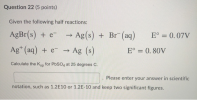 Question 22 (5 points) Given the following half reactions: - AgBr(s) + e- Ag+ (aq) + e- Ag(s) + Br- (aq) E° = 0.07V → Ag (s) E° = 0.80V - Calculate the Ksp for PbSO4 at 25 degrees C. Please enter your answer in scientific notation, such as 1.2E10 or 1.2E-10 and keep two significant figures.
Given the following reactions, AgBr(s) = Ag+ (aq) + Br(aq) Ksp = 5.8 x 10⁻¹³ Ag+...
 Given the following reactions, AgBr(s) = Ag+ (aq) + Br(aq) Ksp = 5.8 x 10⁻¹³ Ag+ (aq) + 2 CN"(aq) = Ag(CN)2(aq) Kf = 9.5 x 10²¹ determine the equilibrium constant for the reaction below. AgBr(s) + 2 CN"(aq) =Ag(CN)2(aq) + Br(aq) Answer: 1.2E21 Check
Question 5 Calculate Eº cell for the reaction below, 2 AgBr(aq) + 2 Hg(1) 2 Ag(s)...
 Question 5 Calculate Eº cell for the reaction below, 2 AgBr(aq) + 2 Hg(1) 2 Ag(s) + Hg2Br2(5) given the following standard reduction potentials. Hg2Br2(s) + 2 - 2 Hg(1) + 2 Br"(aq) E = +0.140 V AgBr(aq) + e - Ag(s) + Br" (aq) E = +0.071 V O a. -0.211 V O b. +0.069 V O C. +1.97 v O d. -0.069 V O e. +0.211 V Question 6 Given the following substances and their vapor pressures at...
Consider the two reduction half-reactions: Br2(l) + 2 e− ⟶ 2 Br−(aq) Eo = 1.09 V...
Consider the two reduction half-reactions: Br2(l) + 2 e− ⟶ 2 Br−(aq) Eo = 1.09 V Ag+(aq) + e− ⟶ Ag(s) Eo = 0.337 V Use the electrode potentials above to calculate Eocell and ∆Gorxn for the reaction below, and determine if it is the reaction for a voltaic cell or an electrolytic cell.
A concentration cell is constructed using two Ag-AgBr electrodes, each of which is based on the...
A concentration cell is constructed using two Ag-AgBr electrodes, each of which is based on the half-reaction: AgBr(s) + e ⇌Ag(s) + Br (aq), E° = 0.070 V. If the anode half-cell contains 0.050 M Br and the cell has an initial potential of 0.090 V at 25°C, what is the concentration of Br− in the cathode? The answer is .0015M please explain why this is correct and how to solve
Given the following reactions, AgBr(s) Ag (aq) + Br(aq) Ag*(aq)2 CN (aq)=Ag(CN)2(aq) K 1.2E+21 determine the...
 Given the following reactions, AgBr(s) Ag (aq) + Br(aq) Ag*(aq)2 CN (aq)=Ag(CN)2(aq) K 1.2E+21 determine the equilibrium constant for the reaction below AgBr(s)2 CN-(aq)= Ag(CN)2 (aq) Brr(aq) Ksp 5.4E-13
the equilibrium constant for the reaction AgBr(s)<—>Ag(aq)+Br-(aq) is the solubility product constant Ksp=7.7*10^-13 at 25 degrees...
the equilibrium constant for the reaction AgBr(s)<—>Ag(aq)+Br-(aq) is the solubility product constant Ksp=7.7*10^-13 at 25 degrees C calculate the delta G for the reaction [Ag]= 1.0*10^-2 M and [Br]= 1.0*10^3 M. is the reaction spontaneous or nonspontaneous at these concentrations
The standard reduction potential of the Ag Ag electrode is +0.80 V and the standard potential...
 The standard reduction potential of the Ag Ag electrode is +0.80 V and the standard potential of the cell Fe(s) Fe3+(aq) || Ag" (aq) Ag(s) is +0.84 V. What is the standard reduction potential of the Fe3+1Fe electrode? +1.64 V +0.04 V O-1.64v -0.04 v -0.12 V Question 10 (1 point) In the following cell, A is a standard Co2+1Co electrode connected to a standard hydrogen electrode. If the voltmeter reading is -0.28 V, which half-reaction occurs in the left-hand...
Consider the following half-reactions: Half-reaction E° (V) Ag+(aq) +e → Ag(s) 0.799V Cu2+(aq) + 2e →...
 Consider the following half-reactions: Half-reaction E° (V) Ag+(aq) +e → Ag(s) 0.799V Cu2+(aq) + 2e → Cu(s) 0.337V Mg2+(aq) + 2e —— Mg(s) -2.370V The strongest oxidizing agent is: enter symbol The weakest oxidizing agent is: The weakest reducing agent is: The strongest reducing agent is: Will Mg(s) oxidize Ag(s) to Ag+(aq)? V Which species can be oxidized by Cu2+(aq)? If none enter none. Consider the following half-reactions: Half-reaction E° (V) 2Br (aq) 1.080V Br2(1) + 2e — Ni2+(aq) +...
 Question 22 (5 points) Given the following half reactions: - AgBr(s) + e- Ag+ (aq) + e- Ag(s) + Br- (aq) E° = 0.07V → Ag (s) E° = 0.80V - Calculate the Ksp for PbSO4 at 25 degrees C. Please enter your answer in scientific notation, such as 1.2E10 or 1.2E-10 and keep two significant figures.
 Given the following reactions, AgBr(s) = Ag+ (aq) + Br(aq) Ksp = 5.8 x 10⁻¹³ Ag+ (aq) + 2 CN"(aq) = Ag(CN)2(aq) Kf = 9.5 x 10²¹ determine the equilibrium constant for the reaction below. AgBr(s) + 2 CN"(aq) =Ag(CN)2(aq) + Br(aq) Answer: 1.2E21 Check
 Question 5 Calculate Eº cell for the reaction below, 2 AgBr(aq) + 2 Hg(1) 2 Ag(s) + Hg2Br2(5) given the following standard reduction potentials. Hg2Br2(s) + 2 - 2 Hg(1) + 2 Br"(aq) E = +0.140 V AgBr(aq) + e - Ag(s) + Br" (aq) E = +0.071 V O a. -0.211 V O b. +0.069 V O C. +1.97 v O d. -0.069 V O e. +0.211 V Question 6 Given the following substances and their vapor pressures at...
 Given the following reactions, AgBr(s) Ag (aq) + Br(aq) Ag*(aq)2 CN (aq)=Ag(CN)2(aq) K 1.2E+21 determine the equilibrium constant for the reaction below AgBr(s)2 CN-(aq)= Ag(CN)2 (aq) Brr(aq) Ksp 5.4E-13
 The standard reduction potential of the Ag Ag electrode is +0.80 V and the standard potential of the cell Fe(s) Fe3+(aq) || Ag" (aq) Ag(s) is +0.84 V. What is the standard reduction potential of the Fe3+1Fe electrode? +1.64 V +0.04 V O-1.64v -0.04 v -0.12 V Question 10 (1 point) In the following cell, A is a standard Co2+1Co electrode connected to a standard hydrogen electrode. If the voltmeter reading is -0.28 V, which half-reaction occurs in the left-hand...
 Consider the following half-reactions: Half-reaction E° (V) Ag+(aq) +e → Ag(s) 0.799V Cu2+(aq) + 2e → Cu(s) 0.337V Mg2+(aq) + 2e —— Mg(s) -2.370V The strongest oxidizing agent is: enter symbol The weakest oxidizing agent is: The weakest reducing agent is: The strongest reducing agent is: Will Mg(s) oxidize Ag(s) to Ag+(aq)? V Which species can be oxidized by Cu2+(aq)? If none enter none. Consider the following half-reactions: Half-reaction E° (V) 2Br (aq) 1.080V Br2(1) + 2e — Ni2+(aq) +...
Most questions answered within 3 hours.
-
Where is the error in this code sequence?
String s1 = "Hello";
String s2 = "ello";...
asked 10 months ago -
Financial data for Joel de Paris, Inc., for last year
follow:
Joel de Paris, Inc.
Balance...
asked 10 months ago -
Consider this reaction:
Al2(SO4)3 (aq)+ BaCl3
(aq) Al2Cl6 (aq)- +
3BaSO4(s) . What is the...
asked 10 months ago -
Suppose that Savneet is considering increasing her
recent random sample from 20 car rentals to 40...
asked 10 months ago -
Trucks arrive at an unloading terminal at an average rate of 120
per hour.
Trucks arrive...
asked 10 months ago -
Why are methanol and ethanol completely soluble in water while
octanol is not very little soluble....
asked 10 months ago -
A facilities manager at a university reads in a research report
that the mean amount of...
asked 10 months ago -
When the CuSO4 is rehydrated by adding water to the anhydrous
compound, is this an endothermic...
asked 10 months ago -
A ray of sunlight is passing from diamond into crown glass; the
angle of incidence is...
asked 10 months ago -
A block of mass 0.249 kg is placed on top of a light, vertical
spring of...
asked 10 months ago -
how do the kidneys compensate in the presences of acidosis
a) trigger hyperventilate
b) reserve acid...
asked 10 months ago -
Question 501 pts
The rental rate of capital to the firm increases. Which of the
following...
asked 10 months ago