Plot the modulated waveform of the binary sequence 00011011 using OOK, BFSK, BPSK, and 4-QAM.
Plot the modulated waveform of the binary sequence 00011011 using OOK, BFSK, BPSK, and 4-QAM.
Homework Answers

Add Answer to:
Plot the modulated waveform of the binary sequence 00011011
using OOK, BFSK, BPSK, and 4-QAM.
Suppose a digital data signal b(t) is transmitted using Binary Phase Shift Keying (BPSK) modulati...
 please show all steps and explaination
Suppose a digital data signal b(t) is transmitted using Binary Phase Shift Keying (BPSK) modulation. a. If the digital data signal b(t) is NRZ binary waveform with bit rate of 1 Mbps and the 2. modulation carrier frequency is 10 MHz, provide an approximate magnitude plot of the frequency spectrum. What is the required bandwidth of this BPSK modulated signal? What happens if you half the bit rate? Provide an approximate magnitude plot of...
please show all steps and explaination
Suppose a digital data signal b(t) is transmitted using Binary Phase Shift Keying (BPSK) modulation. a. If the digital data signal b(t) is NRZ binary waveform with bit rate of 1 Mbps and the 2. modulation carrier frequency is 10 MHz, provide an approximate magnitude plot of the frequency spectrum. What is the required bandwidth of this BPSK modulated signal? What happens if you half the bit rate? Provide an approximate magnitude plot of...
Please design the following digital modulations for the sequence of “01100” a-ASK b- BFSK c- BPSK
Please design the following digital modulations for the sequence of “01100” a-ASK b- BFSK c- BPSK
a binary signal is filtered with r = 1 and then modulated onto a carrier for...
a binary signal is filtered with r = 1 and then modulated onto a carrier for transmission at 9600bps a) what is the bandwidth requirements if the modulation is ASK? b) BFSK with f1 = 100khz and f2 = 120khz (FSK bandwidth = B = 2fd + (1+r)R c) using the same centre frequency as in b) , choose two new frequencies with minimum frequency separation
Consider a DS-BPSK spread spectrum transmitter in Figure 2. Let d(t) be a binary sequence 1101...
 Consider a DS-BPSK spread spectrum transmitter in Figure 2. Let d(t) be a binary sequence 1101 arriving at a rate of 100 bps, where left most bit is the earliest bit. Let c(t) be the pseudorandom binary sequence 100110111000 with a clock rate of 300 Hz. Assuming a bipolar signaling scheme with binary 'O' and binary 'l' represented by a signal levels -l' and '+1', respectively: d(t) Binary-to-bipolar mapping Binary-to-bipolar mapping 2Pcos(211) (1) BPSK modulator P(t) VZPpt) cos(ft) (b) (c)...
Solve q2 1.) The binary sequence 11100101 is applied to an ASK modulator. The bit duration...
 Solve
q2
1.) The binary sequence 11100101 is applied to an ASK modulator. The bit duration is 1us, and the sinusoidal carrier wave is used to represent symbol 1 has a frequency equal to 7 MHz. a. Find the transmission bandwidth of the transmitted signal. b. Plot the waveform of the transmitted ASK signal. Assume that the line encoder and the carrier-wave oscillator are controlled by a common clock 2.) Repeat Problem (I) for the case when the binary sequence...
Solve
q2
1.) The binary sequence 11100101 is applied to an ASK modulator. The bit duration is 1us, and the sinusoidal carrier wave is used to represent symbol 1 has a frequency equal to 7 MHz. a. Find the transmission bandwidth of the transmitted signal. b. Plot the waveform of the transmitted ASK signal. Assume that the line encoder and the carrier-wave oscillator are controlled by a common clock 2.) Repeat Problem (I) for the case when the binary sequence...
please explain steps in multisim Using Multisim, plot V. by applying the triangular waveform in (a)...
 please explain steps in multisim
Using Multisim, plot V. by applying the triangular waveform in (a) to the input of the circuit in (b). I 2 3 4 "(ms) (a) 20 ks 2 0.01 uF O + 10 HI
please explain steps in multisim
Using Multisim, plot V. by applying the triangular waveform in (a) to the input of the circuit in (b). I 2 3 4 "(ms) (a) 20 ks 2 0.01 uF O + 10 HI
3-6. Plot the waveform of y(t) = 4 rect((t + 1)/4) * 2 rect((t - 4)/2)....
 3-6. Plot the waveform of y(t) = 4 rect((t + 1)/4) * 2 rect((t - 4)/2). 3-7. Plot the waveform of r(t) = rect((t + 3)/3) * 6 rect(t/3). Problem 3-6: -7 -6 -5 -4 -3 -2 -1 0 1 2 3 4 5 6 7 vt) vs. Problem 3-7: -6 -5 - -3 -2 2 3 4 5 6 7 -1 0 ott) vs.
1. Consider the following 7-bit binary sequence "1010001" a. Assuming the sequence is 7-bit unsigned binary,...
 1. Consider the following 7-bit binary sequence "1010001" a. Assuming the sequence is 7-bit unsigned binary, convert it to decimal. [5 points] b. Assuming the sequence is 7-bit 2's complement format, convert it to decimal. (5 points c. What is the range of numbers (in decimal) that can be represented using 7-bit binary, signed 2's complement format? [5 points 2. Consider the following Boolean function: F(x, y, z) = (x + y)z'+xy! a. Implement the circuit for the function using...
Using QAM we wish to transmit the following baseband message signals Bcos (w t a) Show the time and frequency domain expression for the transmitted signal. Also, plot the magnitude of the frequency d...
 Using QAM we wish to transmit the following baseband message signals Bcos (w t a) Show the time and frequency domain expression for the transmitted signal. Also, plot the magnitude of the frequency domain representation of the signal. b) On the receiver end, we demodulate the received signal by multiplying with 2cos(Wet +Au). Derive the expression of the demodulated signal in the time domain, before low-pass filtering. c) Derive the Fourier Transform of the demodulated signal.
Using QAM we wish...
Using QAM we wish to transmit the following baseband message signals Bcos (w t a) Show the time and frequency domain expression for the transmitted signal. Also, plot the magnitude of the frequency domain representation of the signal. b) On the receiver end, we demodulate the received signal by multiplying with 2cos(Wet +Au). Derive the expression of the demodulated signal in the time domain, before low-pass filtering. c) Derive the Fourier Transform of the demodulated signal.
Using QAM we wish...
Please I want the solution of this exercise. Thanks. . (10 pts) The binary sequence 1100100010 is applied to a DPSK modulator. The carrier frequency is f 1/T a- Draw the block diagram of the DPSK modu...
 Please I want the solution of this exercise.
Thanks.
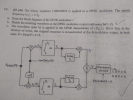
. (10 pts) The binary sequence 1100100010 is applied to a DPSK modulator. The carrier frequency is f 1/T a- Draw the block diagram of the DPSK modulator. b- Sk etch the resulting waveform at the DPSK modulator output (reference bit = 1). SK demodulator of (Fig.2). Show that, in the output, in both c- The waveform (part b) is applied to the DP absence of noise, the original sequence is...
Please I want the solution of this exercise.
Thanks.
. (10 pts) The binary sequence 1100100010 is applied to a DPSK modulator. The carrier frequency is f 1/T a- Draw the block diagram of the DPSK modulator. b- Sk etch the resulting waveform at the DPSK modulator output (reference bit = 1). SK demodulator of (Fig.2). Show that, in the output, in both c- The waveform (part b) is applied to the DP absence of noise, the original sequence is...
 please show all steps and explaination
Suppose a digital data signal b(t) is transmitted using Binary Phase Shift Keying (BPSK) modulation. a. If the digital data signal b(t) is NRZ binary waveform with bit rate of 1 Mbps and the 2. modulation carrier frequency is 10 MHz, provide an approximate magnitude plot of the frequency spectrum. What is the required bandwidth of this BPSK modulated signal? What happens if you half the bit rate? Provide an approximate magnitude plot of...
please show all steps and explaination
Suppose a digital data signal b(t) is transmitted using Binary Phase Shift Keying (BPSK) modulation. a. If the digital data signal b(t) is NRZ binary waveform with bit rate of 1 Mbps and the 2. modulation carrier frequency is 10 MHz, provide an approximate magnitude plot of the frequency spectrum. What is the required bandwidth of this BPSK modulated signal? What happens if you half the bit rate? Provide an approximate magnitude plot of...
 Consider a DS-BPSK spread spectrum transmitter in Figure 2. Let d(t) be a binary sequence 1101 arriving at a rate of 100 bps, where left most bit is the earliest bit. Let c(t) be the pseudorandom binary sequence 100110111000 with a clock rate of 300 Hz. Assuming a bipolar signaling scheme with binary 'O' and binary 'l' represented by a signal levels -l' and '+1', respectively: d(t) Binary-to-bipolar mapping Binary-to-bipolar mapping 2Pcos(211) (1) BPSK modulator P(t) VZPpt) cos(ft) (b) (c)...
 Solve
q2
1.) The binary sequence 11100101 is applied to an ASK modulator. The bit duration is 1us, and the sinusoidal carrier wave is used to represent symbol 1 has a frequency equal to 7 MHz. a. Find the transmission bandwidth of the transmitted signal. b. Plot the waveform of the transmitted ASK signal. Assume that the line encoder and the carrier-wave oscillator are controlled by a common clock 2.) Repeat Problem (I) for the case when the binary sequence...
Solve
q2
1.) The binary sequence 11100101 is applied to an ASK modulator. The bit duration is 1us, and the sinusoidal carrier wave is used to represent symbol 1 has a frequency equal to 7 MHz. a. Find the transmission bandwidth of the transmitted signal. b. Plot the waveform of the transmitted ASK signal. Assume that the line encoder and the carrier-wave oscillator are controlled by a common clock 2.) Repeat Problem (I) for the case when the binary sequence...
 please explain steps in multisim
Using Multisim, plot V. by applying the triangular waveform in (a) to the input of the circuit in (b). I 2 3 4 "(ms) (a) 20 ks 2 0.01 uF O + 10 HI
please explain steps in multisim
Using Multisim, plot V. by applying the triangular waveform in (a) to the input of the circuit in (b). I 2 3 4 "(ms) (a) 20 ks 2 0.01 uF O + 10 HI
 3-6. Plot the waveform of y(t) = 4 rect((t + 1)/4) * 2 rect((t - 4)/2). 3-7. Plot the waveform of r(t) = rect((t + 3)/3) * 6 rect(t/3). Problem 3-6: -7 -6 -5 -4 -3 -2 -1 0 1 2 3 4 5 6 7 vt) vs. Problem 3-7: -6 -5 - -3 -2 2 3 4 5 6 7 -1 0 ott) vs.
 1. Consider the following 7-bit binary sequence "1010001" a. Assuming the sequence is 7-bit unsigned binary, convert it to decimal. [5 points] b. Assuming the sequence is 7-bit 2's complement format, convert it to decimal. (5 points c. What is the range of numbers (in decimal) that can be represented using 7-bit binary, signed 2's complement format? [5 points 2. Consider the following Boolean function: F(x, y, z) = (x + y)z'+xy! a. Implement the circuit for the function using...
 Using QAM we wish to transmit the following baseband message signals Bcos (w t a) Show the time and frequency domain expression for the transmitted signal. Also, plot the magnitude of the frequency domain representation of the signal. b) On the receiver end, we demodulate the received signal by multiplying with 2cos(Wet +Au). Derive the expression of the demodulated signal in the time domain, before low-pass filtering. c) Derive the Fourier Transform of the demodulated signal.
Using QAM we wish...
Using QAM we wish to transmit the following baseband message signals Bcos (w t a) Show the time and frequency domain expression for the transmitted signal. Also, plot the magnitude of the frequency domain representation of the signal. b) On the receiver end, we demodulate the received signal by multiplying with 2cos(Wet +Au). Derive the expression of the demodulated signal in the time domain, before low-pass filtering. c) Derive the Fourier Transform of the demodulated signal.
Using QAM we wish...
 Please I want the solution of this exercise.
Thanks.
. (10 pts) The binary sequence 1100100010 is applied to a DPSK modulator. The carrier frequency is f 1/T a- Draw the block diagram of the DPSK modulator. b- Sk etch the resulting waveform at the DPSK modulator output (reference bit = 1). SK demodulator of (Fig.2). Show that, in the output, in both c- The waveform (part b) is applied to the DP absence of noise, the original sequence is...
Please I want the solution of this exercise.
Thanks.
. (10 pts) The binary sequence 1100100010 is applied to a DPSK modulator. The carrier frequency is f 1/T a- Draw the block diagram of the DPSK modulator. b- Sk etch the resulting waveform at the DPSK modulator output (reference bit = 1). SK demodulator of (Fig.2). Show that, in the output, in both c- The waveform (part b) is applied to the DP absence of noise, the original sequence is...
Most questions answered within 3 hours.
-
Where is the error in this code sequence?
String s1 = "Hello";
String s2 = "ello";...
asked 11 months ago -
Financial data for Joel de Paris, Inc., for last year
follow:
Joel de Paris, Inc.
Balance...
asked 11 months ago -
Consider this reaction:
Al2(SO4)3 (aq)+ BaCl3
(aq) Al2Cl6 (aq)- +
3BaSO4(s) . What is the...
asked 11 months ago -
Suppose that Savneet is considering increasing her
recent random sample from 20 car rentals to 40...
asked 11 months ago -
Trucks arrive at an unloading terminal at an average rate of 120
per hour.
Trucks arrive...
asked 11 months ago -
Why are methanol and ethanol completely soluble in water while
octanol is not very little soluble....
asked 11 months ago -
A facilities manager at a university reads in a research report
that the mean amount of...
asked 11 months ago -
When the CuSO4 is rehydrated by adding water to the anhydrous
compound, is this an endothermic...
asked 11 months ago -
A ray of sunlight is passing from diamond into crown glass; the
angle of incidence is...
asked 11 months ago -
A block of mass 0.249 kg is placed on top of a light, vertical
spring of...
asked 11 months ago -
how do the kidneys compensate in the presences of acidosis
a) trigger hyperventilate
b) reserve acid...
asked 11 months ago -
Question 501 pts
The rental rate of capital to the firm increases. Which of the
following...
asked 11 months ago