How do the bacteria and fungi which can grow at different temperature adapt to changes in...
How do the bacteria and fungi which can grow at different temperature adapt to changes in membrane fluidity?
Homework Answers
Membrane lipids should be in such a way that in hot weather it should not be too fluid so that it will melt away or in cold it should not be too rigid that the membrane will break.
In order to maintain an optimum membrane fluidity in different temperatures the composition of membrane lipids are changed. The lipid composition depends on the length of the hydrocarbon chain and the degree of saturation.
Saturated fatty acids will have only single bonds while unsaturated fatty acids have double bonds and triple bonds in the hydrocarbon chain.
Unsaturated fattyacids (lipids) thus are of lower melting point( will remain fluid at lower temperature) and will not freeze as fast as saturated fatty acids.
Short and branched chain fatty acids have higher melting point compared to long unbranched chain
So in cold weather membrane should not freeze and be rigid, so fatty acids with lower melting point is preferred. Thus the organisms in cold weather will have more unsaturated, short , branched chain fatty acids in their membrane.
While for hot weather higher melting point fatty acid is preferred, so that the membrane will not be too fluid. So the organisms in hot weather will have more saturated, long,unbranched fatty acids in their membrane.
Add Answer to:
How do the bacteria and fungi which can grow at different
temperature adapt to changes in...
please help ways in which fungi are different than bacteria? (Prokaryotic vs. eukaryotic DOESN'T about reproduction,...
 please help
ways in which fungi are different than bacteria? (Prokaryotic vs. eukaryotic DOESN'T about reproduction, nutrients, environmental conditions they can grow it, etc.) b) Why are 16. a) Explain two COUNT .Think nfections often harder to treat than bacterial infections? (Think about how similar human cells are to fungi and bacteria and how this determines possible treatments.) bacteria is uniellular is muth cellular.
please help
ways in which fungi are different than bacteria? (Prokaryotic vs. eukaryotic DOESN'T about reproduction, nutrients, environmental conditions they can grow it, etc.) b) Why are 16. a) Explain two COUNT .Think nfections often harder to treat than bacterial infections? (Think about how similar human cells are to fungi and bacteria and how this determines possible treatments.) bacteria is uniellular is muth cellular.
I need help with a couple questions How do fungi and bacteria function in many ecosystems,...
I need help with a couple questions How do fungi and bacteria function in many ecosystems, and what makes sponges different from other animals?
1.) Which of the following statement best describes how bacteria in a hot spring control the...
1.) Which of the following statement best describes how bacteria in a hot spring control the fluidity of their plasma membrane? They decrease the percentage of lipids with unsaturated hydrocarbon chains in their plasma membrane Because they don't synthesize cholesterol, they cannot control membrane fluidity and therefore have a very fluid plasma membrane. They use cholesterol to prevent membranes from becoming too fluid. They form lipid rafts to prevent too much fluidity They increase the percentage of lipids with unsaturated...
Streptococcus bacteria can grow in the presence of oxygen, but they do not make catalase. Explain how...
Streptococcus bacteria can grow in the presence of oxygen, but they do not make catalase. Explain how this can be.
1.) How do the fungi, protozoa, and multicellular parasites compare with the bacteria in size and...
1.) How do the fungi, protozoa, and multicellular parasites compare with the bacteria in size and morphological features? especially size comparison
What are the factors influencing the fluidity and phase transition temperature of a membrane? How is...
 What are the factors influencing the fluidity and phase transition temperature of a membrane? How is the Ras protein anchored to the cell membrane? How lipid molecules influence membrane curvature formation? Which lipid molecules give preference to formation of different curvatures on membrane? Why facilitated transport across membrane is a saturable process? How do small hydrophobic molecules cross a membrane? Which lipids form/maintain the liquid-ordered raft structures in the cell membrane? How does the pancreatic lipase cleave triglycerides? How do...
Physicians have been affected by changes in managed care. Explain how physicians can adapt to these...
Physicians have been affected by changes in managed care. Explain how physicians can adapt to these changes and still practice medicine with the required quality of care. Explain how quality of care can be achieved in a healthcare environment that is heavily influenced by managed care organizations.
Physicians have been affected by changes in managed care. Explain how physicians can adapt to these...
Physicians have been affected by changes in managed care. Explain how physicians can adapt to these changes and still practice medicine with the required quality of care. Explain how quality of care can be achieved in a healthcare environment that is heavily influenced by managed care organizations.
How do filamentous fungi grow in length? Select one: O a. Their hyphae undergo meiosis to...
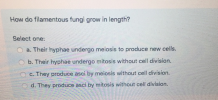 How do filamentous fungi grow in length? Select one: O a. Their hyphae undergo meiosis to produce new cells. b. Their hyphae undergo mitosis without cell division. c. They produce asci by meiosis without cell division. d. They produce asci by mitosis without cell division.
1. Explain the basic fungi life-cycle, and the different types of reproductive structures seen. How do...
1. Explain the basic fungi life-cycle, and the different types of reproductive structures seen. How do these reproductive structures divide the groups up into different phyla within Kingdom Fungi?
 please help
ways in which fungi are different than bacteria? (Prokaryotic vs. eukaryotic DOESN'T about reproduction, nutrients, environmental conditions they can grow it, etc.) b) Why are 16. a) Explain two COUNT .Think nfections often harder to treat than bacterial infections? (Think about how similar human cells are to fungi and bacteria and how this determines possible treatments.) bacteria is uniellular is muth cellular.
please help
ways in which fungi are different than bacteria? (Prokaryotic vs. eukaryotic DOESN'T about reproduction, nutrients, environmental conditions they can grow it, etc.) b) Why are 16. a) Explain two COUNT .Think nfections often harder to treat than bacterial infections? (Think about how similar human cells are to fungi and bacteria and how this determines possible treatments.) bacteria is uniellular is muth cellular.
 What are the factors influencing the fluidity and phase transition temperature of a membrane? How is the Ras protein anchored to the cell membrane? How lipid molecules influence membrane curvature formation? Which lipid molecules give preference to formation of different curvatures on membrane? Why facilitated transport across membrane is a saturable process? How do small hydrophobic molecules cross a membrane? Which lipids form/maintain the liquid-ordered raft structures in the cell membrane? How does the pancreatic lipase cleave triglycerides? How do...
 How do filamentous fungi grow in length? Select one: O a. Their hyphae undergo meiosis to produce new cells. b. Their hyphae undergo mitosis without cell division. c. They produce asci by meiosis without cell division. d. They produce asci by mitosis without cell division.
Most questions answered within 3 hours.
-
Where is the error in this code sequence?
String s1 = "Hello";
String s2 = "ello";...
asked 11 months ago -
Financial data for Joel de Paris, Inc., for last year
follow:
Joel de Paris, Inc.
Balance...
asked 11 months ago -
Consider this reaction:
Al2(SO4)3 (aq)+ BaCl3
(aq) Al2Cl6 (aq)- +
3BaSO4(s) . What is the...
asked 11 months ago -
Suppose that Savneet is considering increasing her
recent random sample from 20 car rentals to 40...
asked 11 months ago -
Trucks arrive at an unloading terminal at an average rate of 120
per hour.
Trucks arrive...
asked 11 months ago -
Why are methanol and ethanol completely soluble in water while
octanol is not very little soluble....
asked 11 months ago -
A facilities manager at a university reads in a research report
that the mean amount of...
asked 11 months ago -
When the CuSO4 is rehydrated by adding water to the anhydrous
compound, is this an endothermic...
asked 11 months ago -
A ray of sunlight is passing from diamond into crown glass; the
angle of incidence is...
asked 11 months ago -
A block of mass 0.249 kg is placed on top of a light, vertical
spring of...
asked 11 months ago -
how do the kidneys compensate in the presences of acidosis
a) trigger hyperventilate
b) reserve acid...
asked 11 months ago -
Question 501 pts
The rental rate of capital to the firm increases. Which of the
following...
asked 11 months ago