Streptococcus bacteria can grow in the presence of oxygen, but they do not make catalase. Explain how...
Streptococcus bacteria can grow in the presence of oxygen, but they do not make catalase. Explain how this can be.
Homework Answers
Vigorous and anaerobic conditions can be found in various specialties all through nature, including various locales inside and on the human body.
Microorganisms shift in their necessities for sub-atomic oxygen. Commit aerobes rely upon high-impact breath and use oxygen as a terminal electron acceptor. They can't develop without oxygen.
Commit anaerobes can't develop within the sight of oxygen. They rely upon aging and anaerobic breath utilizing the last electron acceptor other than oxygen.
Facultative anaerobes show better development within the sight of oxygen yet will likewise develop without it.
Despite the fact that aerotolerant anaerobes don't perform vigorous breath, they can develop within the sight of oxygen. Most aerotolerant anaerobes test negative for the chemical catalase.
Microaerophiles need oxygen to develop, yet at a lower fixation than 21% oxygen in the air.
Ideal oxygen focus for a living being is the oxygen level that advances the quickest development rate. The base lenient oxygen focus and the greatest tolerant oxygen fixation are, individually, the most minimal and the most noteworthy oxygen levels that the life form will endure.
Peroxidase, superoxide dismutase, and catalase are the principle compounds engaged with the detoxification of the receptive oxygen species. Superoxide dismutase is generally present in a cell that can endure oxygen. Every one of the three proteins is normally discernible in cells that perform oxygen-consuming breath and produce more ROS.
A capnophile is a living being that requires a higher than barometrical convergence of CO2 to develop.
Add Answer to:
Streptococcus bacteria can grow in the presence
of oxygen, but they do not make catalase. Explain how...
4) Which of the bacteria grew well in 6.5% NaCl? Which bacteria did not grow well...
4) Which of the bacteria grew well in 6.5% NaCl? Which bacteria did not grow well in 6.5% NaCl? Based on your knowledge of the normal microflora, do these results make sense? Why or why not? The bacterias that grew well in 6.5% NaCl were the Staph bacteria (Staphylococcus aureus, Staphylococcus epidermidis, and Staphylococcus saprophyticus), Micrococcus luteus, and Enterococcus faebalis. The bacterias that did not grow well in 6.5% NaCl were Streptococcus pyogenes and Streptococcus pneumoniae.
5. You have a bacteria that grows only the presence of oxygen, but you do not...
 5. You have a bacteria that grows only the presence of oxygen, but you do not know if it is motile or not. What would you do to conclusively test for motility? A. Hanging drop B. Semi-solid motility agar C. Can use either of them D. Neither of them will
catalase test EXPERIMENT 30 LAB REPORT OBSERVATIONS AND RESULTS Record your observations in the following chart....
 catalase test
EXPERIMENT 30 LAB REPORT OBSERVATIONS AND RESULTS Record your observations in the following chart. Bacteria Foaming or No Foaming Catalase Present Absent M. luteus S. aureus S. lactis 1. Review Questions: 1. Explain why the enzyme catalase is essential for the survival of many aerobic and facultative anaerobic organisms? 2. Explain how catalase negative bacteria are capable of growing in the presence of oxygen Experiment 30 Catalase Test 273 3. Can bacterial cultures grown on blood agar be...
catalase test
EXPERIMENT 30 LAB REPORT OBSERVATIONS AND RESULTS Record your observations in the following chart. Bacteria Foaming or No Foaming Catalase Present Absent M. luteus S. aureus S. lactis 1. Review Questions: 1. Explain why the enzyme catalase is essential for the survival of many aerobic and facultative anaerobic organisms? 2. Explain how catalase negative bacteria are capable of growing in the presence of oxygen Experiment 30 Catalase Test 273 3. Can bacterial cultures grown on blood agar be...
Explain why organisms that can survive and/or grow under aerobic conditions need the enzymes catalase and...
Explain why organisms that can survive and/or grow under aerobic conditions need the enzymes catalase and superoxide dismutase.
How do the bacteria and fungi which can grow at different temperature adapt to changes in...
How do the bacteria and fungi which can grow at different temperature adapt to changes in membrane fluidity?
How to determine which bacteria was growing on this Mitis salivarius agar plate? Streptococcus salicarius, streptococcus...
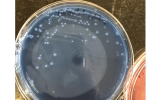 How to determine which bacteria was growing on this Mitis
salivarius agar plate? Streptococcus salicarius, streptococcus
mitis, streptococcus mutans, or enterococcus.
How to determine which bacteria was growing on this Mitis
salivarius agar plate? Streptococcus salicarius, streptococcus
mitis, streptococcus mutans, or enterococcus.
1. Descri be the process of a bacterial transformation. Explain how scientists can make bacteria take...
 1. Descri be the process of a bacterial transformation. Explain how scientists can make bacteria take up DNA in a laboratory setting. (15 pts.) 2. Genetic transformations are not limited to bacteria. There are real-world applications where scientists have taken genes from one organism and inserted them into another organism. Give an example of how a genetically modified organism (can be any organ- ism, you are not limited to bacteria) have been used to solve real-world issues. Describe the organisms...
How do the presence & arrangement of flagella help in identifying the bacteria?
 How do the presence & arrangement of flagella help in identifying the bacteria?
Which groups of bacteria produce catalase & SOD? Why is it necessary to do so?
Which groups of bacteria produce catalase & SOD? Why is it necessary to do so?
Some bacteria such as Streptococcus have evolved enzymes to break clots so they can then attack...
Some bacteria such as Streptococcus have evolved enzymes to break clots so they can then attack the host. This disables the walling-off component of the general inflammatory response. Other functions of inflammation include which of the following : 1) increased metabolic rate of cells 2) dilution of harmful substances 3) bring in oxygen & nutrients 4) resistance to digestion by macrophages
 5. You have a bacteria that grows only the presence of oxygen, but you do not know if it is motile or not. What would you do to conclusively test for motility? A. Hanging drop B. Semi-solid motility agar C. Can use either of them D. Neither of them will
 catalase test
EXPERIMENT 30 LAB REPORT OBSERVATIONS AND RESULTS Record your observations in the following chart. Bacteria Foaming or No Foaming Catalase Present Absent M. luteus S. aureus S. lactis 1. Review Questions: 1. Explain why the enzyme catalase is essential for the survival of many aerobic and facultative anaerobic organisms? 2. Explain how catalase negative bacteria are capable of growing in the presence of oxygen Experiment 30 Catalase Test 273 3. Can bacterial cultures grown on blood agar be...
catalase test
EXPERIMENT 30 LAB REPORT OBSERVATIONS AND RESULTS Record your observations in the following chart. Bacteria Foaming or No Foaming Catalase Present Absent M. luteus S. aureus S. lactis 1. Review Questions: 1. Explain why the enzyme catalase is essential for the survival of many aerobic and facultative anaerobic organisms? 2. Explain how catalase negative bacteria are capable of growing in the presence of oxygen Experiment 30 Catalase Test 273 3. Can bacterial cultures grown on blood agar be...
 How to determine which bacteria was growing on this Mitis
salivarius agar plate? Streptococcus salicarius, streptococcus
mitis, streptococcus mutans, or enterococcus.
How to determine which bacteria was growing on this Mitis
salivarius agar plate? Streptococcus salicarius, streptococcus
mitis, streptococcus mutans, or enterococcus.
 1. Descri be the process of a bacterial transformation. Explain how scientists can make bacteria take up DNA in a laboratory setting. (15 pts.) 2. Genetic transformations are not limited to bacteria. There are real-world applications where scientists have taken genes from one organism and inserted them into another organism. Give an example of how a genetically modified organism (can be any organ- ism, you are not limited to bacteria) have been used to solve real-world issues. Describe the organisms...
 How do the presence & arrangement of flagella help in identifying the bacteria?
Most questions answered within 3 hours.
-
Where is the error in this code sequence?
String s1 = "Hello";
String s2 = "ello";...
asked 10 months ago -
Financial data for Joel de Paris, Inc., for last year
follow:
Joel de Paris, Inc.
Balance...
asked 10 months ago -
Consider this reaction:
Al2(SO4)3 (aq)+ BaCl3
(aq) Al2Cl6 (aq)- +
3BaSO4(s) . What is the...
asked 10 months ago -
Suppose that Savneet is considering increasing her
recent random sample from 20 car rentals to 40...
asked 10 months ago -
Trucks arrive at an unloading terminal at an average rate of 120
per hour.
Trucks arrive...
asked 10 months ago -
Why are methanol and ethanol completely soluble in water while
octanol is not very little soluble....
asked 10 months ago -
A facilities manager at a university reads in a research report
that the mean amount of...
asked 10 months ago -
When the CuSO4 is rehydrated by adding water to the anhydrous
compound, is this an endothermic...
asked 10 months ago -
A ray of sunlight is passing from diamond into crown glass; the
angle of incidence is...
asked 10 months ago -
A block of mass 0.249 kg is placed on top of a light, vertical
spring of...
asked 10 months ago -
how do the kidneys compensate in the presences of acidosis
a) trigger hyperventilate
b) reserve acid...
asked 10 months ago -
Question 501 pts
The rental rate of capital to the firm increases. Which of the
following...
asked 10 months ago