Many biomolecules contain the same atoms bonded to the same atoms so they have the same...
Many biomolecules contain the same atoms bonded to the same atoms so they have the same molecular formula. Enantiomers are isomers of this type that are mirror images of each other and cannot be superimposed on each other. All properties of enantiorners are identical except they rotate the plane of polarized light in opposite directions and
a. they react differently with non-chiral compounds
b. they have different specific gravities
c. an enzyme that binds one of the enantiomers won't be able to bind with the other
d. one will usually dissolve in water wile the other will not
e. they have different molecular weights because of slightly different isotopes they contain
Homework Answers
Answer : Option(c) is correct
Explanation: Enantiomers are the isomers which have same chemical formula but they form non super imposable mirror image to each other. As we know that enzymes are always specific to the site (Steriospecific) where they attach to show the reaction . Due to the two different forms the enzyme specifically can not bind to the same position on the both enantiomers. so an enzyme that binds one of the enantiomers won't be able to bind with the other .
Add Answer to:
Many biomolecules contain the same atoms bonded to the same
atoms so they have the same...
Astillman.Instructure.com Terms: Molecular formula Conformational isomers Double bond isomers Ether Alcohol Stereoisomers Geometric isomers Enantiomers Diastereomers...
 Astillman.Instructure.com Terms: Molecular formula Conformational isomers Double bond isomers Ether Alcohol Stereoisomers Geometric isomers Enantiomers Diastereomers Stereoisomers A compound with an oxygen bonded between two alkyl (or aromatic) groups. [Choose Stereoisomers that differ in their cis-trans arrangement on a double bond or on a ring. [Choose <> The number of atoms of each element in one molecule of a compound. [Choose + Stereoisomers that are not mirror images. [Choose [Choose Isomers whose atoms are connected differently, they differ in their...
Geometric Geometric Geometric 23. Organic molecules which are optically active and they are mirror images to...
 Geometric Geometric Geometric 23. Organic molecules which are optically active and they are mirror images to each other are called....... Enantiomers. a. Chain isomers. d. Geometrical isomers c. Diastereoisomers. 24. The organic molecule that rotates the plane-polarized light to left is called a. Dextrorotatory b. Functional isomers c. Positional isomers d. levorotatory 25. The organic molecule that rotates the plane-polarized light to right is called a. Dextrorotatory b. Functional isomers c. Positional isomers d. levorotatory 26. Chiral molecules are organic...
A. Enantiomers: Certain substances have the unique property of rotating the plane of plane-polarized light. Such...
 A. Enantiomers: Certain substances have the unique property of rotating the plane of plane-polarized light. Such light rotation is detectable with the aid of a polarimeter. In order for a molecule to be optically active it must be chiral. Chiral objects lack a plane of symmetry and are non-superimposable on their mirror images. A sp?- hybridized carbon atom can fulfill these requirements if all four of its substituents are different. 1. Methane a) Prepare a methane molecule and then substitute...
Match the following definitions with the correct type of isomer. : Two or more coordiantion compounds...
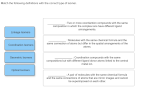 Match the following definitions with the correct type of isomer. : Two or more coordiantion compounds with the same composition in which the complex ions have different ligand arrrangements. Linkage Isomers Coordination Isomers : Molecules with the same chemical formula and the same connection of atoms but differ in the spatial arrangements of the atoms. Geometric Isomers : Coordination compounds with the same compositions but with different ligand donor atoms linked to the central metal ion. Optical Isomers : A...
: 2013 Complete the following by illing in the blanks have different Have same a) Molecular...
 : 2013 Complete the following by illing in the blanks have different Have same a) Molecular Shape may be due to e) Isomers c) d) have different have g) Mirror Images
3. Cyclic compounds The presence of the ring in all but very large ring cyclic molecules...
 3. Cyclic compounds The presence of the ring in all but very large ring cyclic molecules prevents full rotation of the ring atoms. For this reason, stereoisomerism may also occur in cyclic molecules. a) Prepare a model of cyclohexane, C6H12. Draw the condensed formula. b) Build a model of methylcyclohexane (C7H14) by replacing one of the hydrogens of cyclohexane with a methyl group. Draw the skeletal formula for methylcyclohexane. 2 c) How many different isomers exist for methylcyclohexane (CyH34)? d)...
For the following question(s) MATCH each definition to a term from the list below. Place the...
 For the following question(s) MATCH each definition to a term from the list below. Place the letter of the term in the blank to the left of the definition. a. racemates b. chirality center c. chirality d. diastereomers e. enantiomers f. meso compounds g. optically active h. prochirality center i. optically inactive j. achiral ____ describes organic molecules which rotate plane-polarized light. ___ is the property of "handedness": the property of an object that causes it to be nonsuperimposable on...
Organic molecules have the same molecular formula but differ in the arrangement of atoms or groups...
 Organic molecules have the same molecular formula but differ in the arrangement of atoms or groups in space and rotate the plane-polarized light to right or left are called Geometrical isomers b. Optical isomers Constitutionalisomers d. Inorganic molecules 30. Organic molecules have the same molecular formula but differ in the arrangement of atoms or groups in space are called............... a Geometrical isomers b. Optical isomers c. Constitutional isomers d. Inorganic molecules 31. What is the relationship between the following two...
Week 10- Constitutional isomers Constitutional isomers have the same molecular formula, but their atoms are bonded...
 Week 10- Constitutional isomers Constitutional isomers have the same molecular formula, but their atoms are bonded in different orders. These may be further distinguished as chain isomers, which differ only in hydrocarbon chain structure, positional isomers, which differ in the location of a functional group, and functional group isomers which differ in the nature of their functional groups. Typically chain and position isomers show only modest differences in their physical and chemical properties, while functional group isomers differ greatly from...
19-26 thanks! 19-29* PART 3: 2,3-BUTANEDIOL CH-CH(OH)-CH(OH)-CH, mirror images, not superimposable Build as many models of...
 19-26 thanks!
19-29*
PART 3: 2,3-BUTANEDIOL CH-CH(OH)-CH(OH)-CH, mirror images, not superimposable Build as many models of 2,3-butanediol as you can. First, attach two carbons with a single bond. To each carbon add one carbon, one hydrogen, and one oxygen. To complete the structure, Ti the remaining hydrogen atoms. Remember, a model is not different if it is completely superimposable on one already constructed! 13. How many stereochemically different models are possible for 2,3-butanediol? 14. What characteristic does one of these...
19-26 thanks!
19-29*
PART 3: 2,3-BUTANEDIOL CH-CH(OH)-CH(OH)-CH, mirror images, not superimposable Build as many models of 2,3-butanediol as you can. First, attach two carbons with a single bond. To each carbon add one carbon, one hydrogen, and one oxygen. To complete the structure, Ti the remaining hydrogen atoms. Remember, a model is not different if it is completely superimposable on one already constructed! 13. How many stereochemically different models are possible for 2,3-butanediol? 14. What characteristic does one of these...
 Astillman.Instructure.com Terms: Molecular formula Conformational isomers Double bond isomers Ether Alcohol Stereoisomers Geometric isomers Enantiomers Diastereomers Stereoisomers A compound with an oxygen bonded between two alkyl (or aromatic) groups. [Choose Stereoisomers that differ in their cis-trans arrangement on a double bond or on a ring. [Choose <> The number of atoms of each element in one molecule of a compound. [Choose + Stereoisomers that are not mirror images. [Choose [Choose Isomers whose atoms are connected differently, they differ in their...
 Geometric Geometric Geometric 23. Organic molecules which are optically active and they are mirror images to each other are called....... Enantiomers. a. Chain isomers. d. Geometrical isomers c. Diastereoisomers. 24. The organic molecule that rotates the plane-polarized light to left is called a. Dextrorotatory b. Functional isomers c. Positional isomers d. levorotatory 25. The organic molecule that rotates the plane-polarized light to right is called a. Dextrorotatory b. Functional isomers c. Positional isomers d. levorotatory 26. Chiral molecules are organic...
 A. Enantiomers: Certain substances have the unique property of rotating the plane of plane-polarized light. Such light rotation is detectable with the aid of a polarimeter. In order for a molecule to be optically active it must be chiral. Chiral objects lack a plane of symmetry and are non-superimposable on their mirror images. A sp?- hybridized carbon atom can fulfill these requirements if all four of its substituents are different. 1. Methane a) Prepare a methane molecule and then substitute...
 Match the following definitions with the correct type of isomer. : Two or more coordiantion compounds with the same composition in which the complex ions have different ligand arrrangements. Linkage Isomers Coordination Isomers : Molecules with the same chemical formula and the same connection of atoms but differ in the spatial arrangements of the atoms. Geometric Isomers : Coordination compounds with the same compositions but with different ligand donor atoms linked to the central metal ion. Optical Isomers : A...
 : 2013 Complete the following by illing in the blanks have different Have same a) Molecular Shape may be due to e) Isomers c) d) have different have g) Mirror Images
 3. Cyclic compounds The presence of the ring in all but very large ring cyclic molecules prevents full rotation of the ring atoms. For this reason, stereoisomerism may also occur in cyclic molecules. a) Prepare a model of cyclohexane, C6H12. Draw the condensed formula. b) Build a model of methylcyclohexane (C7H14) by replacing one of the hydrogens of cyclohexane with a methyl group. Draw the skeletal formula for methylcyclohexane. 2 c) How many different isomers exist for methylcyclohexane (CyH34)? d)...
 For the following question(s) MATCH each definition to a term from the list below. Place the letter of the term in the blank to the left of the definition. a. racemates b. chirality center c. chirality d. diastereomers e. enantiomers f. meso compounds g. optically active h. prochirality center i. optically inactive j. achiral ____ describes organic molecules which rotate plane-polarized light. ___ is the property of "handedness": the property of an object that causes it to be nonsuperimposable on...
 Organic molecules have the same molecular formula but differ in the arrangement of atoms or groups in space and rotate the plane-polarized light to right or left are called Geometrical isomers b. Optical isomers Constitutionalisomers d. Inorganic molecules 30. Organic molecules have the same molecular formula but differ in the arrangement of atoms or groups in space are called............... a Geometrical isomers b. Optical isomers c. Constitutional isomers d. Inorganic molecules 31. What is the relationship between the following two...
 Week 10- Constitutional isomers Constitutional isomers have the same molecular formula, but their atoms are bonded in different orders. These may be further distinguished as chain isomers, which differ only in hydrocarbon chain structure, positional isomers, which differ in the location of a functional group, and functional group isomers which differ in the nature of their functional groups. Typically chain and position isomers show only modest differences in their physical and chemical properties, while functional group isomers differ greatly from...
 19-26 thanks!
19-29*
PART 3: 2,3-BUTANEDIOL CH-CH(OH)-CH(OH)-CH, mirror images, not superimposable Build as many models of 2,3-butanediol as you can. First, attach two carbons with a single bond. To each carbon add one carbon, one hydrogen, and one oxygen. To complete the structure, Ti the remaining hydrogen atoms. Remember, a model is not different if it is completely superimposable on one already constructed! 13. How many stereochemically different models are possible for 2,3-butanediol? 14. What characteristic does one of these...
19-26 thanks!
19-29*
PART 3: 2,3-BUTANEDIOL CH-CH(OH)-CH(OH)-CH, mirror images, not superimposable Build as many models of 2,3-butanediol as you can. First, attach two carbons with a single bond. To each carbon add one carbon, one hydrogen, and one oxygen. To complete the structure, Ti the remaining hydrogen atoms. Remember, a model is not different if it is completely superimposable on one already constructed! 13. How many stereochemically different models are possible for 2,3-butanediol? 14. What characteristic does one of these...
Most questions answered within 3 hours.
-
Where is the error in this code sequence?
String s1 = "Hello";
String s2 = "ello";...
asked 10 months ago -
Financial data for Joel de Paris, Inc., for last year
follow:
Joel de Paris, Inc.
Balance...
asked 10 months ago -
Consider this reaction:
Al2(SO4)3 (aq)+ BaCl3
(aq) Al2Cl6 (aq)- +
3BaSO4(s) . What is the...
asked 10 months ago -
Suppose that Savneet is considering increasing her
recent random sample from 20 car rentals to 40...
asked 10 months ago -
Trucks arrive at an unloading terminal at an average rate of 120
per hour.
Trucks arrive...
asked 10 months ago -
Why are methanol and ethanol completely soluble in water while
octanol is not very little soluble....
asked 10 months ago -
A facilities manager at a university reads in a research report
that the mean amount of...
asked 10 months ago -
When the CuSO4 is rehydrated by adding water to the anhydrous
compound, is this an endothermic...
asked 10 months ago -
A ray of sunlight is passing from diamond into crown glass; the
angle of incidence is...
asked 10 months ago -
A block of mass 0.249 kg is placed on top of a light, vertical
spring of...
asked 10 months ago -
how do the kidneys compensate in the presences of acidosis
a) trigger hyperventilate
b) reserve acid...
asked 10 months ago -
Question 501 pts
The rental rate of capital to the firm increases. Which of the
following...
asked 10 months ago