1. Does the feeding interaction differ between rotifers and the two yeast strains? 2. How long...
1. Does the feeding interaction differ between rotifers and the two yeast strains?
2. How long does it take rotifers to fill their stomachs?
Homework Answers
1.Rotifers are not isolated from S-strains generally but are smaller than common S-strains.The S-and L-morphophytes differ in their optimal growth temperature.Rotifers feed on baker's yeast are generally larger than those fed on live algae.
Rotifers eat organic detritus, dead bacteria,, algae and protozoan.They eat particles upto 10micrometer in size.
Two yeast strains can from a stable cross feeding mutualism in a range of nutrient concentration. Probiotic yeast gives a useful nutritional strategy which allows increasing diet digestibility and enhance the performance in ruminants consequently.
2)Rotifers have a fluid filled body cavity. It contains a loose syncytium of amoeboid cell. It will take almost 15 to 30 minutes for the stomach and intestinal lumina .It fills with red cells.
As an AI language model, I don't have access to specific experimental data or real-time information. Therefore, I cannot directly answer questions about specific interactions between rotifers and yeast strains in real-world scenarios or provide specific time frames for their feeding behavior.
However, I can provide some general information based on common knowledge about rotifers and yeast interactions:
Feeding Interaction between Rotifers and Yeast Strains: Rotifers are microscopic aquatic organisms that are filter feeders, meaning they feed on small particles suspended in the water, including algae, bacteria, and yeast. The feeding interaction between rotifers and yeast strains would depend on the specific species of rotifers and yeast involved, as well as the availability and size of yeast cells in the water.
Some rotifer species may consume yeast as part of their diet, while others may have a preference for different types of food. Additionally, the feeding behavior of rotifers can be influenced by environmental factors such as temperature, nutrient availability, and population density.
To determine if there is a difference in feeding interactions between rotifers and the two yeast strains, specific experiments or observations would need to be conducted under controlled conditions.
Time Taken by Rotifers to Fill Their Stomachs: The time it takes for rotifers to fill their stomachs can vary depending on several factors, including the species of rotifer, the type and abundance of food available, and the individual size and physiological condition of the rotifers.
Rotifers are known for their rapid feeding and reproductive rates, and they can consume a significant amount of food relative to their body size. Some rotifer species have been observed to fill their stomachs within minutes to hours after being exposed to food particles.
The time taken for rotifers to fill their stomachs can be influenced by the concentration of food in the environment, the presence of other competing organisms, and the reproductive stage of the rotifers.
Again, to obtain specific and accurate information about the time it takes for rotifers to fill their stomachs, experimental studies and observations on particular rotifer species would be required.
Add Answer to:
1. Does the feeding interaction differ between rotifers and the
two yeast strains?
2. How long...
4. Explain how the genes that control galactose metabolism in yeast are regulated in yeast. How does it differ from the regulation of the lac operon in bacteria? please be detailed in your answer
4. Explain how the genes that control galactose metabolism in yeast are regulated in yeast. How does it differ from the regulation of the lac operon in bacteria? please be detailed in your answer
please help with part A and B. 2. A yeast geneticist isolates two different haploid mutant...
 please help with part A and B.
2. A yeast geneticist isolates two different haploid mutant yeast strains, Strain A and Strain B, which cannot grow unless the amino acid leucine is added to the growth media. Wild-type yeast strains can make their own leucine and do not require that it be added to the growth media. The geneticist discovers that each mutant yeast strain contains a single recessive mutation that leads to the observed leucine-requiring phenotype. When she crosses...
please help with part A and B.
2. A yeast geneticist isolates two different haploid mutant yeast strains, Strain A and Strain B, which cannot grow unless the amino acid leucine is added to the growth media. Wild-type yeast strains can make their own leucine and do not require that it be added to the growth media. The geneticist discovers that each mutant yeast strain contains a single recessive mutation that leads to the observed leucine-requiring phenotype. When she crosses...
Two strains of yeast were mated and formed asci, each with four spores. The spores in...
Two strains of yeast were mated and formed asci, each with four spores. The spores in each ascus were genotyped at two genes and the following types of asci were identified: Type 1 (AB AB ab ab) Type 2 (AB Ab aB ab) Type 3 (Ab Ab aB aB). 300 asci were genotyped and the number of each type ascus was: # asci found: Type I 32 Type II 75 Type III 193 Are these genes linked? State your reasoning....
Genetics Yeast Lab The Awesome Power of Yeast Genetics Pre-lab questions Two weeks ago, you received...
 Genetics Yeast Lab
The Awesome Power of Yeast Genetics Pre-lab questions Two weeks ago, you received three unknown yeast strains. One was lys- (it cannot synthesize its own lysine) while the other two were LYS+. Because they were LYS+, they should be sensitive to high levels of aminoadipate (AA) before spontaneous and/or induced mutations occur that may allow some cells to become AA resistant. The two LYS+ strains differ in the rate at which they accumulate mutations. Two weeks ago,...
Genetics Yeast Lab
The Awesome Power of Yeast Genetics Pre-lab questions Two weeks ago, you received three unknown yeast strains. One was lys- (it cannot synthesize its own lysine) while the other two were LYS+. Because they were LYS+, they should be sensitive to high levels of aminoadipate (AA) before spontaneous and/or induced mutations occur that may allow some cells to become AA resistant. The two LYS+ strains differ in the rate at which they accumulate mutations. Two weeks ago,...
Type of interaction Interaction between species 1 and species 2 Effect on species 1 Effect on...
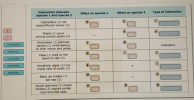 Type of interaction Interaction between species 1 and species 2 Effect on species 1 Effect on species 2 Caterpillars (1) eat passionflower leaves (2). Weeds (1) grow among tomato plants (2) Honeybees (1) pollinate daisies (2) while feeding on their nectar and pollen competaon mutualism herbivory Fleas (1) feed on the blood of cats (2). Unicellular algae (1) live inside cells of corals (2), parasitsm predation Black rat snakes (1) eat rats (2) House sparrows (1) house finches (2) require...
1. Describe the two yeast expression plasmids used to transform a strain of yeast. 2. How...
1. Describe the two yeast expression plasmids used to transform a strain of yeast. 2. How do the plasmid vectors (how do their expression products) lead to us knowing whether a known protein and unknown protein bind or interact? Questions on DNA Testing for Genetic Diseases Associated with Mutations: 3. What are the factors that lead to limits of detecting genetic diseases with DNA molecular testing? 4. What is the difference between information gathered by screening for a disease and...
Garcia Ch. 1 1. What is bilingual education? How does it differ from language education? 2....
 Garcia Ch. 1 1. What is bilingual education? How does it differ from language education? 2. Explain the difference between the bicycle and the all-terrain vehicle in thinking about bilingualism.
Garcia Ch. 1 1. What is bilingual education? How does it differ from language education? 2. Explain the difference between the bicycle and the all-terrain vehicle in thinking about bilingualism.
Garcia Ch. 1 1. What is bilingual education? How does it differ from language education? 2. Explain the difference between the bicycle and the all-terrain vehicle in thinking about bilingualism.
Two blocks differ in temperature by 8.0°C. By how much does their temperature differ in the...
Two blocks differ in temperature by 8.0°C. By how much does their temperature differ in the Kelvin scale?
How does the morphology and function of the pedipalps differ between scorpions and spiders?
How does the morphology and function of the pedipalps differ between scorpions and spiders?
Chapter 20 Yeast Breads Questions 1. What does kneading accomplish in yeast breads? 2. What is...
 Chapter 20 Yeast Breads Questions 1. What does kneading accomplish in yeast breads? 2. What is the purpose of the second rise in yeast breads? 3. What are the different types of yeast breads? 4. What is the difference in sourdough bread compared to yeast bread? 5. Describe the proper steps in yeast dough preparation
 please help with part A and B.
2. A yeast geneticist isolates two different haploid mutant yeast strains, Strain A and Strain B, which cannot grow unless the amino acid leucine is added to the growth media. Wild-type yeast strains can make their own leucine and do not require that it be added to the growth media. The geneticist discovers that each mutant yeast strain contains a single recessive mutation that leads to the observed leucine-requiring phenotype. When she crosses...
please help with part A and B.
2. A yeast geneticist isolates two different haploid mutant yeast strains, Strain A and Strain B, which cannot grow unless the amino acid leucine is added to the growth media. Wild-type yeast strains can make their own leucine and do not require that it be added to the growth media. The geneticist discovers that each mutant yeast strain contains a single recessive mutation that leads to the observed leucine-requiring phenotype. When she crosses...
 Genetics Yeast Lab
The Awesome Power of Yeast Genetics Pre-lab questions Two weeks ago, you received three unknown yeast strains. One was lys- (it cannot synthesize its own lysine) while the other two were LYS+. Because they were LYS+, they should be sensitive to high levels of aminoadipate (AA) before spontaneous and/or induced mutations occur that may allow some cells to become AA resistant. The two LYS+ strains differ in the rate at which they accumulate mutations. Two weeks ago,...
Genetics Yeast Lab
The Awesome Power of Yeast Genetics Pre-lab questions Two weeks ago, you received three unknown yeast strains. One was lys- (it cannot synthesize its own lysine) while the other two were LYS+. Because they were LYS+, they should be sensitive to high levels of aminoadipate (AA) before spontaneous and/or induced mutations occur that may allow some cells to become AA resistant. The two LYS+ strains differ in the rate at which they accumulate mutations. Two weeks ago,...
 Type of interaction Interaction between species 1 and species 2 Effect on species 1 Effect on species 2 Caterpillars (1) eat passionflower leaves (2). Weeds (1) grow among tomato plants (2) Honeybees (1) pollinate daisies (2) while feeding on their nectar and pollen competaon mutualism herbivory Fleas (1) feed on the blood of cats (2). Unicellular algae (1) live inside cells of corals (2), parasitsm predation Black rat snakes (1) eat rats (2) House sparrows (1) house finches (2) require...
 Garcia Ch. 1 1. What is bilingual education? How does it differ from language education? 2. Explain the difference between the bicycle and the all-terrain vehicle in thinking about bilingualism.
Garcia Ch. 1 1. What is bilingual education? How does it differ from language education? 2. Explain the difference between the bicycle and the all-terrain vehicle in thinking about bilingualism.
Garcia Ch. 1 1. What is bilingual education? How does it differ from language education? 2. Explain the difference between the bicycle and the all-terrain vehicle in thinking about bilingualism.
 Chapter 20 Yeast Breads Questions 1. What does kneading accomplish in yeast breads? 2. What is the purpose of the second rise in yeast breads? 3. What are the different types of yeast breads? 4. What is the difference in sourdough bread compared to yeast bread? 5. Describe the proper steps in yeast dough preparation
Most questions answered within 3 hours.
-
Where is the error in this code sequence?
String s1 = "Hello";
String s2 = "ello";...
asked 10 months ago -
Financial data for Joel de Paris, Inc., for last year
follow:
Joel de Paris, Inc.
Balance...
asked 10 months ago -
Consider this reaction:
Al2(SO4)3 (aq)+ BaCl3
(aq) Al2Cl6 (aq)- +
3BaSO4(s) . What is the...
asked 10 months ago -
Suppose that Savneet is considering increasing her
recent random sample from 20 car rentals to 40...
asked 10 months ago -
Trucks arrive at an unloading terminal at an average rate of 120
per hour.
Trucks arrive...
asked 10 months ago -
Why are methanol and ethanol completely soluble in water while
octanol is not very little soluble....
asked 10 months ago -
A facilities manager at a university reads in a research report
that the mean amount of...
asked 10 months ago -
When the CuSO4 is rehydrated by adding water to the anhydrous
compound, is this an endothermic...
asked 10 months ago -
A ray of sunlight is passing from diamond into crown glass; the
angle of incidence is...
asked 10 months ago -
A block of mass 0.249 kg is placed on top of a light, vertical
spring of...
asked 10 months ago -
how do the kidneys compensate in the presences of acidosis
a) trigger hyperventilate
b) reserve acid...
asked 10 months ago -
Question 501 pts
The rental rate of capital to the firm increases. Which of the
following...
asked 10 months ago