For the reduction of benzophenone to benzohydrol by NaBH4 1) Draw the reaction, showing the reactants...
For the reduction of benzophenone to benzohydrol by NaBH4
1) Draw the reaction, showing the reactants and products. • What apparatus and conditions (solvent, temp., reaction time, etc) will be used for the reaction? (we are using ethanol and Buchner funnel filtration)
• How will the benzhydrol product be isolated from the reaction mixture and how will it then be further purified?
How will the product be characterized?
• Identify which is the reducing agent and which is the oxidizing agent in the reaction of benzophenone with sodium borohydride and explain your reasoning, ie. show the changes in oxidation states (best to give a drawing as per the introduction)?
• give the mechanism of the reaction, indicate what bonds are broken/formed and draw arrows to show what happens to the electrons as bonds break and form.
Homework Answers


Add Answer to:
For the reduction of benzophenone to benzohydrol by NaBH4
1) Draw the reaction, showing the reactants...
Identify which is the reducing agent and which is the oxidizing agent in the reaction of...
Identify which is the reducing agent and which is the oxidizing agent in the reaction of benzophenone with sodium borohydride and explain your reasoning, ie. show the changes in oxidation states (best to give a drawing as per the introduction)? Identify which is the reducing agent and which is the oxidizing agent in the reaction of benzophenone with sodium borohydride and explain your reasoning, ie. show the changes in oxidation states (best to give a drawing)?
Give a balanced equation for the reaction that includes both the oxidizing agent (benzil) and reducing...
Give a balanced equation for the reaction that includes both the oxidizing agent (benzil) and reducing agent (NaBH4). In other words I do not want to see 4 R2C=O. Give a brief definition/explanation of reduction in terms of gain/loss of hydrogens, oxygen, and electrons. Sodium borohydride can be used in ethanol solutions to rapidly reduce aldehydes and ketones at room temperature. Even though lithium aluminum hydride (LiAlH4) is much more reactive than sodium borohydride (NaBH4) it can’t be used to reduce aldehydes...
18 Question (1 point) Draw the product that results from the following reaction. NaBH4 ethanol C)
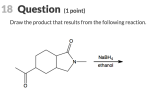 18 Question (1 point) Draw the product that results from the following reaction. NaBH4 ethanol C)
Sodium Borohydride Reduction of Benzoin Pre-Lab Worksheet (1) Why is it important to use 100% ethanol...
 Sodium Borohydride Reduction of Benzoin Pre-Lab
Worksheet
(1) Why is it important to use 100% ethanol for this reaction? 5, ethanol (absolute ethanol) rather than 95% of benzoin? ow would you expect the IR spectrum of the reduced product to differ from that 7. (2) How would you expect the 1H rom that of benzNMR spectrum of the reduced product to differ 8. (2) How many peaks do you expect in the 13C NMR spectrum of the product? Suppose you...
Sodium Borohydride Reduction of Benzoin Pre-Lab
Worksheet
(1) Why is it important to use 100% ethanol for this reaction? 5, ethanol (absolute ethanol) rather than 95% of benzoin? ow would you expect the IR spectrum of the reduced product to differ from that 7. (2) How would you expect the 1H rom that of benzNMR spectrum of the reduced product to differ 8. (2) How many peaks do you expect in the 13C NMR spectrum of the product? Suppose you...
1. Alcohol [1] is added to an aqueous solution of sulfuric acid, H,SO4. The solution was...
 1. Alcohol [1] is added to an aqueous solution of sulfuric acid, H,SO4. The solution was then heated. The product was purified to determine its structure. It was found that the product was alkene [2]. Draw the mechanism of the reaction. Show all steps with curved arrows that are necessary to form the product alkene [2]. OH H 0H H heat [2] [1] Consider the following reaction. A. Draw the mechanism of the reaction to predict ALL constitutional products. Show...
7. (4 pts) In the reaction of 1-chloro-l-phenylpropane with potassium 1-butoxide: a. Draw the arrows showing...
 7. (4 pts) In the reaction of 1-chloro-l-phenylpropane with potassium 1-butoxide: a. Draw the arrows showing the flow of electrons for all bonds broken and all bonds formed during the reaction. b. In the labeled boxes, provide the structures of the Organic Product (containing carbon) that are formed from each specified conformation of 1-chloro-1-phenylpropane. CH H3- CH -OH K сн. OH H3C-+CHE 1-chloro-1-phenylpropane CHE Organic Product A IH CH, HCCHE OH к OH H3CCHE CHE 1-chloro-1-phenylpropane Organic Product B
B. Determine the major product of part A. Explain. 2. Consider the following reaction. A. Draw...
 B. Determine the major product of part A. Explain.
2. Consider the following reaction. A. Draw the mechanism of the reaction to predict All constitutional products. Show all bonds being made and broken. Show all steps with curved arrows that are necessary to form the products. :B: H H.
B. Determine the major product of part A. Explain.
2. Consider the following reaction. A. Draw the mechanism of the reaction to predict All constitutional products. Show all bonds being made and broken. Show all steps with curved arrows that are necessary to form the products. :B: H H.
1. For each reaction below, draw the reaction mechanism for the rate determining step. On the...
 1. For each reaction below, draw the reaction mechanism for the rate determining step. On the starting structures, draw all appropriate arrows to indicate the flow of electrons. Fill in the box above the arrows with the reaction mechanism as SN1 or SN2. Draw the first key transition state and product(s). Use dotted lines to indicate bonds that are in the process of being broken or made. Write all formal charges. H H-02 + HC Transition State H3C H-OCH, +...
1. For each reaction below, draw the reaction mechanism for the rate determining step. On the...
 1. For each reaction below, draw the reaction mechanism for the rate determining step. On the starting structures, draw all appropriate arrows to indicate the flow of electrons. Fill in the box above the arrows with the reaction mechanism as SN1 or SN2. Draw the first key transition state and product(s). Use dotted lines to indicate bonds that are in the process of being broken or made. Write all formal charges н H- Н,с Transition State Нас н— осн, Нас...
1. For each reaction below, draw the reaction mechanism for the rate determining step. On the...
 1. For each reaction below, draw the reaction mechanism for the rate determining step. On the starting structures, draw all appropriate arrows to indicate the flow of electrons. Fill in the box above the arrows with the reaction mechanism as SN1 or SN2. Draw the first key transition state and product(s). Use dotted lines to indicate bonds that are in the process of being broken or made. Write all formal charges. *- _ - нс" Transition State HAC CHS H-OCH,...
 18 Question (1 point) Draw the product that results from the following reaction. NaBH4 ethanol C)
 Sodium Borohydride Reduction of Benzoin Pre-Lab
Worksheet
(1) Why is it important to use 100% ethanol for this reaction? 5, ethanol (absolute ethanol) rather than 95% of benzoin? ow would you expect the IR spectrum of the reduced product to differ from that 7. (2) How would you expect the 1H rom that of benzNMR spectrum of the reduced product to differ 8. (2) How many peaks do you expect in the 13C NMR spectrum of the product? Suppose you...
Sodium Borohydride Reduction of Benzoin Pre-Lab
Worksheet
(1) Why is it important to use 100% ethanol for this reaction? 5, ethanol (absolute ethanol) rather than 95% of benzoin? ow would you expect the IR spectrum of the reduced product to differ from that 7. (2) How would you expect the 1H rom that of benzNMR spectrum of the reduced product to differ 8. (2) How many peaks do you expect in the 13C NMR spectrum of the product? Suppose you...
 1. Alcohol [1] is added to an aqueous solution of sulfuric acid, H,SO4. The solution was then heated. The product was purified to determine its structure. It was found that the product was alkene [2]. Draw the mechanism of the reaction. Show all steps with curved arrows that are necessary to form the product alkene [2]. OH H 0H H heat [2] [1] Consider the following reaction. A. Draw the mechanism of the reaction to predict ALL constitutional products. Show...
 7. (4 pts) In the reaction of 1-chloro-l-phenylpropane with potassium 1-butoxide: a. Draw the arrows showing the flow of electrons for all bonds broken and all bonds formed during the reaction. b. In the labeled boxes, provide the structures of the Organic Product (containing carbon) that are formed from each specified conformation of 1-chloro-1-phenylpropane. CH H3- CH -OH K сн. OH H3C-+CHE 1-chloro-1-phenylpropane CHE Organic Product A IH CH, HCCHE OH к OH H3CCHE CHE 1-chloro-1-phenylpropane Organic Product B
 B. Determine the major product of part A. Explain.
2. Consider the following reaction. A. Draw the mechanism of the reaction to predict All constitutional products. Show all bonds being made and broken. Show all steps with curved arrows that are necessary to form the products. :B: H H.
B. Determine the major product of part A. Explain.
2. Consider the following reaction. A. Draw the mechanism of the reaction to predict All constitutional products. Show all bonds being made and broken. Show all steps with curved arrows that are necessary to form the products. :B: H H.
 1. For each reaction below, draw the reaction mechanism for the rate determining step. On the starting structures, draw all appropriate arrows to indicate the flow of electrons. Fill in the box above the arrows with the reaction mechanism as SN1 or SN2. Draw the first key transition state and product(s). Use dotted lines to indicate bonds that are in the process of being broken or made. Write all formal charges. H H-02 + HC Transition State H3C H-OCH, +...
 1. For each reaction below, draw the reaction mechanism for the rate determining step. On the starting structures, draw all appropriate arrows to indicate the flow of electrons. Fill in the box above the arrows with the reaction mechanism as SN1 or SN2. Draw the first key transition state and product(s). Use dotted lines to indicate bonds that are in the process of being broken or made. Write all formal charges н H- Н,с Transition State Нас н— осн, Нас...
 1. For each reaction below, draw the reaction mechanism for the rate determining step. On the starting structures, draw all appropriate arrows to indicate the flow of electrons. Fill in the box above the arrows with the reaction mechanism as SN1 or SN2. Draw the first key transition state and product(s). Use dotted lines to indicate bonds that are in the process of being broken or made. Write all formal charges. *- _ - нс" Transition State HAC CHS H-OCH,...
Most questions answered within 3 hours.
-
Where is the error in this code sequence?
String s1 = "Hello";
String s2 = "ello";...
asked 11 months ago -
Financial data for Joel de Paris, Inc., for last year
follow:
Joel de Paris, Inc.
Balance...
asked 11 months ago -
Consider this reaction:
Al2(SO4)3 (aq)+ BaCl3
(aq) Al2Cl6 (aq)- +
3BaSO4(s) . What is the...
asked 11 months ago -
Suppose that Savneet is considering increasing her
recent random sample from 20 car rentals to 40...
asked 11 months ago -
Trucks arrive at an unloading terminal at an average rate of 120
per hour.
Trucks arrive...
asked 11 months ago -
Why are methanol and ethanol completely soluble in water while
octanol is not very little soluble....
asked 11 months ago -
A facilities manager at a university reads in a research report
that the mean amount of...
asked 11 months ago -
When the CuSO4 is rehydrated by adding water to the anhydrous
compound, is this an endothermic...
asked 11 months ago -
A ray of sunlight is passing from diamond into crown glass; the
angle of incidence is...
asked 11 months ago -
A block of mass 0.249 kg is placed on top of a light, vertical
spring of...
asked 11 months ago -
how do the kidneys compensate in the presences of acidosis
a) trigger hyperventilate
b) reserve acid...
asked 11 months ago -
Question 501 pts
The rental rate of capital to the firm increases. Which of the
following...
asked 11 months ago