Which of the following terms are synonyms of each other? a. monophyletic group, clade, lineage b....
Which of the following terms are synonyms of each other?
a. monophyletic group, clade, lineage
b. allopatry, sympatry, synapomorphy
c. synapomorphy, apomorphy, monophyletic group
d. Monolithic group, clade, subspecies
Homework Answers
Answer- a. Monophyletic group, clade, lineage.
Explanation- Clade can deined as the phylogenetic relationship that represent all discendent comes from that ancestor. So, from clade we can determine the lineage. Monophyletic group also represents the discendent from the where they originate i.e. ancestor. So, they are synonymous.
Add Answer to:
Which of the following terms are synonyms of each other?
a. monophyletic group, clade, lineage
b....
Which of the following is a species? a. A monophyletic group of beetles who share a...
Which of the following is a species? a. A monophyletic group of beetles who share a common ancestor and can be distinguished from the most closely related group of beetles b. A group of birds who are interbreeding with each other but are reproductively isolated from other groups c. A metapopulation of salamanders who are linked by gene flow d. A lineage of microbes adapted to a particular ecological niche e. All of the above are considered species under at...
Based on this phylogenetic tree, answer the following questions: A: What is the sister group to...
 Based on this phylogenetic tree, answer the following questions: A: What is the sister group to Ephedra? _________ B: Which clade have the unique character (synapomorphy) 'vessels porose? ________ C. Are there any unresolved branches/polytomies in this tree? If so, mark it/them with a star. _________ D. What is the closest relative of Angiospermae (flowering plants)? ___________ E. Mark a groupings of terminals that would be paraphyletic with a circle. __________ D. Give a name of a group in the...
A) The two species, along with their most recent common ancestor, constitute a clade 8) One speties is the descendant of the other 1. whidh f the olowingscie are comidered evolutionary sister gro...
 A) The two species, along with their most recent common ancestor, constitute a clade 8) One speties is the descendant of the other 1. whidh f the olowingscie are comidered evolutionary sister groups? C) The two species can be considered more closely related to one another than either is to any other species g gees withac hr than either species does with D) They share more s a third species 2) They share at least one synapomorphy г which ofthe...
Which of the following are not a monophyletic group? Other options include angiosperms bryophytes ferns/horsetails and...
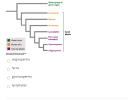 Which of the following are not a monophyletic group?
Other options include
angiosperms
bryophytes
ferns/horsetails and bryophytes
ferns/horsetails
gymnosperms
Please select all of them
Sister group of green algae Liverworts Mosses Hornworts Lycophytes Land plants Ferns and horsetails Green algae Bryophytes Gymnosperms Vascular plants Angiosperms Dirbour How LoneWres Sound MENNO angiosperms o ferns O gymnosperms olycophytes
Which of the following are not a monophyletic group?
Other options include
angiosperms
bryophytes
ferns/horsetails and bryophytes
ferns/horsetails
gymnosperms
Please select all of them
Sister group of green algae Liverworts Mosses Hornworts Lycophytes Land plants Ferns and horsetails Green algae Bryophytes Gymnosperms Vascular plants Angiosperms Dirbour How LoneWres Sound MENNO angiosperms o ferns O gymnosperms olycophytes
Root the above tree at Node A. Which of the following statements about this rooted tree...
 Root the above tree at Node A. Which of the following statements about this rooted tree are TRUE? A Taxa 1 and 2 form a monophyletic clade B. Taxa 4 and 5 form a monophyletic clade. C. Taxa 3, 1, and 2 form a monophyletic clade. D. A and B are both TRUE, but not C. E. A, B, and C are all TRUE.
Complete the following paragraph to describe the evolutionary lineage of reptiles. An ancestral reptile gave rise...
 Complete the following paragraph to describe the evolutionary lineage of reptiles. An ancestral reptile gave rise to the amniotes that include today's reptiles one opening The group is not a natural group because it is not monophyletic amphibian Its many lineages forma group because they do not share a single common ancestor no openings The amniotes are divided into three lineages, each with a different type of opening in the skull Turtles are examples of which have in the skull...
9. GenBank is a a. monophyletic group of organisms. b. replacement for the principle of parsimony....
9. GenBank is a a. monophyletic group of organisms. b. replacement for the principle of parsimony. c. proposed universal system to classify organisms. d. type of molecular clock. e. large database of genetic information.
Which of the following are not a monophyletic group? angiosperms ferns gymnosperms lycophytes bryophytes ferns/horsetails and...
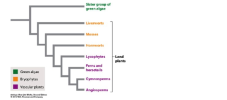 Which of the following are not a monophyletic group?
angiosperms
ferns
gymnosperms
lycophytes
bryophytes
ferns/horsetails and bryophytes
ferns/horsetails
Sister group of green algae Liverworts Mosses Hornworts Lycophytes Land plants Ferns and horsetails Green algae Bryophytes Gymnosperms Vascular plants Angiosperms De How We Seed Cation HO
Which of the following are not a monophyletic group?
angiosperms
ferns
gymnosperms
lycophytes
bryophytes
ferns/horsetails and bryophytes
ferns/horsetails
Sister group of green algae Liverworts Mosses Hornworts Lycophytes Land plants Ferns and horsetails Green algae Bryophytes Gymnosperms Vascular plants Angiosperms De How We Seed Cation HO
Which of the following is/ are true about archaea? A) They share histone and some other...
Which of the following is/ are true about archaea? A) They share histone and some other features with eukaryotes features that are absent in bacteria. B) They include only methanogens and species that live extremely hot or extremely salty habitats. C)They are currently accepted as a monophyletic group, sister to eukaryotes. D) They are prokaryotes and superficially resemble bacteria.
36. Which of these groups of taxa are not close-relatives? a. Diplomonads & Parabasalids c. Red...
 36. Which of these groups of taxa are not close-relatives? a. Diplomonads & Parabasalids c. Red algae & Green algae b. Spirochetes and Amoebas d. Apicomplexans & Ciliates 57. Which form a monophyletic group (clade)? a. Prokaryotes b. Green Algae c. Flagellates d. Ciliates 58. Which type of protozoans are not able to move (nonmotile)? a. apicomplexans b. ciliates c. flagellates d. amoebas 59. are protists formed by endosymbiosis between a heterotrophic eukaryote and a red algae. a. Rhizarians/Amoebozoans c....
 Based on this phylogenetic tree, answer the following questions: A: What is the sister group to Ephedra? _________ B: Which clade have the unique character (synapomorphy) 'vessels porose? ________ C. Are there any unresolved branches/polytomies in this tree? If so, mark it/them with a star. _________ D. What is the closest relative of Angiospermae (flowering plants)? ___________ E. Mark a groupings of terminals that would be paraphyletic with a circle. __________ D. Give a name of a group in the...
 A) The two species, along with their most recent common ancestor, constitute a clade 8) One speties is the descendant of the other 1. whidh f the olowingscie are comidered evolutionary sister groups? C) The two species can be considered more closely related to one another than either is to any other species g gees withac hr than either species does with D) They share more s a third species 2) They share at least one synapomorphy г which ofthe...
 Which of the following are not a monophyletic group?
Other options include
angiosperms
bryophytes
ferns/horsetails and bryophytes
ferns/horsetails
gymnosperms
Please select all of them
Sister group of green algae Liverworts Mosses Hornworts Lycophytes Land plants Ferns and horsetails Green algae Bryophytes Gymnosperms Vascular plants Angiosperms Dirbour How LoneWres Sound MENNO angiosperms o ferns O gymnosperms olycophytes
Which of the following are not a monophyletic group?
Other options include
angiosperms
bryophytes
ferns/horsetails and bryophytes
ferns/horsetails
gymnosperms
Please select all of them
Sister group of green algae Liverworts Mosses Hornworts Lycophytes Land plants Ferns and horsetails Green algae Bryophytes Gymnosperms Vascular plants Angiosperms Dirbour How LoneWres Sound MENNO angiosperms o ferns O gymnosperms olycophytes
 Root the above tree at Node A. Which of the following statements about this rooted tree are TRUE? A Taxa 1 and 2 form a monophyletic clade B. Taxa 4 and 5 form a monophyletic clade. C. Taxa 3, 1, and 2 form a monophyletic clade. D. A and B are both TRUE, but not C. E. A, B, and C are all TRUE.
 Complete the following paragraph to describe the evolutionary lineage of reptiles. An ancestral reptile gave rise to the amniotes that include today's reptiles one opening The group is not a natural group because it is not monophyletic amphibian Its many lineages forma group because they do not share a single common ancestor no openings The amniotes are divided into three lineages, each with a different type of opening in the skull Turtles are examples of which have in the skull...
 Which of the following are not a monophyletic group?
angiosperms
ferns
gymnosperms
lycophytes
bryophytes
ferns/horsetails and bryophytes
ferns/horsetails
Sister group of green algae Liverworts Mosses Hornworts Lycophytes Land plants Ferns and horsetails Green algae Bryophytes Gymnosperms Vascular plants Angiosperms De How We Seed Cation HO
Which of the following are not a monophyletic group?
angiosperms
ferns
gymnosperms
lycophytes
bryophytes
ferns/horsetails and bryophytes
ferns/horsetails
Sister group of green algae Liverworts Mosses Hornworts Lycophytes Land plants Ferns and horsetails Green algae Bryophytes Gymnosperms Vascular plants Angiosperms De How We Seed Cation HO
 36. Which of these groups of taxa are not close-relatives? a. Diplomonads & Parabasalids c. Red algae & Green algae b. Spirochetes and Amoebas d. Apicomplexans & Ciliates 57. Which form a monophyletic group (clade)? a. Prokaryotes b. Green Algae c. Flagellates d. Ciliates 58. Which type of protozoans are not able to move (nonmotile)? a. apicomplexans b. ciliates c. flagellates d. amoebas 59. are protists formed by endosymbiosis between a heterotrophic eukaryote and a red algae. a. Rhizarians/Amoebozoans c....
Most questions answered within 3 hours.
-
Where is the error in this code sequence?
String s1 = "Hello";
String s2 = "ello";...
asked 11 months ago -
Financial data for Joel de Paris, Inc., for last year
follow:
Joel de Paris, Inc.
Balance...
asked 11 months ago -
Consider this reaction:
Al2(SO4)3 (aq)+ BaCl3
(aq) Al2Cl6 (aq)- +
3BaSO4(s) . What is the...
asked 11 months ago -
Suppose that Savneet is considering increasing her
recent random sample from 20 car rentals to 40...
asked 11 months ago -
Trucks arrive at an unloading terminal at an average rate of 120
per hour.
Trucks arrive...
asked 11 months ago -
Why are methanol and ethanol completely soluble in water while
octanol is not very little soluble....
asked 11 months ago -
A facilities manager at a university reads in a research report
that the mean amount of...
asked 11 months ago -
When the CuSO4 is rehydrated by adding water to the anhydrous
compound, is this an endothermic...
asked 11 months ago -
A ray of sunlight is passing from diamond into crown glass; the
angle of incidence is...
asked 11 months ago -
A block of mass 0.249 kg is placed on top of a light, vertical
spring of...
asked 11 months ago -
how do the kidneys compensate in the presences of acidosis
a) trigger hyperventilate
b) reserve acid...
asked 11 months ago -
Question 501 pts
The rental rate of capital to the firm increases. Which of the
following...
asked 11 months ago