Brute force algorithm in C that counts the NUMBER OF TIMES (not just once) a string...
Brute force algorithm in C that counts the NUMBER OF TIMES (not just once) a string occurs in a file of text. Text is stored in a file called "data_5.txt"
Homework Answers
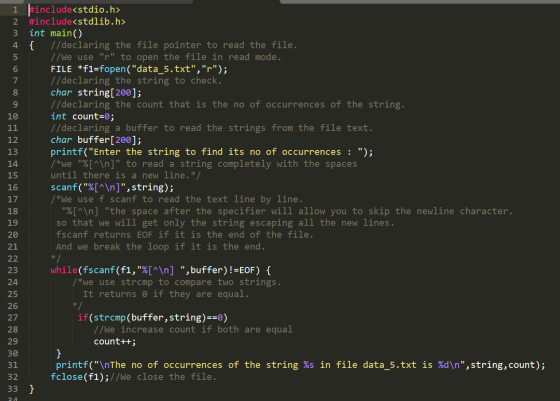
CODE:
#include<stdio.h>
#include<stdlib.h>
int main()
{ //declaring the file pointer to read the file.
//We use "r" to open the file in read mode.
FILE *f1=fopen("data_5.txt","r");
//declaring the string to check.
char string[200];
//declaring the count that is the no of occurrences of the
string.
int count=0;
//declaring a buffer to read the strings from the file text.
char buffer[200];
printf("Enter the string to find its no of occurrences : ");
/*we "%[^\n]" to read a string completely with the spaces
until there is a new line.*/
scanf("%[^\n]",string);
/*We use f scanf to read the text line by line.
"%[^\n] "the space after the specifier will allow you to skip the
newline character.
so that we will get only the string escaping all the new
lines.
fscanf returns EOF if it is the end of the file.
And we break the loop if it is the end.
*/
while(fscanf(f1,"%[^\n] ",buffer)!=EOF) {
/*we use strcmp to compare two strings.
It returns 0 if they are equal.
*/
if(strcmp(buffer,string)==0)
//We increase count if both are equal
count++;
}
printf("\nThe no of occurrences of the string %s in file data_5.txt
is %d\n",string,count);
fclose(f1);//We close the file.
}
CODE
ATTACHMENTS:
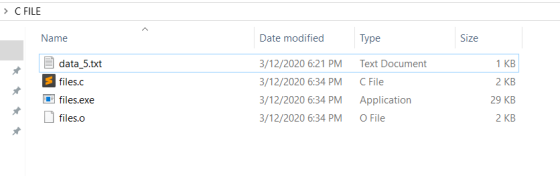
FILE DIRECTORY:
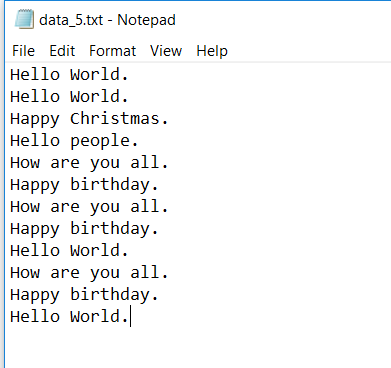
data_5.txt:
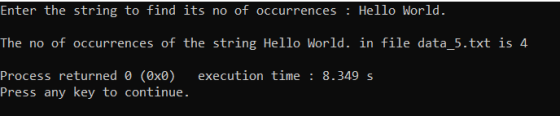
OUTPUT:
We use f scanf to read the text line by line.
We use "%[^\n] "the space after the specifier will allow you to
skip the newline character.
so that we will get only the string escaping all the new
lines.
fscanf returns EOF if it is the end of the file.
And we break the loop if it is the end.
we use strcmp to compare two strings.
It returns 0 if they are equal.
We then count the occurrences.
For any queries please do comment.
Please like it.
Thank you.
Add Answer to:
Brute force algorithm in C that counts the NUMBER OF TIMES (not
just once) a string...
Java Counts the occurrences of each digit in a string
Write a method that counts the occurrences of each digit in a string using the following header: public static int[] count(String s) The method counts how many times a digit appears in the string. The return value is an array of ten elements, each of which holds the count for a digit. For example, after executing int[] counts = count("12203AB3"), counts[0] is 1, counts[1] is 1, counts[2] is 2, and counts[3] is 2. Write a test program that prompts the...
Give 3 Pattern/String Matching algorithms. Given a Text and a Pattern, apply the Boyer-Moore algorithm, The...
Give 3 Pattern/String Matching algorithms. Given a Text and a Pattern, apply the Boyer-Moore algorithm, The KMP algorithm, The Brute Force algorithm and match the pattern in the below string. Also, write the algorithm. Text: CBADBCACBADCBBACACBCAABCA Pattern: ACBCAABC Answer the entire question Step by Step written out not typed. Don't answer if your answering part of question, typing solution, or guessing it.
Program by force brute in (c++ or java language )
The question of validity is to answer the question of whether for a Boolean expression consisting of n variables . There is a combination of values of variables that make the result of the expression true or not. In this phrase each The variable can be simple or contradictory. Force brute method of all compounds . Creates and evaluates the possible and the first time the result is true (if it is) the answer to the problem Come and stop...
3 Brute Force Attack vs Birthday Attack (50 pts) Message-Digest Algorithm (MD5) and Secure Hash Algorithm 1 (SHA...
 3 Brute Force Attack vs Birthday Attack (50 pts) Message-Digest Algorithm (MD5) and Secure Hash Algorithm 1 (SHA-1) are com- monly used cryptographic hash functions 1. Do research to find the numbers of bits used in MD5 and SHA-1. (8 pts) perform An adversary an attack to a hash algorithm by applying random inputs can and y (y) that satisfie Hx) and repeating until finding two inputs H(y) where H() denotes a hash code. This is called a "hash collision."...
This should be a program to implement the Boyer-Moore algorithm for string search in C. The...
This should be a program to implement the Boyer-Moore algorithm for string search in C. The text is in file data 5.txt, which has 44049 lines of strings. A search patterns includes the 52 upper and lower case letters only. Search is case-sensitive. When a program is executed, it reads in the text, prompts for a pattern, finds all the occurrences of the pattern in the text, and reports the total number of occurrences found. Don’t remove any symbols (characters)...
5) Which of the following is/are true? (2pts) I) a brute force algorithm will always give...
 5) Which of the following is/are true? (2pts) I) a brute force algorithm will always give you the optimal solution Il) since greedy algorithms make locally optimal choices, they are always guaranteed to find the best possible solution to an optimization problem IlI) brute-force solutions generally run slower than greedy algorithms a) I and lIl b)1 and IlI c) Il and III d) Ill only e) I, I and llI
Create an algorithm to count the number of 1’s in a 32-bit number. Implement the program in a high level language like...
Create an algorithm to count the number of 1’s in a 32-bit number. Implement the program in a high level language like C or Java. It does not need to run for me, but the code should be included in a text document called FirstnameLastnameHLA3.txt along with your assignment submission. Implement the program in MIPSzy Assembly language. Use the high level code as comments to the right of the Assembly code as the textbook does. If you write that MIPSzy...
Question 9 CLO2: The following algorithm counts the number of times Sarah" is repeated in the given array called names. names James", "Alan", "Chrs", "Aln", "J...
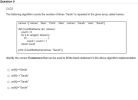 Question 9 CLO2: The following algorithm counts the number of times Sarah" is repeated in the given array called names. names James", "Alan", "Chrs", "Aln", "James", "Sarah", "Alan", "Sarah] def CounttheName (arr, names) count 0 for k in range(0, len(arr)): if ( count = count + 1 return count print (CounttheName(names, "Sarah" Identify the correct if statement that can be used to fill the blank statement in the above algorithm implementation. O arr[k]=-sarah O arrlkj>Sarah O arr[k]:="Sarah" O arrk]- Sarah...
a. Use pseudocode to specify a brute-force algorithm that takes as input a list of n...
 a. Use pseudocode to specify a brute-force algorithm that takes as input a list of n positive integers and determines whether there are two distinct elements of the list that have as their sum a third element of the list. That is, whether there exists i, j.k such that iヂj, i关k,j关k and ai + aj = ak. The algorithm should loop through all triples of elements of the list checking whether the sum of the first two is the third...
Write function vowelCount2() that takes a string as input and counts and prints the number of...
Write function vowelCount2() that takes a string as input and counts and prints the number of occurrences of vowels in the string. Vowels are a, e, i, o, and u. Implement the code in the file lab5.py. This function is very similar to the function of the problem 4.25, but the vowel information which did not appear in the string should not be printed. The printing order of the vowels is a, e, i, o, u. e.g.) >>> lab5.vowelCount2(‘augustana’) a,...
 3 Brute Force Attack vs Birthday Attack (50 pts) Message-Digest Algorithm (MD5) and Secure Hash Algorithm 1 (SHA-1) are com- monly used cryptographic hash functions 1. Do research to find the numbers of bits used in MD5 and SHA-1. (8 pts) perform An adversary an attack to a hash algorithm by applying random inputs can and y (y) that satisfie Hx) and repeating until finding two inputs H(y) where H() denotes a hash code. This is called a "hash collision."...
 5) Which of the following is/are true? (2pts) I) a brute force algorithm will always give you the optimal solution Il) since greedy algorithms make locally optimal choices, they are always guaranteed to find the best possible solution to an optimization problem IlI) brute-force solutions generally run slower than greedy algorithms a) I and lIl b)1 and IlI c) Il and III d) Ill only e) I, I and llI
 Question 9 CLO2: The following algorithm counts the number of times Sarah" is repeated in the given array called names. names James", "Alan", "Chrs", "Aln", "James", "Sarah", "Alan", "Sarah] def CounttheName (arr, names) count 0 for k in range(0, len(arr)): if ( count = count + 1 return count print (CounttheName(names, "Sarah" Identify the correct if statement that can be used to fill the blank statement in the above algorithm implementation. O arr[k]=-sarah O arrlkj>Sarah O arr[k]:="Sarah" O arrk]- Sarah...
 a. Use pseudocode to specify a brute-force algorithm that takes as input a list of n positive integers and determines whether there are two distinct elements of the list that have as their sum a third element of the list. That is, whether there exists i, j.k such that iヂj, i关k,j关k and ai + aj = ak. The algorithm should loop through all triples of elements of the list checking whether the sum of the first two is the third...
Most questions answered within 3 hours.
-
Where is the error in this code sequence?
String s1 = "Hello";
String s2 = "ello";...
asked 10 months ago -
Financial data for Joel de Paris, Inc., for last year
follow:
Joel de Paris, Inc.
Balance...
asked 10 months ago -
Consider this reaction:
Al2(SO4)3 (aq)+ BaCl3
(aq) Al2Cl6 (aq)- +
3BaSO4(s) . What is the...
asked 10 months ago -
Suppose that Savneet is considering increasing her
recent random sample from 20 car rentals to 40...
asked 10 months ago -
Trucks arrive at an unloading terminal at an average rate of 120
per hour.
Trucks arrive...
asked 10 months ago -
Why are methanol and ethanol completely soluble in water while
octanol is not very little soluble....
asked 10 months ago -
A facilities manager at a university reads in a research report
that the mean amount of...
asked 10 months ago -
When the CuSO4 is rehydrated by adding water to the anhydrous
compound, is this an endothermic...
asked 10 months ago -
A ray of sunlight is passing from diamond into crown glass; the
angle of incidence is...
asked 10 months ago -
A block of mass 0.249 kg is placed on top of a light, vertical
spring of...
asked 10 months ago -
how do the kidneys compensate in the presences of acidosis
a) trigger hyperventilate
b) reserve acid...
asked 10 months ago -
Question 501 pts
The rental rate of capital to the firm increases. Which of the
following...
asked 10 months ago