-You calculate the impedance of a single element in the circuit. The impedance is j25. What...
-You calculate the impedance of a single element in the circuit. The impedance is j25. What is the polar form? (25 angle -90 is incorrect, probably just the angle is incorrect not sure)
-You are using a 10x oscilloscope probe on a circuit. The alligator clip of the probe connects to the: (A is incorrect, I think it is D)
a) Vout of the circuit
b) Vin of the circuit
c) Negative side of the resistor
d) Ground reference
e) Same place as the hook clip on the probe
-Using what you learned about the Vout.Vin amplitude vs frequency log plot that you created in lab for this circuit and using what you know about the impedance of the capacitor vs frequency, what can you say about Vout for this circuit? (I think it is A or B, a high or low filter. D is incorrect)
a) It allows high frequency Vin signals to pass without changing amplitude
b) It allows low frequency Vin signals to pass without changing amplitude
c) It allows all Vin frequencies to pass equally without changing amplitude
d) It allows no Vin frequencies to pass without changing amplitude
e) It is not effected by frequency
Homework Answers
Since the measured impedance is j25, therefore when we express it in polar form it becomes magnitude of 25 and having phase angle of +90. This is because real part is 0,therefore the ratio of imaginary part to real part will be +infinity because imaginary part is +ve. now inverse tangent of (+infinity) becomes +90.
Here there is no circuit probably you are finding frequency response of some simple filter.by observing the options it was like low pass filter so you have to connect the probe of oscilloscope at negative side of the resistor. Hence option c.
Since it is low pass filter and you are taking output across capacitor.it allows low frequency input signals to pass without change in amplitude. So option b.
Add Answer to:
-You calculate the impedance of a single element in the circuit.
The impedance is j25. What...
1. Read the laboratory supplement entitled “Frequency Response". 2. Read the remainder of this handout. 3....
 1. Read the laboratory supplement entitled “Frequency Response". 2. Read the remainder of this handout. 3. In Multisim, build the circuit shown in Figure 1 with C=0.22 uF and R = 2.2 k12. This circuit looks like a simple voltage divider except that one of the resistors is replaced by a capacitor. Il Figure 1: RC network. F Set up Vin to be a 1 Vpp sinusoid with 0 VDC Offset using a function generator. 2. Connect the oscilloscope in...
Please give a detailed answer step by step. There are other solutions but they are not legible, p...
 Please give a detailed answer step by step.
There are other solutions but they are not legible, please only
answer if you are able to do it without copying.
7. The circuit shown is called an LRC high pass filter because high input frequencies are transmitted with greater amplitude than low input frequencies. If the input voltage is VinVo cos ω, find an expression for the outputvoltage.yal, the voltage across the resistor and inductor. (Recall that X 1/oC andxl and...
Please give a detailed answer step by step.
There are other solutions but they are not legible, please only
answer if you are able to do it without copying.
7. The circuit shown is called an LRC high pass filter because high input frequencies are transmitted with greater amplitude than low input frequencies. If the input voltage is VinVo cos ω, find an expression for the outputvoltage.yal, the voltage across the resistor and inductor. (Recall that X 1/oC andxl and...
1. In the circuit shown in Fig. 1,where L= 8 mH and R-Ska. a. Determine how the input impedance Z...
 1. In the circuit shown in Fig. 1,where L= 8 mH and R-Ska. a. Determine how the input impedance Zja)-D behaves at ev extremely high ves at and low frequencies. b. Find an expression for the impedance. C. Show that this expression can be manipulated into the form ZGe)-RT+j d. Determine the frequency ω-ae for which the imaginary part of the expression in part c is equal to 1. Estimate (without computing it) the magnitude and phase angle of ZO...
Please help especially with the excel part. Thank you 2. A series RLC circuit has 3mH...
 Please help especially with the excel part. Thank you
2. A series RLC circuit has 3mH of inductance, 75.612 of resistance, and 84.4nF of capacitance. A 12v ac source is used. a. Determine the resonant frequency, bandwidth, and high & low cutoff frequencies of the circuit, all in kHz. b. Use the Excel spreadsheet posted to create a table and calculate the following over a range of 2kHz to 20kHz, at every 1kHz: • Capacitive Reactance • Inductive Reactance •...
Please help especially with the excel part. Thank you
2. A series RLC circuit has 3mH of inductance, 75.612 of resistance, and 84.4nF of capacitance. A 12v ac source is used. a. Determine the resonant frequency, bandwidth, and high & low cutoff frequencies of the circuit, all in kHz. b. Use the Excel spreadsheet posted to create a table and calculate the following over a range of 2kHz to 20kHz, at every 1kHz: • Capacitive Reactance • Inductive Reactance •...
What is the answer to question 23.1? 23.1 Active low-pass filter You can make a low-pass...
 What is the answer to question
23.1?
23.1 Active low-pass filter You can make a low-pass filter by putting a capacitor Cr and resistor Rf in parallel for Zj as shown in Figure 23.1. At low frequencies (well below the corner frequency), the feedback impedance is approximately Rf and the gain of a non-inverting amplifier is is 1 +R//R,. At high frequencies (well above the corner frequency),the impedance is approx- imately 1/(jwCs), and the gain of a non-inverting amplifier is...
What is the answer to question
23.1?
23.1 Active low-pass filter You can make a low-pass filter by putting a capacitor Cr and resistor Rf in parallel for Zj as shown in Figure 23.1. At low frequencies (well below the corner frequency), the feedback impedance is approximately Rf and the gain of a non-inverting amplifier is is 1 +R//R,. At high frequencies (well above the corner frequency),the impedance is approx- imately 1/(jwCs), and the gain of a non-inverting amplifier is...
Part A: What is the impedance of the circuit? Part B: What is the current amplitude?...
 Part A: What is the impedance of the circuit?
Part B: What is the current amplitude?
Part C: What is the phase angle of the source voltage with
respect to the current?
Part D: Does the source voltage lag or lead the current?
Part E: What is the voltage amplitude across the resistor?
Part F: What is the voltage amplitude across the inductor?
Part G: What is the voltage amplitudes across the capacitor?
Constants You have a resistor of resistance...
Part A: What is the impedance of the circuit?
Part B: What is the current amplitude?
Part C: What is the phase angle of the source voltage with
respect to the current?
Part D: Does the source voltage lag or lead the current?
Part E: What is the voltage amplitude across the resistor?
Part F: What is the voltage amplitude across the inductor?
Part G: What is the voltage amplitudes across the capacitor?
Constants You have a resistor of resistance...
TE Question 5 (20 marks) An active filter circuit is shown in Fig. 4. The cut-off frequency of this active filter is...
 TE Question 5 (20 marks) An active filter circuit is shown in Fig. 4. The cut-off frequency of this active filter is 1590Hz. The Input impedance and voltage gain of this filter are 10k0 and -5VN respectively Vout R1 vin R2 C1 Fig. 4 By assuming the operational amplifier, A is ideal, answer the following questions: (a) () State the type of this active fiter. (i) Explain the characteristic of this active filter. [2 marks] 3 marks] (b) 0) Calculate...
Please answer with screenshot of code in Python sistor and one capacitor. Exercise 8.1: A low-pass...
 Please answer with screenshot of code in Python
sistor and one capacitor. Exercise 8.1: A low-pass filter Here is a simple electronic circuit with on - Vour Vin - W- This circuit acts as a low-pass filter: you send a signal in on the left and it comes out filtered on the right Using Ohm's law and the capacitor law and assuming that the output load has very high impedance, so that a negligible amount of current flows through it,...
Please answer with screenshot of code in Python
sistor and one capacitor. Exercise 8.1: A low-pass filter Here is a simple electronic circuit with on - Vour Vin - W- This circuit acts as a low-pass filter: you send a signal in on the left and it comes out filtered on the right Using Ohm's law and the capacitor law and assuming that the output load has very high impedance, so that a negligible amount of current flows through it,...
Given the second order filter in figure, with ? = 4 ?Ω, ? = 50 ??,...
 Given the second order filter in figure, with ? = 4 ?Ω, ? = 50
??, ?1 = 50 nF and ?2 = 1 μF:
a) Reason the value that the gain of this filter will have for
very low frequencies, at the resonance frequency of the parallel LC
circuit and for very high frequencies. In the latter case (high
frequencies) keep in mind that, since there are two capacitors with
a similar asymptotic behavior, we cannot assume that its...
Given the second order filter in figure, with ? = 4 ?Ω, ? = 50
??, ?1 = 50 nF and ?2 = 1 μF:
a) Reason the value that the gain of this filter will have for
very low frequencies, at the resonance frequency of the parallel LC
circuit and for very high frequencies. In the latter case (high
frequencies) keep in mind that, since there are two capacitors with
a similar asymptotic behavior, we cannot assume that its...
1. The circuit below, which uses one inductor and two identical resistors, (30 pts] can be...
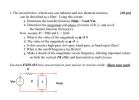 1. The circuit below, which uses one inductor and two identical resistors, (30 pts] can be described as a filter. Using this circuit: a. Determine the transfer function, H(@) = Vout/Vin. b. Determine the magnitude and phase (in terms of R, L, and o) of the transfer function from part a. Now, assume R = 5022 and L = 2mH c. What is the value of the magnitude as 0 0 d. The value of the magnitude as → e....
 1. Read the laboratory supplement entitled “Frequency Response". 2. Read the remainder of this handout. 3. In Multisim, build the circuit shown in Figure 1 with C=0.22 uF and R = 2.2 k12. This circuit looks like a simple voltage divider except that one of the resistors is replaced by a capacitor. Il Figure 1: RC network. F Set up Vin to be a 1 Vpp sinusoid with 0 VDC Offset using a function generator. 2. Connect the oscilloscope in...
 Please give a detailed answer step by step.
There are other solutions but they are not legible, please only
answer if you are able to do it without copying.
7. The circuit shown is called an LRC high pass filter because high input frequencies are transmitted with greater amplitude than low input frequencies. If the input voltage is VinVo cos ω, find an expression for the outputvoltage.yal, the voltage across the resistor and inductor. (Recall that X 1/oC andxl and...
Please give a detailed answer step by step.
There are other solutions but they are not legible, please only
answer if you are able to do it without copying.
7. The circuit shown is called an LRC high pass filter because high input frequencies are transmitted with greater amplitude than low input frequencies. If the input voltage is VinVo cos ω, find an expression for the outputvoltage.yal, the voltage across the resistor and inductor. (Recall that X 1/oC andxl and...
 1. In the circuit shown in Fig. 1,where L= 8 mH and R-Ska. a. Determine how the input impedance Zja)-D behaves at ev extremely high ves at and low frequencies. b. Find an expression for the impedance. C. Show that this expression can be manipulated into the form ZGe)-RT+j d. Determine the frequency ω-ae for which the imaginary part of the expression in part c is equal to 1. Estimate (without computing it) the magnitude and phase angle of ZO...
 Please help especially with the excel part. Thank you
2. A series RLC circuit has 3mH of inductance, 75.612 of resistance, and 84.4nF of capacitance. A 12v ac source is used. a. Determine the resonant frequency, bandwidth, and high & low cutoff frequencies of the circuit, all in kHz. b. Use the Excel spreadsheet posted to create a table and calculate the following over a range of 2kHz to 20kHz, at every 1kHz: • Capacitive Reactance • Inductive Reactance •...
Please help especially with the excel part. Thank you
2. A series RLC circuit has 3mH of inductance, 75.612 of resistance, and 84.4nF of capacitance. A 12v ac source is used. a. Determine the resonant frequency, bandwidth, and high & low cutoff frequencies of the circuit, all in kHz. b. Use the Excel spreadsheet posted to create a table and calculate the following over a range of 2kHz to 20kHz, at every 1kHz: • Capacitive Reactance • Inductive Reactance •...
 What is the answer to question
23.1?
23.1 Active low-pass filter You can make a low-pass filter by putting a capacitor Cr and resistor Rf in parallel for Zj as shown in Figure 23.1. At low frequencies (well below the corner frequency), the feedback impedance is approximately Rf and the gain of a non-inverting amplifier is is 1 +R//R,. At high frequencies (well above the corner frequency),the impedance is approx- imately 1/(jwCs), and the gain of a non-inverting amplifier is...
What is the answer to question
23.1?
23.1 Active low-pass filter You can make a low-pass filter by putting a capacitor Cr and resistor Rf in parallel for Zj as shown in Figure 23.1. At low frequencies (well below the corner frequency), the feedback impedance is approximately Rf and the gain of a non-inverting amplifier is is 1 +R//R,. At high frequencies (well above the corner frequency),the impedance is approx- imately 1/(jwCs), and the gain of a non-inverting amplifier is...
 Part A: What is the impedance of the circuit?
Part B: What is the current amplitude?
Part C: What is the phase angle of the source voltage with
respect to the current?
Part D: Does the source voltage lag or lead the current?
Part E: What is the voltage amplitude across the resistor?
Part F: What is the voltage amplitude across the inductor?
Part G: What is the voltage amplitudes across the capacitor?
Constants You have a resistor of resistance...
Part A: What is the impedance of the circuit?
Part B: What is the current amplitude?
Part C: What is the phase angle of the source voltage with
respect to the current?
Part D: Does the source voltage lag or lead the current?
Part E: What is the voltage amplitude across the resistor?
Part F: What is the voltage amplitude across the inductor?
Part G: What is the voltage amplitudes across the capacitor?
Constants You have a resistor of resistance...
 TE Question 5 (20 marks) An active filter circuit is shown in Fig. 4. The cut-off frequency of this active filter is 1590Hz. The Input impedance and voltage gain of this filter are 10k0 and -5VN respectively Vout R1 vin R2 C1 Fig. 4 By assuming the operational amplifier, A is ideal, answer the following questions: (a) () State the type of this active fiter. (i) Explain the characteristic of this active filter. [2 marks] 3 marks] (b) 0) Calculate...
 Please answer with screenshot of code in Python
sistor and one capacitor. Exercise 8.1: A low-pass filter Here is a simple electronic circuit with on - Vour Vin - W- This circuit acts as a low-pass filter: you send a signal in on the left and it comes out filtered on the right Using Ohm's law and the capacitor law and assuming that the output load has very high impedance, so that a negligible amount of current flows through it,...
Please answer with screenshot of code in Python
sistor and one capacitor. Exercise 8.1: A low-pass filter Here is a simple electronic circuit with on - Vour Vin - W- This circuit acts as a low-pass filter: you send a signal in on the left and it comes out filtered on the right Using Ohm's law and the capacitor law and assuming that the output load has very high impedance, so that a negligible amount of current flows through it,...
 Given the second order filter in figure, with ? = 4 ?Ω, ? = 50
??, ?1 = 50 nF and ?2 = 1 μF:
a) Reason the value that the gain of this filter will have for
very low frequencies, at the resonance frequency of the parallel LC
circuit and for very high frequencies. In the latter case (high
frequencies) keep in mind that, since there are two capacitors with
a similar asymptotic behavior, we cannot assume that its...
Given the second order filter in figure, with ? = 4 ?Ω, ? = 50
??, ?1 = 50 nF and ?2 = 1 μF:
a) Reason the value that the gain of this filter will have for
very low frequencies, at the resonance frequency of the parallel LC
circuit and for very high frequencies. In the latter case (high
frequencies) keep in mind that, since there are two capacitors with
a similar asymptotic behavior, we cannot assume that its...
 1. The circuit below, which uses one inductor and two identical resistors, (30 pts] can be described as a filter. Using this circuit: a. Determine the transfer function, H(@) = Vout/Vin. b. Determine the magnitude and phase (in terms of R, L, and o) of the transfer function from part a. Now, assume R = 5022 and L = 2mH c. What is the value of the magnitude as 0 0 d. The value of the magnitude as → e....
Most questions answered within 3 hours.
-
Where is the error in this code sequence?
String s1 = "Hello";
String s2 = "ello";...
asked 11 months ago -
Financial data for Joel de Paris, Inc., for last year
follow:
Joel de Paris, Inc.
Balance...
asked 11 months ago -
Consider this reaction:
Al2(SO4)3 (aq)+ BaCl3
(aq) Al2Cl6 (aq)- +
3BaSO4(s) . What is the...
asked 11 months ago -
Suppose that Savneet is considering increasing her
recent random sample from 20 car rentals to 40...
asked 11 months ago -
Trucks arrive at an unloading terminal at an average rate of 120
per hour.
Trucks arrive...
asked 11 months ago -
Why are methanol and ethanol completely soluble in water while
octanol is not very little soluble....
asked 11 months ago -
A facilities manager at a university reads in a research report
that the mean amount of...
asked 11 months ago -
When the CuSO4 is rehydrated by adding water to the anhydrous
compound, is this an endothermic...
asked 11 months ago -
A ray of sunlight is passing from diamond into crown glass; the
angle of incidence is...
asked 11 months ago -
A block of mass 0.249 kg is placed on top of a light, vertical
spring of...
asked 11 months ago -
how do the kidneys compensate in the presences of acidosis
a) trigger hyperventilate
b) reserve acid...
asked 11 months ago -
Question 501 pts
The rental rate of capital to the firm increases. Which of the
following...
asked 11 months ago