what will be printed? String s = "Donal J. Trump"; boolean b = ture; for (int...
what will be printed?
String s = "Donal J. Trump";
boolean b = ture;
for (int i = 0; i < s.length(); i++){
if (b) {
System.out.print(s.charAt(i));
}
if (s.charAt(i) == ' ') {
b = true;
}else {
b = false;
}
Homework Answers

Add Answer to:
what will be printed?
String s = "Donal J. Trump";
boolean b = ture;
for (int...
10. What prints when the following code is executed? public static void main (String args) "Cattywampus"; for (...
 10. What prints when the following code is executed? public static void main (String args) "Cattywampus"; for (int i-s.length )-1 i> 0 i-2) if (s.charAt (i)a') System.out.print(""); ] else if (s.charAt (i)'t') System.out.print (s.charAt (i-2)) i+ti else System. out. print (s . charAt (İ) ) ; if (i<2) System.out.print ("y"); System.out.println ()
10. What prints when the following code is executed? public static void main (String args) "Cattywampus"; for (int i-s.length )-1 i> 0 i-2) if (s.charAt (i)a') System.out.print(""); ]...
10. What prints when the following code is executed? public static void main (String args) "Cattywampus"; for (int i-s.length )-1 i> 0 i-2) if (s.charAt (i)a') System.out.print(""); ] else if (s.charAt (i)'t') System.out.print (s.charAt (i-2)) i+ti else System. out. print (s . charAt (İ) ) ; if (i<2) System.out.print ("y"); System.out.println ()
10. What prints when the following code is executed? public static void main (String args) "Cattywampus"; for (int i-s.length )-1 i> 0 i-2) if (s.charAt (i)a') System.out.print(""); ]...
Show the Activation Stack for “ZEROREZ” boolean isPal(String s) { if(s.length() == 0 || s.length() ==...
Show the Activation Stack for “ZEROREZ” boolean isPal(String s) { if(s.length() == 0 || s.length() == 1) // if length =0 OR 1 then it is return true; if(s.charAt(0) == s.charAt(s.length()-1)) // check first and last char of String: // if same then do same for substring // for substring and carry on this // remove first and last char. return isPal(s.substring(1, s.length()-1)); // if its not the case than string is not. return false; }
10. What prints when the following code is executed? public static void main (String args) "Cattywampus";...
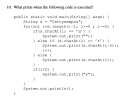 10. What prints when the following code is executed? public static void main (String args) "Cattywampus"; for (int i-s.length )-1 i> 0 i-2) if (s.charAt (i)a') System.out.print(""); ] else if (s.charAt (i)'t') System.out.print (s.charAt (i-2)) i+ti else System. out. print (s . charAt (İ) ) ; if (i<2) System.out.print ("y"); System.out.println ()
JAVA 5) What is the output of the following code? int a = 70; boolean b...
JAVA 5) What is the output of the following code? int a = 70; boolean b = false; if(a >= 70) { System.out.print(1); if(b==true) { System.out.print(2); } } else { System.out.print(3); if(b==false) { System.out.print(4); } } System.out.print(5); 6) What is the output of the code above using these initial values? int a = 43; boolean b = false; 7) The following method is SYNTACTICALLY correct (meaning it will compile). True or false? public boolean method() { int value = 5;...
Consider the encryption code Encryption Code true false - stringContains is an encryption algorithm that can be...
Consider the encryption code Encryption Code true false - stringContains is an encryption algorithm that can be decrpyted true false - Running reverseString twice will have no effect true false - Running incLetters(s,4) then incLetters(s,-4) will have no effect true false - using maxDigit as an encryption algorighm, it can be decrypted USE CODE BELOW: package encryption; import java.util.Scanner; public class Encryption { public static void main(String[] args) { Scanner scanner = new Scanner (System.in); String password, encryptedPassword, salt; int increment;...
instructions These questions should test if you have understood the contents of Chapter 18 "Recursion". 1....
instructions These questions should test if you have understood the contents of Chapter 18 "Recursion". 1. What will this method return if you call it this: xMethod (4) static int xMethod (int n) { if (n == 1) return 1; else return n + xMethod (n - 1); } 1. 10 2. 11 3. 12 4. 9 2. Analyze the following code: public class Test { public static void main (String [] args) { int [] x = {1, 2,...
Debug following methods(longestRun(finds how many times a character got repeated), findLastP(finds last p in a string),...
Debug following methods(longestRun(finds how many times a character got repeated), findLastP(finds last p in a string), findFirstP(finds first p in a string)) in java language. public class simpleLoops { /** * @param args */ public static void main(String[] args) { System.out.println(longestRun("aabbbccd")); System.out.println("Expected 3"); System.out.println(longestRun("aaa")); System.out.println("Expected 3"); System.out.println(longestRun("aabbbb")); System.out.println("Expected 4"); int count = countP("Mississippi"); System.out.println(count); int result = findLastP("Mississippi"); System.out.println(result); result = findFirstP("stop"); System.out.println(result); result = findFirstP("xxxyyyzzz"); System.out.println(result); } /** *...
Given the following code: public static void foo3(String s) { if (s.length() >0) { System.out.print(s.charAt(s.length() -1));...
Given the following code: public static void foo3(String s) { if (s.length() >0) { System.out.print(s.charAt(s.length() -1)); foo3(s.substring(0, s.length() -1)); } } What is the output of: foo3(“”); 2, You coded the following in the file Test.java : System.out.println( foo(5)); //more code here public static int foo(int n) //line 9 { if (n = = 0) return 1; else System.out.println(n* foo(n-1) ); } //line 15 At compile time, you get the following error: Text.java: 15: missing return statement } ...
Please fix my code so I can get this output: Enter the first 12-digit of an...
Please fix my code so I can get this output: Enter the first 12-digit of an ISBN number as a string: 978013213080 The ISBN number is 9780132130806 This was my output: import java.util.Scanner; public class Isbn { private static int getChecksum(String s) { // Calculate checksum int sum = 0; for (int i = 0; i < s.length(); i++) if (i % 2 == 0) sum += (s.charAt(i) - '0') * 3; else sum += s.charAt(i) - '0'; return 10...
Consider the interface Predicate defined as follows. interface Predicate { boolean eval(int j); } Recall that...
Consider the interface Predicate defined as follows. interface Predicate { boolean eval(int j); } Recall that you can check if an integer “i” is even by using the expression “i%2 == 0”. Write a class IsEven that determines whether a number is even: class IsEven implements Predicate { public boolean eval(int j) { } } For example, the following code Predicate p = new IsEven(); if ( p.eval(2)) { System.out.println("2 is even"); } if (! p.eval(3)) { System.out.println("3 is not...
 10. What prints when the following code is executed? public static void main (String args) "Cattywampus"; for (int i-s.length )-1 i> 0 i-2) if (s.charAt (i)a') System.out.print(""); ] else if (s.charAt (i)'t') System.out.print (s.charAt (i-2)) i+ti else System. out. print (s . charAt (İ) ) ; if (i<2) System.out.print ("y"); System.out.println ()
10. What prints when the following code is executed? public static void main (String args) "Cattywampus"; for (int i-s.length )-1 i> 0 i-2) if (s.charAt (i)a') System.out.print(""); ]...
10. What prints when the following code is executed? public static void main (String args) "Cattywampus"; for (int i-s.length )-1 i> 0 i-2) if (s.charAt (i)a') System.out.print(""); ] else if (s.charAt (i)'t') System.out.print (s.charAt (i-2)) i+ti else System. out. print (s . charAt (İ) ) ; if (i<2) System.out.print ("y"); System.out.println ()
10. What prints when the following code is executed? public static void main (String args) "Cattywampus"; for (int i-s.length )-1 i> 0 i-2) if (s.charAt (i)a') System.out.print(""); ]...
 10. What prints when the following code is executed? public static void main (String args) "Cattywampus"; for (int i-s.length )-1 i> 0 i-2) if (s.charAt (i)a') System.out.print(""); ] else if (s.charAt (i)'t') System.out.print (s.charAt (i-2)) i+ti else System. out. print (s . charAt (İ) ) ; if (i<2) System.out.print ("y"); System.out.println ()
Most questions answered within 3 hours.
-
Where is the error in this code sequence?
String s1 = "Hello";
String s2 = "ello";...
asked 10 months ago -
Financial data for Joel de Paris, Inc., for last year
follow:
Joel de Paris, Inc.
Balance...
asked 10 months ago -
Consider this reaction:
Al2(SO4)3 (aq)+ BaCl3
(aq) Al2Cl6 (aq)- +
3BaSO4(s) . What is the...
asked 10 months ago -
Suppose that Savneet is considering increasing her
recent random sample from 20 car rentals to 40...
asked 10 months ago -
Trucks arrive at an unloading terminal at an average rate of 120
per hour.
Trucks arrive...
asked 10 months ago -
Why are methanol and ethanol completely soluble in water while
octanol is not very little soluble....
asked 10 months ago -
A facilities manager at a university reads in a research report
that the mean amount of...
asked 10 months ago -
When the CuSO4 is rehydrated by adding water to the anhydrous
compound, is this an endothermic...
asked 10 months ago -
A ray of sunlight is passing from diamond into crown glass; the
angle of incidence is...
asked 10 months ago -
A block of mass 0.249 kg is placed on top of a light, vertical
spring of...
asked 10 months ago -
how do the kidneys compensate in the presences of acidosis
a) trigger hyperventilate
b) reserve acid...
asked 10 months ago -
Question 501 pts
The rental rate of capital to the firm increases. Which of the
following...
asked 10 months ago