Research the negative feedback loop that controls blood glucose level. Explain what happens if blood glucose...
Research the negative feedback loop that controls blood glucose level. Explain what happens if blood glucose levels drop too low, making sure to list the effector(s).
Homework Answers
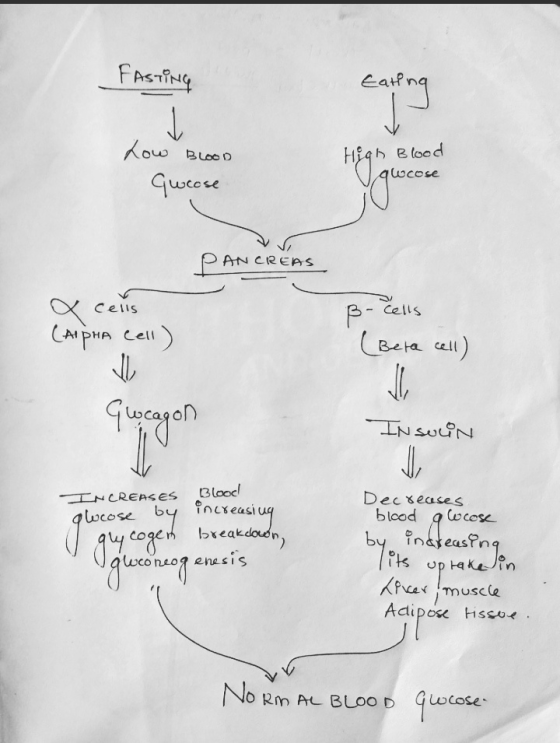
Blood glucose level is mainly controlled by 2 hormones - insulin and glucagon. Insulin is released from beta cells of pancreas and glucagon from alpha cells of pancreas. Insulin is released when blood glucose is high and it decreases blood glucose.
Glucagon is released when blood glucose is low and it increases blood glucose by negative feedback. It acts on -
- liver and stimulate breakdown of liver glycogen into glucose
- Adipose tissue and stimulate breakdown of fats to produce energy and glucoe
- Acts on adipose tissue and inhibit synthesis of fat cepls
- Stimulate gluconeogenesis.
If you found this answer helpful then please rate it. Comment if you have any problem in understanding this answer
Add Answer to:
Research the negative feedback loop that controls blood
glucose level. Explain what happens if blood glucose...
22. Diagram or describe in words the negative feedback loop for blood calcium levels. Make sure...
 22. Diagram or describe in words the negative feedback loop for blood calcium levels. Make sure to include BOTH what happens when blood calcium levels rise too high and what happens when blood calcium levels fall too low. Include the roles of the 2 main hormones involved, the organs that secrete those hormones, and the organs those hormones act on.
21. Diagram or describe in words the negative feedback loop for blood sugar. Make sure to...
 21. Diagram or describe in words the negative feedback loop for blood sugar. Make sure to include BOTH what happens when blood sugar rises too high and what happens when blood sugar falls too low. Include the roles of the 2 main hormones involved, the organs that secrete those hormones, and the organs those hormones act on
Explain how the body maintains its blood glucose concentration and what happens when blood glucose rises...
Explain how the body maintains its blood glucose concentration and what happens when blood glucose rises too high or falls too low.
Model 2 - Feedback Control of Blood Glucose Pancreas .. Liver Other cells OO Blood glucose...
 Model 2 - Feedback Control of Blood Glucose Pancreas .. Liver Other cells OO Blood glucose is too high. Cycle A Blood glucose drops. Baseline blood glucose level. Blood glucose rises. Glucose Insulin Glycogen Glucagon Cycle B Blood glucose is too low. 7. Where in the body does insulin and glucagon originate? 8. In what form is glucose stored in the liver and what is the consequence in terms of glucose blood levels? 10. Which hormone (insulin or glucagon) helps...
Insulin and glucagon release from the pancreas is a vital part of the negative feedback loop...
 Insulin and glucagon release from the pancreas is a vital part
of the negative feedback loop that regulates blood glucose levels.
Let's review how insulin and glucagon release change in response to
plasma glucose levels and how that helps keep plasma glucose
constant.
Drag the labels onto the figure to create a flow chart of how
insulin and glucagon release change in different circumstances to
keep blood glucose within a normal range.
Reset
Help
secrete less glucagon
secrete less glucagon...
Insulin and glucagon release from the pancreas is a vital part
of the negative feedback loop that regulates blood glucose levels.
Let's review how insulin and glucagon release change in response to
plasma glucose levels and how that helps keep plasma glucose
constant.
Drag the labels onto the figure to create a flow chart of how
insulin and glucagon release change in different circumstances to
keep blood glucose within a normal range.
Reset
Help
secrete less glucagon
secrete less glucagon...
Blood glucose homeostasis Complete the following statements to describe how the pancreatic hormones help maintain blood...
 Blood glucose homeostasis Complete the following statements to describe how the pancreatic hormones help maintain blood glucose homeostasis. Not all choices will be used. Eating insulin _ blood glucose. When blood glucose is the pancreas secretes into the blood. glycogen breakdown This hormone is secreted by the B cells in the pancreatic islet. It stimulates the of glucose, which is stored as in the liver and muscle cells and used to form fat in the adipose tissue. increases glucose After...
In a negative feedback situation, if your blood glucose levels went UP because you ate a...
 In a negative feedback situation, if your blood glucose levels went UP because you ate a cherry pie, how would your body para 1. Blood sugar would go UP 2. Blood sugar would go DOWN 3. All of these are complete bullshit and not true. At all. All lies. Lies.. 4. Blood sugar would not be changed by your body in this situation
20. What happens when beta cells of the pancreas release insulin into the blood? glucose levels...
 20. What happens when beta cells of the pancreas release insulin into the blood? glucose levels rise to a set point and stimulate glucagon release. b) Body cells take up more glucose. c) The liver breaks down glycogen to glucose. d) Alpha cells are stimulated to release glucose into the blood óth B and D are correct.
I am very confused by these flow charts. They are both negative feedback loops, which I...
 I am very confused by these flow charts. They are both
negative feedback loops, which I get, but I feel like I'm missing
something with these charts. Can someone please explain for
me?
Activity 2 Negative feedback control of body temperature during heating. Given the information in the paragraph below, fill in the empty boxes with the appropriate item Ambient temperature above body temperature. Ambient and body temperature input to the preoptic and anterior hypothalamus originates from the cutaneous and...
I am very confused by these flow charts. They are both
negative feedback loops, which I get, but I feel like I'm missing
something with these charts. Can someone please explain for
me?
Activity 2 Negative feedback control of body temperature during heating. Given the information in the paragraph below, fill in the empty boxes with the appropriate item Ambient temperature above body temperature. Ambient and body temperature input to the preoptic and anterior hypothalamus originates from the cutaneous and...
Use the homeostasis lab to answer the question below. The negative feedback mechanisms involved with maintaining...
 Use the homeostasis lab to answer the question below. The
negative feedback mechanisms involved with maintaining the
homeostasis of blood sugar are very complicated. Consider how you
could design an investigation to better understand these mechanisms
using the homeostasislab. Which questions could be explored in this
manner? Mark all that apply.
ve the homeostasis lab to answer the question below. The negative feedback mechanisms involved with maintaining the homeostasis of blood sugar are very complicated. Consider how you could design...
Use the homeostasis lab to answer the question below. The
negative feedback mechanisms involved with maintaining the
homeostasis of blood sugar are very complicated. Consider how you
could design an investigation to better understand these mechanisms
using the homeostasislab. Which questions could be explored in this
manner? Mark all that apply.
ve the homeostasis lab to answer the question below. The negative feedback mechanisms involved with maintaining the homeostasis of blood sugar are very complicated. Consider how you could design...
 22. Diagram or describe in words the negative feedback loop for blood calcium levels. Make sure to include BOTH what happens when blood calcium levels rise too high and what happens when blood calcium levels fall too low. Include the roles of the 2 main hormones involved, the organs that secrete those hormones, and the organs those hormones act on.
 21. Diagram or describe in words the negative feedback loop for blood sugar. Make sure to include BOTH what happens when blood sugar rises too high and what happens when blood sugar falls too low. Include the roles of the 2 main hormones involved, the organs that secrete those hormones, and the organs those hormones act on
 Model 2 - Feedback Control of Blood Glucose Pancreas .. Liver Other cells OO Blood glucose is too high. Cycle A Blood glucose drops. Baseline blood glucose level. Blood glucose rises. Glucose Insulin Glycogen Glucagon Cycle B Blood glucose is too low. 7. Where in the body does insulin and glucagon originate? 8. In what form is glucose stored in the liver and what is the consequence in terms of glucose blood levels? 10. Which hormone (insulin or glucagon) helps...
 Insulin and glucagon release from the pancreas is a vital part
of the negative feedback loop that regulates blood glucose levels.
Let's review how insulin and glucagon release change in response to
plasma glucose levels and how that helps keep plasma glucose
constant.
Drag the labels onto the figure to create a flow chart of how
insulin and glucagon release change in different circumstances to
keep blood glucose within a normal range.
Reset
Help
secrete less glucagon
secrete less glucagon...
Insulin and glucagon release from the pancreas is a vital part
of the negative feedback loop that regulates blood glucose levels.
Let's review how insulin and glucagon release change in response to
plasma glucose levels and how that helps keep plasma glucose
constant.
Drag the labels onto the figure to create a flow chart of how
insulin and glucagon release change in different circumstances to
keep blood glucose within a normal range.
Reset
Help
secrete less glucagon
secrete less glucagon...
 Blood glucose homeostasis Complete the following statements to describe how the pancreatic hormones help maintain blood glucose homeostasis. Not all choices will be used. Eating insulin _ blood glucose. When blood glucose is the pancreas secretes into the blood. glycogen breakdown This hormone is secreted by the B cells in the pancreatic islet. It stimulates the of glucose, which is stored as in the liver and muscle cells and used to form fat in the adipose tissue. increases glucose After...
 In a negative feedback situation, if your blood glucose levels went UP because you ate a cherry pie, how would your body para 1. Blood sugar would go UP 2. Blood sugar would go DOWN 3. All of these are complete bullshit and not true. At all. All lies. Lies.. 4. Blood sugar would not be changed by your body in this situation
 20. What happens when beta cells of the pancreas release insulin into the blood? glucose levels rise to a set point and stimulate glucagon release. b) Body cells take up more glucose. c) The liver breaks down glycogen to glucose. d) Alpha cells are stimulated to release glucose into the blood óth B and D are correct.
 I am very confused by these flow charts. They are both
negative feedback loops, which I get, but I feel like I'm missing
something with these charts. Can someone please explain for
me?
Activity 2 Negative feedback control of body temperature during heating. Given the information in the paragraph below, fill in the empty boxes with the appropriate item Ambient temperature above body temperature. Ambient and body temperature input to the preoptic and anterior hypothalamus originates from the cutaneous and...
I am very confused by these flow charts. They are both
negative feedback loops, which I get, but I feel like I'm missing
something with these charts. Can someone please explain for
me?
Activity 2 Negative feedback control of body temperature during heating. Given the information in the paragraph below, fill in the empty boxes with the appropriate item Ambient temperature above body temperature. Ambient and body temperature input to the preoptic and anterior hypothalamus originates from the cutaneous and...
 Use the homeostasis lab to answer the question below. The
negative feedback mechanisms involved with maintaining the
homeostasis of blood sugar are very complicated. Consider how you
could design an investigation to better understand these mechanisms
using the homeostasislab. Which questions could be explored in this
manner? Mark all that apply.
ve the homeostasis lab to answer the question below. The negative feedback mechanisms involved with maintaining the homeostasis of blood sugar are very complicated. Consider how you could design...
Use the homeostasis lab to answer the question below. The
negative feedback mechanisms involved with maintaining the
homeostasis of blood sugar are very complicated. Consider how you
could design an investigation to better understand these mechanisms
using the homeostasislab. Which questions could be explored in this
manner? Mark all that apply.
ve the homeostasis lab to answer the question below. The negative feedback mechanisms involved with maintaining the homeostasis of blood sugar are very complicated. Consider how you could design...
Most questions answered within 3 hours.
-
Where is the error in this code sequence?
String s1 = "Hello";
String s2 = "ello";...
asked 10 months ago -
Financial data for Joel de Paris, Inc., for last year
follow:
Joel de Paris, Inc.
Balance...
asked 10 months ago -
Consider this reaction:
Al2(SO4)3 (aq)+ BaCl3
(aq) Al2Cl6 (aq)- +
3BaSO4(s) . What is the...
asked 10 months ago -
Suppose that Savneet is considering increasing her
recent random sample from 20 car rentals to 40...
asked 10 months ago -
Trucks arrive at an unloading terminal at an average rate of 120
per hour.
Trucks arrive...
asked 10 months ago -
Why are methanol and ethanol completely soluble in water while
octanol is not very little soluble....
asked 10 months ago -
A facilities manager at a university reads in a research report
that the mean amount of...
asked 10 months ago -
When the CuSO4 is rehydrated by adding water to the anhydrous
compound, is this an endothermic...
asked 10 months ago -
A ray of sunlight is passing from diamond into crown glass; the
angle of incidence is...
asked 10 months ago -
A block of mass 0.249 kg is placed on top of a light, vertical
spring of...
asked 10 months ago -
how do the kidneys compensate in the presences of acidosis
a) trigger hyperventilate
b) reserve acid...
asked 10 months ago -
Question 501 pts
The rental rate of capital to the firm increases. Which of the
following...
asked 10 months ago