Why is a Diels-Alder reaction important to organic chemists, and the general public? What has it...
Why is a Diels-Alder reaction important to organic chemists, and the general public? What has it been able to provide the human race in layman's terms? How would you explain it to someone who isn't a chemist.
Homework Answers

Add Answer to:
Why is a Diels-Alder reaction important to organic chemists, and
the general public? What has it...
Make a prediction of the rate of Aiels-Alder reaction. Give reasoning. 2. The nature of the...
 Make a prediction of the rate of Aiels-Alder reaction. Give
reasoning.
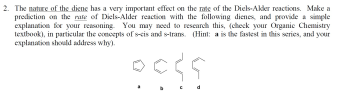
2. The nature of the diene has a very important effect on the rate of the Diels-Alder reactions. Make a prediction on the rate of Diels-Alder reaction with the following dienes, and provide a simple explanation for your reasoning. You may need to research this, (check your Organic Chemistry textbook), in particular the concepts of s -cis and s -trans. (Hint: a is the fastest in this series, and...
Make a prediction of the rate of Aiels-Alder reaction. Give
reasoning.
2. The nature of the diene has a very important effect on the rate of the Diels-Alder reactions. Make a prediction on the rate of Diels-Alder reaction with the following dienes, and provide a simple explanation for your reasoning. You may need to research this, (check your Organic Chemistry textbook), in particular the concepts of s -cis and s -trans. (Hint: a is the fastest in this series, and...
Questions 1. Why does the trans conformation of a diene, in reaction with a dienophile, not lead to a Diels-Alder r...
 Questions 1. Why does the trans conformation of a diene, in reaction with a dienophile, not lead to a Diels-Alder reaction product? 2. Complete the following Diels-Alder reactions. Provide the major endo-product(s). Dienophile Product(s) 3. How many i electrons are there in a molecule of 1,3-butadiene?
This is an organic chemistry question regarding the Diels-Alder reaction. The problems are 16.22 and 16.18....
 This is an organic chemistry question regarding the
Diels-Alder reaction. The problems are 16.22 and 16.18. I would
like to know if I did these correctly. If I did not, could someone
help me go through the process?
er reaction Conjugation, Resonance and Dienes Chapter 16 dienophile react in a Diels-Alder CH3 C. 16.18 Draw the product formed when each diene and Problem 16.18 COOCH3 15 Specific Rules Governing the Diels-Alder Reaction 16.13A Diene Reactivity Rule [1] The diene can...
This is an organic chemistry question regarding the
Diels-Alder reaction. The problems are 16.22 and 16.18. I would
like to know if I did these correctly. If I did not, could someone
help me go through the process?
er reaction Conjugation, Resonance and Dienes Chapter 16 dienophile react in a Diels-Alder CH3 C. 16.18 Draw the product formed when each diene and Problem 16.18 COOCH3 15 Specific Rules Governing the Diels-Alder Reaction 16.13A Diene Reactivity Rule [1] The diene can...
Would the rate of a Diels-Alder reaction, be faster, slower, or the same as if you...
Would the rate of a Diels-Alder reaction, be faster, slower, or the same as if you used difluoromaleic anhydride instead of maleic anhydride. Explain your answer. What is the purpose of adding petroleum ether to the reaction mixture prior to filtration ? Explain how it causes crystals to form .
I did an organic chemistry lab using the Diels-Alder reaction with anthracene-9-methanol, N-methylmaleimide, and water. I...
I did an organic chemistry lab using the Diels-Alder reaction with anthracene-9-methanol, N-methylmaleimide, and water. I started with 0.066 g of anthracene-9-methanol, 25 mL of deionized water, and 0.070 g of N-methylmaleimide. How would I calculate the percent recovery of the product? (not the percent yield)
5. Arrange the following solvents in increasing order of reaction rate for Diels-Alder reaction between anthracene...
 5. Arrange the following solvents in increasing order of reaction rate for Diels-Alder reaction between anthracene and 1,3-dimethylcyclopentene. Draw structure of product with appropriate stereochemistry. 10 points Ethyl acetate diisopropyl ether Ethanol Water Hexane The same order of reactivity would not necessarily result in the highest yield of the product - meaning, the solvent with highest reactivity would not necessarily give you the most amount of product based on procedure employed in the lab. Explain why this is so.
EXPERIMENT 2A DIELS-ALDER REACTION OF ANTHRACENE REFERENCES Pavia et al (4/e): Tech. 6.1/6.2, 7.2-7.4 Klein (1/e)...
 EXPERIMENT 2A DIELS-ALDER REACTION OF ANTHRACENE REFERENCES Pavia et al (4/e): Tech. 6.1/6.2, 7.2-7.4 Klein (1/e) pp. 784-792 EQUATION heat Diels-Alder Adduct 9,30-dihydroanthracene-9,10- endo-o B-seccinic anhydride mp 262264 PROCEDURE Place 0.200 grams of anthracene and an equal molar amount of maleic anhydride in 5 mL of xylenes in a 10-mL round-bottom flask with a magnetic stir bar. Attach a water-cooled condenser and reflux for 60 minutes. Allow the solution to cool to room temperature and then place the flask in...
A student is conducting a reaction (not necessarily your Diels-Alder reaction). They are monitoring the progress...
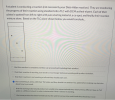 A student is conducting a reaction (not necessarily your Diels-Alder reaction). They are monitoring the progress of their reaction using standard silica TLC with DCM as their eluent. Each of their plates is spotted from left to right with pure starting material, a co-spot, and finally, their reaction mixture alone. Based on the TLC place shown below, you would conclude... that the reaction is complete and they can proceed with isolating their product. that their reaction is working, but needs...
please explain as well, thank you. (8) 1. Draw all the molecular orbitals for the X-system of the allyl anion. Indic...
 please explain as well, thank you.
(8) 1. Draw all the molecular orbitals for the X-system of the allyl anion. Indicate which orbital is the HOMO. (20) 2. Provide reasonable product structures for the following reactions. Indicate clearly if you expect one isomer to predominate. NBS/ROOH D-Br (1 mg) +25°C (1g) -40 °C ) Br (1 e -78 "C (12) 3. Provide product structures for the following Diels-Alder reactions. The second Diels-Alder product eliminates a neutral substance upon further heating....
please explain as well, thank you.
(8) 1. Draw all the molecular orbitals for the X-system of the allyl anion. Indicate which orbital is the HOMO. (20) 2. Provide reasonable product structures for the following reactions. Indicate clearly if you expect one isomer to predominate. NBS/ROOH D-Br (1 mg) +25°C (1g) -40 °C ) Br (1 e -78 "C (12) 3. Provide product structures for the following Diels-Alder reactions. The second Diels-Alder product eliminates a neutral substance upon further heating....
1. Synthetic organic chemists have established clever ways for probing the mechanisms of chemical reactions. In...
 1. Synthetic organic chemists have established clever ways for probing the mechanisms of chemical reactions. In general, a preference for anti- periplanar elimination is observed; however, under some conditions the syn-periplanar elimination product can be observed. How do chemists tell the difference between anti-and syn-periplanar eliminations? Let's find out! The reaction of the substrate below under E2 conditions (NaOEt in ethanol) will give different products by syn- and anti- elimination mechanisms. By analyzing the distribution of the products, organic chemists...
 Make a prediction of the rate of Aiels-Alder reaction. Give
reasoning.
2. The nature of the diene has a very important effect on the rate of the Diels-Alder reactions. Make a prediction on the rate of Diels-Alder reaction with the following dienes, and provide a simple explanation for your reasoning. You may need to research this, (check your Organic Chemistry textbook), in particular the concepts of s -cis and s -trans. (Hint: a is the fastest in this series, and...
Make a prediction of the rate of Aiels-Alder reaction. Give
reasoning.
2. The nature of the diene has a very important effect on the rate of the Diels-Alder reactions. Make a prediction on the rate of Diels-Alder reaction with the following dienes, and provide a simple explanation for your reasoning. You may need to research this, (check your Organic Chemistry textbook), in particular the concepts of s -cis and s -trans. (Hint: a is the fastest in this series, and...
 Questions 1. Why does the trans conformation of a diene, in reaction with a dienophile, not lead to a Diels-Alder reaction product? 2. Complete the following Diels-Alder reactions. Provide the major endo-product(s). Dienophile Product(s) 3. How many i electrons are there in a molecule of 1,3-butadiene?
 This is an organic chemistry question regarding the
Diels-Alder reaction. The problems are 16.22 and 16.18. I would
like to know if I did these correctly. If I did not, could someone
help me go through the process?
er reaction Conjugation, Resonance and Dienes Chapter 16 dienophile react in a Diels-Alder CH3 C. 16.18 Draw the product formed when each diene and Problem 16.18 COOCH3 15 Specific Rules Governing the Diels-Alder Reaction 16.13A Diene Reactivity Rule [1] The diene can...
This is an organic chemistry question regarding the
Diels-Alder reaction. The problems are 16.22 and 16.18. I would
like to know if I did these correctly. If I did not, could someone
help me go through the process?
er reaction Conjugation, Resonance and Dienes Chapter 16 dienophile react in a Diels-Alder CH3 C. 16.18 Draw the product formed when each diene and Problem 16.18 COOCH3 15 Specific Rules Governing the Diels-Alder Reaction 16.13A Diene Reactivity Rule [1] The diene can...
 5. Arrange the following solvents in increasing order of reaction rate for Diels-Alder reaction between anthracene and 1,3-dimethylcyclopentene. Draw structure of product with appropriate stereochemistry. 10 points Ethyl acetate diisopropyl ether Ethanol Water Hexane The same order of reactivity would not necessarily result in the highest yield of the product - meaning, the solvent with highest reactivity would not necessarily give you the most amount of product based on procedure employed in the lab. Explain why this is so.
 EXPERIMENT 2A DIELS-ALDER REACTION OF ANTHRACENE REFERENCES Pavia et al (4/e): Tech. 6.1/6.2, 7.2-7.4 Klein (1/e) pp. 784-792 EQUATION heat Diels-Alder Adduct 9,30-dihydroanthracene-9,10- endo-o B-seccinic anhydride mp 262264 PROCEDURE Place 0.200 grams of anthracene and an equal molar amount of maleic anhydride in 5 mL of xylenes in a 10-mL round-bottom flask with a magnetic stir bar. Attach a water-cooled condenser and reflux for 60 minutes. Allow the solution to cool to room temperature and then place the flask in...
 A student is conducting a reaction (not necessarily your Diels-Alder reaction). They are monitoring the progress of their reaction using standard silica TLC with DCM as their eluent. Each of their plates is spotted from left to right with pure starting material, a co-spot, and finally, their reaction mixture alone. Based on the TLC place shown below, you would conclude... that the reaction is complete and they can proceed with isolating their product. that their reaction is working, but needs...
 please explain as well, thank you.
(8) 1. Draw all the molecular orbitals for the X-system of the allyl anion. Indicate which orbital is the HOMO. (20) 2. Provide reasonable product structures for the following reactions. Indicate clearly if you expect one isomer to predominate. NBS/ROOH D-Br (1 mg) +25°C (1g) -40 °C ) Br (1 e -78 "C (12) 3. Provide product structures for the following Diels-Alder reactions. The second Diels-Alder product eliminates a neutral substance upon further heating....
please explain as well, thank you.
(8) 1. Draw all the molecular orbitals for the X-system of the allyl anion. Indicate which orbital is the HOMO. (20) 2. Provide reasonable product structures for the following reactions. Indicate clearly if you expect one isomer to predominate. NBS/ROOH D-Br (1 mg) +25°C (1g) -40 °C ) Br (1 e -78 "C (12) 3. Provide product structures for the following Diels-Alder reactions. The second Diels-Alder product eliminates a neutral substance upon further heating....
 1. Synthetic organic chemists have established clever ways for probing the mechanisms of chemical reactions. In general, a preference for anti- periplanar elimination is observed; however, under some conditions the syn-periplanar elimination product can be observed. How do chemists tell the difference between anti-and syn-periplanar eliminations? Let's find out! The reaction of the substrate below under E2 conditions (NaOEt in ethanol) will give different products by syn- and anti- elimination mechanisms. By analyzing the distribution of the products, organic chemists...
Most questions answered within 3 hours.
-
Where is the error in this code sequence?
String s1 = "Hello";
String s2 = "ello";...
asked 10 months ago -
Financial data for Joel de Paris, Inc., for last year
follow:
Joel de Paris, Inc.
Balance...
asked 10 months ago -
Consider this reaction:
Al2(SO4)3 (aq)+ BaCl3
(aq) Al2Cl6 (aq)- +
3BaSO4(s) . What is the...
asked 10 months ago -
Suppose that Savneet is considering increasing her
recent random sample from 20 car rentals to 40...
asked 10 months ago -
Trucks arrive at an unloading terminal at an average rate of 120
per hour.
Trucks arrive...
asked 10 months ago -
Why are methanol and ethanol completely soluble in water while
octanol is not very little soluble....
asked 10 months ago -
A facilities manager at a university reads in a research report
that the mean amount of...
asked 10 months ago -
When the CuSO4 is rehydrated by adding water to the anhydrous
compound, is this an endothermic...
asked 10 months ago -
A ray of sunlight is passing from diamond into crown glass; the
angle of incidence is...
asked 10 months ago -
A block of mass 0.249 kg is placed on top of a light, vertical
spring of...
asked 10 months ago -
how do the kidneys compensate in the presences of acidosis
a) trigger hyperventilate
b) reserve acid...
asked 10 months ago -
Question 501 pts
The rental rate of capital to the firm increases. Which of the
following...
asked 10 months ago