how can a reasonable approximation for time to steady state of an RC circuit be computed
how can a reasonable approximation for time to steady state of an RC circuit be computed
Homework Answers

Add Answer to:
how can a reasonable approximation for time to steady
state of an RC circuit be computed
Could you explain how to Simplicate the circuit in Steady State after a long time? What...
 Could you explain how to Simplicate the circuit in Steady
State after a long time?
What are the rules for reaching steady state and does it
effect other resistors?
30 120V 50V 300 600 Problem 6 (15 points). After a very long time and after all the connections were made in the following circuit, calculate the voltage and power in the 400 resistance. 2H 1F 124 20e 2H -> 120 1200 1F 400 150 120V SA VAne: 100v Prne =...
Could you explain how to Simplicate the circuit in Steady
State after a long time?
What are the rules for reaching steady state and does it
effect other resistors?
30 120V 50V 300 600 Problem 6 (15 points). After a very long time and after all the connections were made in the following circuit, calculate the voltage and power in the 400 resistance. 2H 1F 124 20e 2H -> 120 1200 1F 400 150 120V SA VAne: 100v Prne =...
You have the following circuit in sinusoidal steady-state. Use phasor circuit analysis to find the time...
 You have the following circuit in sinusoidal
steady-state.
Use phasor circuit analysis to find the time domain expression
for the steady-state current, i(t), and steady-state voltages,
VR(t), VC(t) and VL(t).
Vs(t) = 50 cos(1000t) Volts.
Problem 1 (20 points) You have the following circuit in sinusoidal steady-state. Use phasor circuit analysis to find the time domain expression for the steady-state current, i(t), and steady- state voltages, Vr(t), Vc(t) and Vl(t). Vs(t) = 50 cos(1000t) Volts. i(t) 100 12 25 mH...
You have the following circuit in sinusoidal
steady-state.
Use phasor circuit analysis to find the time domain expression
for the steady-state current, i(t), and steady-state voltages,
VR(t), VC(t) and VL(t).
Vs(t) = 50 cos(1000t) Volts.
Problem 1 (20 points) You have the following circuit in sinusoidal steady-state. Use phasor circuit analysis to find the time domain expression for the steady-state current, i(t), and steady- state voltages, Vr(t), Vc(t) and Vl(t). Vs(t) = 50 cos(1000t) Volts. i(t) 100 12 25 mH...
2) a) Briefly describe what is meant by the steady-state approximation. tha Stredy state approximation says...
 2) a) Briefly describe what is meant by the steady-state approximation. tha Stredy state approximation says that we can assime the reaction is taking place ander Steady state conditions b) Consider the following reaction scheme: Express the net rate of change for B. 10+ mate = -d/A] + - + [6] + - d[e] of change dt dt at c) Provide a detailed reason why D may be quite abundant initially, but virtually gone after several hours. i n niin4...
What is the ratio of the time for the capacitor in an RC series circuit to...
What is the ratio of the time for the capacitor in an RC series circuit to reach 90% of capacity from an empty state, to that for the circuit to discharge from a ‘full’ state to 90% capacity?
How do I use Complete Response = Transient Response + Steady State Response and Complete Response...
 How do I use Complete Response = Transient Response + Steady
State Response and Complete Response = Natural Response + Forced
Response for a Step Response RC Circuit.
How do I use KVL and Mesh Analysis for a Step Response RL
Circuit.
Figure 7.40 An RC circuit with voltage step input. Figure 7.48 An RL circuit with a step input voltage.
How do I use Complete Response = Transient Response + Steady
State Response and Complete Response = Natural Response + Forced
Response for a Step Response RC Circuit.
How do I use KVL and Mesh Analysis for a Step Response RL
Circuit.
Figure 7.40 An RC circuit with voltage step input. Figure 7.48 An RL circuit with a step input voltage.
The circuit on the right has been on for a long time has reached steady state....
 The circuit on the right has been on for a long time has reached steady state. a) What are the currents through each of the three resistors (Three answers please.) b) Mark the directions of the three currents in the circuit. c) What is the charge on the capacitor?
Which of the following statements about the steady state approximation is/are correct? The change of intermediate...
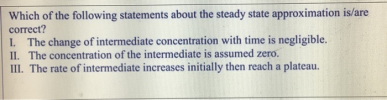 Which of the following statements about the steady state approximation is/are correct? The change of intermediate concentration with time is negligible. II. The concentration of the intermediate is assumed zero. III. The rate of intermediate increases initially then reach a plateau. I.
“Before the switch closes” The circuit is at steady state before the switch opens at time...
 “Before the switch closes”
The circuit is at steady state before the switch opens at time t-. The input to the circuit is the vol tage of the voltage source, 12 V. The output of this circuit is the voltage across the capacitor,v() Determine v() for t>0. Show al work. 10k2 12 V
“Before the switch closes”
The circuit is at steady state before the switch opens at time t-. The input to the circuit is the vol tage of the voltage source, 12 V. The output of this circuit is the voltage across the capacitor,v() Determine v() for t>0. Show al work. 10k2 12 V
2. The time constant for any given RC circuit is the value of the effective resistance...
 2. The time constant for any given RC circuit is the value of the effective resistance of the circuit multiplied by the effec- tive capacitance of the circuit. What is the value of the time constant for the circuit below? 20 ko 500 F 2000 5 500 2000 3. For the circuit below, the switch is closed and steady-state conditions have been reached, meaning the capacitor is full charged 10Ω А B с 12 V 3Ω 422 20 6 F...
3. What is the time constant in an RC circuit? How much energy stored in a...
 3. What is the time constant in an RC circuit? How much energy stored in a capacitor of 10 u F with charge of 24 C.
 Could you explain how to Simplicate the circuit in Steady
State after a long time?
What are the rules for reaching steady state and does it
effect other resistors?
30 120V 50V 300 600 Problem 6 (15 points). After a very long time and after all the connections were made in the following circuit, calculate the voltage and power in the 400 resistance. 2H 1F 124 20e 2H -> 120 1200 1F 400 150 120V SA VAne: 100v Prne =...
Could you explain how to Simplicate the circuit in Steady
State after a long time?
What are the rules for reaching steady state and does it
effect other resistors?
30 120V 50V 300 600 Problem 6 (15 points). After a very long time and after all the connections were made in the following circuit, calculate the voltage and power in the 400 resistance. 2H 1F 124 20e 2H -> 120 1200 1F 400 150 120V SA VAne: 100v Prne =...
 You have the following circuit in sinusoidal
steady-state.
Use phasor circuit analysis to find the time domain expression
for the steady-state current, i(t), and steady-state voltages,
VR(t), VC(t) and VL(t).
Vs(t) = 50 cos(1000t) Volts.
Problem 1 (20 points) You have the following circuit in sinusoidal steady-state. Use phasor circuit analysis to find the time domain expression for the steady-state current, i(t), and steady- state voltages, Vr(t), Vc(t) and Vl(t). Vs(t) = 50 cos(1000t) Volts. i(t) 100 12 25 mH...
You have the following circuit in sinusoidal
steady-state.
Use phasor circuit analysis to find the time domain expression
for the steady-state current, i(t), and steady-state voltages,
VR(t), VC(t) and VL(t).
Vs(t) = 50 cos(1000t) Volts.
Problem 1 (20 points) You have the following circuit in sinusoidal steady-state. Use phasor circuit analysis to find the time domain expression for the steady-state current, i(t), and steady- state voltages, Vr(t), Vc(t) and Vl(t). Vs(t) = 50 cos(1000t) Volts. i(t) 100 12 25 mH...
 2) a) Briefly describe what is meant by the steady-state approximation. tha Stredy state approximation says that we can assime the reaction is taking place ander Steady state conditions b) Consider the following reaction scheme: Express the net rate of change for B. 10+ mate = -d/A] + - + [6] + - d[e] of change dt dt at c) Provide a detailed reason why D may be quite abundant initially, but virtually gone after several hours. i n niin4...
 How do I use Complete Response = Transient Response + Steady
State Response and Complete Response = Natural Response + Forced
Response for a Step Response RC Circuit.
How do I use KVL and Mesh Analysis for a Step Response RL
Circuit.
Figure 7.40 An RC circuit with voltage step input. Figure 7.48 An RL circuit with a step input voltage.
How do I use Complete Response = Transient Response + Steady
State Response and Complete Response = Natural Response + Forced
Response for a Step Response RC Circuit.
How do I use KVL and Mesh Analysis for a Step Response RL
Circuit.
Figure 7.40 An RC circuit with voltage step input. Figure 7.48 An RL circuit with a step input voltage.
 The circuit on the right has been on for a long time has reached steady state. a) What are the currents through each of the three resistors (Three answers please.) b) Mark the directions of the three currents in the circuit. c) What is the charge on the capacitor?
 Which of the following statements about the steady state approximation is/are correct? The change of intermediate concentration with time is negligible. II. The concentration of the intermediate is assumed zero. III. The rate of intermediate increases initially then reach a plateau. I.
 “Before the switch closes”
The circuit is at steady state before the switch opens at time t-. The input to the circuit is the vol tage of the voltage source, 12 V. The output of this circuit is the voltage across the capacitor,v() Determine v() for t>0. Show al work. 10k2 12 V
“Before the switch closes”
The circuit is at steady state before the switch opens at time t-. The input to the circuit is the vol tage of the voltage source, 12 V. The output of this circuit is the voltage across the capacitor,v() Determine v() for t>0. Show al work. 10k2 12 V
 2. The time constant for any given RC circuit is the value of the effective resistance of the circuit multiplied by the effec- tive capacitance of the circuit. What is the value of the time constant for the circuit below? 20 ko 500 F 2000 5 500 2000 3. For the circuit below, the switch is closed and steady-state conditions have been reached, meaning the capacitor is full charged 10Ω А B с 12 V 3Ω 422 20 6 F...
 3. What is the time constant in an RC circuit? How much energy stored in a capacitor of 10 u F with charge of 24 C.
Most questions answered within 3 hours.
-
Where is the error in this code sequence?
String s1 = "Hello";
String s2 = "ello";...
asked 11 months ago -
Financial data for Joel de Paris, Inc., for last year
follow:
Joel de Paris, Inc.
Balance...
asked 11 months ago -
Consider this reaction:
Al2(SO4)3 (aq)+ BaCl3
(aq) Al2Cl6 (aq)- +
3BaSO4(s) . What is the...
asked 11 months ago -
Suppose that Savneet is considering increasing her
recent random sample from 20 car rentals to 40...
asked 11 months ago -
Trucks arrive at an unloading terminal at an average rate of 120
per hour.
Trucks arrive...
asked 11 months ago -
Why are methanol and ethanol completely soluble in water while
octanol is not very little soluble....
asked 11 months ago -
A facilities manager at a university reads in a research report
that the mean amount of...
asked 11 months ago -
When the CuSO4 is rehydrated by adding water to the anhydrous
compound, is this an endothermic...
asked 11 months ago -
A ray of sunlight is passing from diamond into crown glass; the
angle of incidence is...
asked 11 months ago -
A block of mass 0.249 kg is placed on top of a light, vertical
spring of...
asked 11 months ago -
how do the kidneys compensate in the presences of acidosis
a) trigger hyperventilate
b) reserve acid...
asked 11 months ago -
Question 501 pts
The rental rate of capital to the firm increases. Which of the
following...
asked 11 months ago