Consider the substitution reaction: [M(H2O)6]+n + H218O -> [M(H2O)5(H218O)]+n + H2O The rate of H2O exchange...
Consider the substitution reaction: [M(H2O)6]+n + H218O -> [M(H2O)5(H218O)]+n + H2O
The rate of H2O exchange varies over many magnitudes
depending on the metal ion. Place the following metal complexes in
order of increasing rate of H2O substitution (slowest to
fastest) and give your reasoning.
a) Na+(aq), Al3+(aq),
Mg2+(aq)
b) [Fe(H2O)6]2+ ,
[Cu(H2O)6]2+ ,
[V(H2O)6]2+
Homework Answers

Add Answer to:
Consider the substitution reaction:
[M(H2O)6]+n +
H218O ->
[M(H2O)5(H218O)]+n
+ H2O
The rate of H2O exchange...
RODOX EXAMINATION An oxidation-reduction reaction involves the (1) sharing of electrons &n
RODOX EXAMINATION An oxidation-reduction reaction involves the (1) sharing of electrons (3) transfer of electrons (2) sharing of protons (4) transfer of protons In this reaction, CO→ 2 CO + O2 the oxidation number of carbon changes from: (1) 0 to +4 (3) +3 to 0 (2) +2 to +4 (4) +4 to +2 Which balanced equation represents a redox reaction? AgNO3 (aq) +NaCl (aq) →AgCl (s) +NaNO3 (aq) H2CO3 (aq)...
Please draw the d-orbital splitting diagrams for each [M(H2O)6]^n+ [Cr(H2O)6]^3+ [Fe(H2O)6]^2+ [Co(H2O)6]^2+ [Ni(H2O)6]^2+ [Cu(H2O)6]^2+
Please draw the d-orbital splitting diagrams for each [M(H2O)6]^n+ [Cr(H2O)6]^3+ [Fe(H2O)6]^2+ [Co(H2O)6]^2+ [Ni(H2O)6]^2+ [Cu(H2O)6]^2+
Problems about reaction n 4) The rate law for the substitution of NH3 for H20 in...
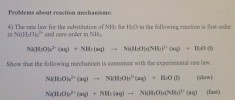 Problems about reaction n 4) The rate law for the substitution of NH3 for H20 in the following reaction is first order in Ni(H2O and zero order in NH3 Ni(H2O)62 + (aq) + NH3(aq) → Ni(H2O)s(NH3)2+ (aq) + H2O (1) Show that the following mechanism is consistent with the experimental rate law. Ni(H2O)62+ (aq) → Ni(H2O)S2+ (aq) +H2O(l) (slow) Ni(H2O),» (aq) + NH3 (aq) → Ni(H2O)5(NH3)2+(aq) (fast)
8-10 8. Determine the reduction potential for H2O(l) in neutral water: [H"]= [OH = 10? (6...
 8-10
8. Determine the reduction potential for H2O(l) in neutral water: [H"]= [OH = 10? (6 points) (P. = 1 atm) 9. A cobalt electrode is placed in 1.00 L of I M CO(NO3)2(aq) and a chromium electrode is placed in 1.00 L of IM Cr(NO3)3(aq). Electrodes are connected by a wire through a voltmeter and the solutions are connected by a salt bridge. (16 points) a. The reduction reaction will be: b. The oxidation reaction will be: c. The...
8-10
8. Determine the reduction potential for H2O(l) in neutral water: [H"]= [OH = 10? (6 points) (P. = 1 atm) 9. A cobalt electrode is placed in 1.00 L of I M CO(NO3)2(aq) and a chromium electrode is placed in 1.00 L of IM Cr(NO3)3(aq). Electrodes are connected by a wire through a voltmeter and the solutions are connected by a salt bridge. (16 points) a. The reduction reaction will be: b. The oxidation reaction will be: c. The...
Rate Laws (Section)Consider the reaction of peroxydisulfate ion (S2O8 2-) with iodide ion (I - )...
Rate Laws (Section)Consider the reaction of peroxydisulfate ion (S2O8 2-) with iodide ion (I - ) in aqueous solution:S2O82 - (aq) + 3 I - (aq)→2 SO42 - (aq) + I3- (aq)At a particular temperature the initial rate of disappearance of S2O8 2 - varies with reactant concentrations in the following manner:Experiment[S2O82‑] (M)[I_] (M)Initial Rate (M/S)10.0180.0362.6 × 10-620.0270.0363.9 × 10-630.0360.0547.8 × 10-640.0500.0721.4 × 10-5(a) Determine the rate law for the reaction and state the units of the rate constant. (b)...
Consider the reaction of peroxydisulfate ion (S20;-) with iodide ion (I) in aqueous solution: S2O3- (aq)...
 Consider the reaction of peroxydisulfate ion (S20;-) with iodide ion (I) in aqueous solution: S2O3- (aq) + 31- (aq) +250- (aq) +15 (aq). At a particular temperature the rate of disappearance of S20% varies with reactant concentrations in the following manner: 1 Experiment S20%- (M) I- (M) Initial Rate (M/s) 0.018 0.036 2.6 x 10⁻⁶ 0.027 0.036 3.9 x 10⁻⁶ 0.036 0.054 7.8 x 10⁻⁶ N 3 4 0.050 0.072 1.4 x 10⁻⁵ Part D What is the rate of...
1. What is the crystal field stabilisation energy (CFSE) of a d5 metal ion in an...
1. What is the crystal field stabilisation energy (CFSE) of a d5 metal ion in an octahedral ligand field surrounded by weak field ligands? +5Dq -20Dq 0Dq -5Dq -20Dq + P 2. The relative ordering of the d orbital energy levels for a complex such as [Cu(H2O)6]2+ which exhibits tetragonal elongation due to the Jahn-Teller Effect is: Group of answer choices xz = yz = xy < x2-y2 = z2 xy < xz = yz < x2-y2 < z2 xz...
Use data above answer questions 2,3,4 EXPERIMENT: Activity of Metals and Ions Part I: n this...
 Use data above answer questions 2,3,4
EXPERIMENT: Activity of Metals and Ions Part I: n this experiment, you will examine the relative tendencies for certain elements to replace one compounds and will use your observations to arrange order of reactivity. The reactions will all be single replacement reactions in which a metallic element is replacing a metal ion in a compound. another in them in metal metal ion in compound Add a small piece of each of the metals listed...
Use data above answer questions 2,3,4
EXPERIMENT: Activity of Metals and Ions Part I: n this experiment, you will examine the relative tendencies for certain elements to replace one compounds and will use your observations to arrange order of reactivity. The reactions will all be single replacement reactions in which a metallic element is replacing a metal ion in a compound. another in them in metal metal ion in compound Add a small piece of each of the metals listed...
Data analysis: write the net ionic equations for any reactions that occurred between the metals and metal ions list occurred with N.R. Indicate any combinations where no reaction ed below (sect...
 Data analysis: write the net ionic equations for any reactions that occurred between the metals and metal ions list occurred with N.R. Indicate any combinations where no reaction ed below (section la). e Lead ion and zinc . Lead ion and copper Zinc ion and lead . Zinc ion and copper . Copper(II) ion and lead . Copper(II) ion and zinc 2. In your notebook, write the net ionic equations for the react tions that occurred between the metals and...
Candidate l: Zn(s) | Zn2+(aq,0.500 M) I Cu2+(aq, 1.00 M) Cu(s) Candidate 2: Pb(s) | Pb2+(aq,...
 Candidate l: Zn(s) | Zn2+(aq,0.500 M) I Cu2+(aq, 1.00 M) Cu(s) Candidate 2: Pb(s) | Pb2+(aq, 0.500 M) || Cu2+(aq, 1.00 M) Cu(s) Candidate 3: Mg(s) | Mg2+(aq, 0.500 M) | Pb2+(aq, 1.00 M)| Pb(s) (a) 6 pts) Choose one of the candidate voltaic cells #1, #2, or #3. Draw a schematic cell diagram for the candidate voltaic cell of choice. Clearly label anode, cathode, electrodes, ions and their concentrations, salt bridge, and the flow of electrons. (b) (5 pts)...
 Problems about reaction n 4) The rate law for the substitution of NH3 for H20 in the following reaction is first order in Ni(H2O and zero order in NH3 Ni(H2O)62 + (aq) + NH3(aq) → Ni(H2O)s(NH3)2+ (aq) + H2O (1) Show that the following mechanism is consistent with the experimental rate law. Ni(H2O)62+ (aq) → Ni(H2O)S2+ (aq) +H2O(l) (slow) Ni(H2O),» (aq) + NH3 (aq) → Ni(H2O)5(NH3)2+(aq) (fast)
 8-10
8. Determine the reduction potential for H2O(l) in neutral water: [H"]= [OH = 10? (6 points) (P. = 1 atm) 9. A cobalt electrode is placed in 1.00 L of I M CO(NO3)2(aq) and a chromium electrode is placed in 1.00 L of IM Cr(NO3)3(aq). Electrodes are connected by a wire through a voltmeter and the solutions are connected by a salt bridge. (16 points) a. The reduction reaction will be: b. The oxidation reaction will be: c. The...
8-10
8. Determine the reduction potential for H2O(l) in neutral water: [H"]= [OH = 10? (6 points) (P. = 1 atm) 9. A cobalt electrode is placed in 1.00 L of I M CO(NO3)2(aq) and a chromium electrode is placed in 1.00 L of IM Cr(NO3)3(aq). Electrodes are connected by a wire through a voltmeter and the solutions are connected by a salt bridge. (16 points) a. The reduction reaction will be: b. The oxidation reaction will be: c. The...
 Consider the reaction of peroxydisulfate ion (S20;-) with iodide ion (I) in aqueous solution: S2O3- (aq) + 31- (aq) +250- (aq) +15 (aq). At a particular temperature the rate of disappearance of S20% varies with reactant concentrations in the following manner: 1 Experiment S20%- (M) I- (M) Initial Rate (M/s) 0.018 0.036 2.6 x 10⁻⁶ 0.027 0.036 3.9 x 10⁻⁶ 0.036 0.054 7.8 x 10⁻⁶ N 3 4 0.050 0.072 1.4 x 10⁻⁵ Part D What is the rate of...
 Use data above answer questions 2,3,4
EXPERIMENT: Activity of Metals and Ions Part I: n this experiment, you will examine the relative tendencies for certain elements to replace one compounds and will use your observations to arrange order of reactivity. The reactions will all be single replacement reactions in which a metallic element is replacing a metal ion in a compound. another in them in metal metal ion in compound Add a small piece of each of the metals listed...
Use data above answer questions 2,3,4
EXPERIMENT: Activity of Metals and Ions Part I: n this experiment, you will examine the relative tendencies for certain elements to replace one compounds and will use your observations to arrange order of reactivity. The reactions will all be single replacement reactions in which a metallic element is replacing a metal ion in a compound. another in them in metal metal ion in compound Add a small piece of each of the metals listed...
 Data analysis: write the net ionic equations for any reactions that occurred between the metals and metal ions list occurred with N.R. Indicate any combinations where no reaction ed below (section la). e Lead ion and zinc . Lead ion and copper Zinc ion and lead . Zinc ion and copper . Copper(II) ion and lead . Copper(II) ion and zinc 2. In your notebook, write the net ionic equations for the react tions that occurred between the metals and...
 Candidate l: Zn(s) | Zn2+(aq,0.500 M) I Cu2+(aq, 1.00 M) Cu(s) Candidate 2: Pb(s) | Pb2+(aq, 0.500 M) || Cu2+(aq, 1.00 M) Cu(s) Candidate 3: Mg(s) | Mg2+(aq, 0.500 M) | Pb2+(aq, 1.00 M)| Pb(s) (a) 6 pts) Choose one of the candidate voltaic cells #1, #2, or #3. Draw a schematic cell diagram for the candidate voltaic cell of choice. Clearly label anode, cathode, electrodes, ions and their concentrations, salt bridge, and the flow of electrons. (b) (5 pts)...
Most questions answered within 3 hours.
-
Where is the error in this code sequence?
String s1 = "Hello";
String s2 = "ello";...
asked 10 months ago -
Financial data for Joel de Paris, Inc., for last year
follow:
Joel de Paris, Inc.
Balance...
asked 10 months ago -
Consider this reaction:
Al2(SO4)3 (aq)+ BaCl3
(aq) Al2Cl6 (aq)- +
3BaSO4(s) . What is the...
asked 10 months ago -
Suppose that Savneet is considering increasing her
recent random sample from 20 car rentals to 40...
asked 10 months ago -
Trucks arrive at an unloading terminal at an average rate of 120
per hour.
Trucks arrive...
asked 10 months ago -
Why are methanol and ethanol completely soluble in water while
octanol is not very little soluble....
asked 10 months ago -
A facilities manager at a university reads in a research report
that the mean amount of...
asked 10 months ago -
When the CuSO4 is rehydrated by adding water to the anhydrous
compound, is this an endothermic...
asked 10 months ago -
A ray of sunlight is passing from diamond into crown glass; the
angle of incidence is...
asked 10 months ago -
A block of mass 0.249 kg is placed on top of a light, vertical
spring of...
asked 10 months ago -
how do the kidneys compensate in the presences of acidosis
a) trigger hyperventilate
b) reserve acid...
asked 10 months ago -
Question 501 pts
The rental rate of capital to the firm increases. Which of the
following...
asked 10 months ago