Write chemical equation for propagation step of cationic polymerization for polystyrene .
Write chemical equation for propagation step of cationic polymerization for polystyrene
.
Homework Answers

Add Answer to:
Write chemical equation for propagation step of cationic
polymerization for polystyrene
.
Draw the mechanism for the cationic polymerization of styrene using H2SO4 as initiator. Include initiation, propagation,...
Draw the mechanism for the cationic polymerization of styrene using H2SO4 as initiator. Include initiation, propagation, ion pair rearrangement, and chain transfer to monomer
reaction mech: initiation , propagation, and termination of the synthesis of polystyrene Polymersti 2. Write the...
 reaction mech: initiation , propagation, and termination of
the synthesis of polystyrene
Polymersti 2. Write the reaction mechanism (showing arrows) of the synthesis of polystyrene. 4pts • Include and show arrows in 2 initiation steps with benzoyl peroxide forming the phenyl radical. (this is shown in Figure 9 of the lab- just add all arrows) A propagation step of the styrene (the monomer) and phenyl radical. A second propagation step showing polymer growth by reacting styrene and the radical product...
reaction mech: initiation , propagation, and termination of
the synthesis of polystyrene
Polymersti 2. Write the reaction mechanism (showing arrows) of the synthesis of polystyrene. 4pts • Include and show arrows in 2 initiation steps with benzoyl peroxide forming the phenyl radical. (this is shown in Figure 9 of the lab- just add all arrows) A propagation step of the styrene (the monomer) and phenyl radical. A second propagation step showing polymer growth by reacting styrene and the radical product...
DRAW OUT STRUCTURAL REACTION FOR: 1. STEP POLYMERIZATION 2. RADICAL POLYMERIZATION 3. CATIONIC POLYMERIZATION 4. ANIONIC...
DRAW OUT STRUCTURAL REACTION FOR: 1. STEP POLYMERIZATION 2. RADICAL POLYMERIZATION 3. CATIONIC POLYMERIZATION 4. ANIONIC POLYMERIZATION 5. HOMOLYTIC AND HETEROLYTIC CLEAVAGE
Write a detailed mechanism for the polymerization of styrene in the presence of benzoyl peroxide. The...
Write a detailed mechanism for the polymerization of styrene in the presence of benzoyl peroxide. The mechanism should include three distinct steps: initiation, propagation, and termination. For propagation, show the first three polystyrene units.
Free Radical Polymerization Mechanism - Draw the mechanism for the polystyrene-forming reaction with the reactants shown...
 Free Radical Polymerization Mechanism - Draw the mechanism for the polystyrene-forming reaction with the reactants shown below: a. Initiation b. Propagation c. Termination
Which polymerization technique (anionic or cationic) would be the best to use for the polymerization of...
Which polymerization technique (anionic or cationic) would be the best to use for the polymerization of isobutyl vinyl ether?
5. Tetrahydrofuran is a useful solvent in anionic polymerization but cannot be used in cationic polymerization....
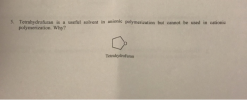 5. Tetrahydrofuran is a useful solvent in anionic polymerization but cannot be used in cationic polymerization. Why? Tetrahydrofuran
Draw a mech. For polymerization using butylithium as initiator. Show the initiation one chain propagation step...
 Draw a mech. For polymerization using butylithium as initiator.
Show the initiation one chain propagation step and use H+ to
terminate growth.
Draw a mech. For polymerization using butylithium as initiator.
Show the initiation one chain propagation step and use H+ to
terminate growth.
1.Give the mechanism for the polymerization of methyl acrylate. Condensation polymerization Radical polymerization Cationic polymerization Anionic...
1.Give the mechanism for the polymerization of methyl acrylate. Condensation polymerization Radical polymerization Cationic polymerization Anionic polymerization 2.Give the amount of sulfur in hard rubber 1 to 2% sulfur 2 to 5% sulfur 15% sulfur 10 to 30% sulfur 50% sulfur 3. List the small molecule that is expelled from the formation of Lexan®. ) Water Ammonia Methanol Hydrochloric acid Hydrobromic acid
POLYSTYRENE: 1. Describe the resin before adding the polymerization catalyst. 2. What is the principle component...
 POLYSTYRENE: 1. Describe the resin before adding the polymerization catalyst. 2. What is the principle component of this resin before polymerization? Draw its structure. 3. Describe the resin after hardening. 4. What is the principle component of this solid polymer? Draw its structure. 5. What is the initiator in this reaction? What is its purpose? NYLON-6,6: 1. Describe the rope formed (i.e. is it rigid or flexible, what is its color, etc.). White, opaque, flexible, tragile 2. What type of...
 reaction mech: initiation , propagation, and termination of
the synthesis of polystyrene
Polymersti 2. Write the reaction mechanism (showing arrows) of the synthesis of polystyrene. 4pts • Include and show arrows in 2 initiation steps with benzoyl peroxide forming the phenyl radical. (this is shown in Figure 9 of the lab- just add all arrows) A propagation step of the styrene (the monomer) and phenyl radical. A second propagation step showing polymer growth by reacting styrene and the radical product...
reaction mech: initiation , propagation, and termination of
the synthesis of polystyrene
Polymersti 2. Write the reaction mechanism (showing arrows) of the synthesis of polystyrene. 4pts • Include and show arrows in 2 initiation steps with benzoyl peroxide forming the phenyl radical. (this is shown in Figure 9 of the lab- just add all arrows) A propagation step of the styrene (the monomer) and phenyl radical. A second propagation step showing polymer growth by reacting styrene and the radical product...
 Free Radical Polymerization Mechanism - Draw the mechanism for the polystyrene-forming reaction with the reactants shown below: a. Initiation b. Propagation c. Termination
 5. Tetrahydrofuran is a useful solvent in anionic polymerization but cannot be used in cationic polymerization. Why? Tetrahydrofuran
 Draw a mech. For polymerization using butylithium as initiator.
Show the initiation one chain propagation step and use H+ to
terminate growth.
Draw a mech. For polymerization using butylithium as initiator.
Show the initiation one chain propagation step and use H+ to
terminate growth.
 POLYSTYRENE: 1. Describe the resin before adding the polymerization catalyst. 2. What is the principle component of this resin before polymerization? Draw its structure. 3. Describe the resin after hardening. 4. What is the principle component of this solid polymer? Draw its structure. 5. What is the initiator in this reaction? What is its purpose? NYLON-6,6: 1. Describe the rope formed (i.e. is it rigid or flexible, what is its color, etc.). White, opaque, flexible, tragile 2. What type of...
Most questions answered within 3 hours.
-
Where is the error in this code sequence?
String s1 = "Hello";
String s2 = "ello";...
asked 10 months ago -
Financial data for Joel de Paris, Inc., for last year
follow:
Joel de Paris, Inc.
Balance...
asked 10 months ago -
Consider this reaction:
Al2(SO4)3 (aq)+ BaCl3
(aq) Al2Cl6 (aq)- +
3BaSO4(s) . What is the...
asked 10 months ago -
Suppose that Savneet is considering increasing her
recent random sample from 20 car rentals to 40...
asked 10 months ago -
Trucks arrive at an unloading terminal at an average rate of 120
per hour.
Trucks arrive...
asked 10 months ago -
Why are methanol and ethanol completely soluble in water while
octanol is not very little soluble....
asked 10 months ago -
A facilities manager at a university reads in a research report
that the mean amount of...
asked 10 months ago -
When the CuSO4 is rehydrated by adding water to the anhydrous
compound, is this an endothermic...
asked 10 months ago -
A ray of sunlight is passing from diamond into crown glass; the
angle of incidence is...
asked 10 months ago -
A block of mass 0.249 kg is placed on top of a light, vertical
spring of...
asked 10 months ago -
how do the kidneys compensate in the presences of acidosis
a) trigger hyperventilate
b) reserve acid...
asked 10 months ago -
Question 501 pts
The rental rate of capital to the firm increases. Which of the
following...
asked 10 months ago