A) Write an equation for the reaction in which H2C6H7O5^-(aq) acts as a base in H2O(l)...
A) Write an equation for the reaction in which H2C6H7O5^-(aq) acts as a base in H2O(l)
B) Write an equation for the reaction in which H2C6H7O5^-(aq) acts as an acid in H2O(l)
C) A solution in which [H+] is 1000 times greater than [OH−]. Express the molarity to two significant digits.
D) At a certain temperature, the pH of a neutral solution is 7.53. What is the value of Kw at that temperature?
E) If a solution of HFHF (Ka=6.8×10⁻⁴) has a pH of 3.00, calculate the concentration of hydrofluoric acid.
Express your answer using two significant figures.
Homework Answers
this question is about the LOWRY -BRONSTED THEORY of conjugate
acid base concept and the answer is following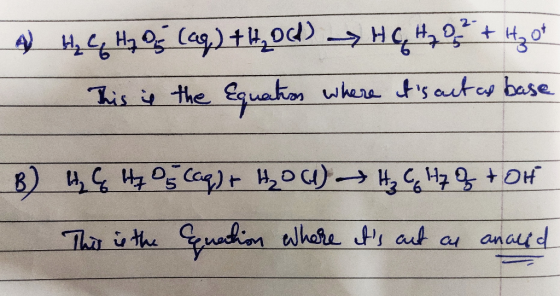
Add Answer to:
A) Write an equation for the reaction in which H2C6H7O5^-(aq)
acts as a base in H2O(l)...
Part A the value of Ky at that temperature? Water ionizes by the equation H2O(l) =...
 Part A the value of Ky at that temperature? Water ionizes by the equation H2O(l) = 1+ (aq) + OH-(aq) The extent of the reaction is small in pure water and dilute aqueous solutions. This reaction creates the following relationship between (H+) and (OH): Ky = [H+][OH-] Keep in mind that, like all equilibrium constants, the value of Kw changes with temperature. At a certain temperature, the pH of a neutral solution is 7.65. What Express your answer numerically using...
Important Info: Ka reaction: HC2H3O2(aq) + H2O(l) <-->C2H3O2 (aq) +H3O+(aq) HC2H3O(aq) +OH-(aq) -> C2H3O2-(aq) + H2O...
Important Info: Ka reaction: HC2H3O2(aq) + H2O(l) <-->C2H3O2 (aq) +H3O+(aq) HC2H3O(aq) +OH-(aq) -> C2H3O2-(aq) + H2O (l) A 1.0 L buffer solution is 0.280 M in HC2H302 (acetic acid) and 0.320 M in NaC2H302 (sodium acetate). Calculate the pH of the budder and he Ka for HC2H3O2 IS 1.8 X 10⁻⁵ Calculate the pH of te solution above after the addition of 0.0400 moles of solid NaOH. Assume no volume change upon the addition of base.
Water ionizes by the equation H2O(l)⇌H+(aq)+OH−(aq) The extent of the reaction is small in pure water...
Water ionizes by the equation H2O(l)⇌H+(aq)+OH−(aq) The extent of the reaction is small in pure water and dilute aqueous solutions. This reaction creates the following relationship between [H+] and [OH−]: Kw=[H+][OH−] Keep in mind that, like all equilibrium constants, the value of Kw changes with temperature. Part A What is the H+ concentration for an aqueous solution with pOH = 3.02 at 25 ∘C?
Water ionizes by the equation H2 0()--H+ (aq) + OH-(aq) The extent of the reaction is...
 Water ionizes by the equation H2 0()--H+ (aq) + OH-(aq) The extent of the reaction is small in pure water and dilute aqueous solutions. This reaction creates the following relationship between H and [OH Keep in mind that, like all equilibrium constants, the value of Kw changes with temperature. ▼ Part A What is the H concentration for an aqueous solution with pOH 4.50 at 25 ° C? Express your answer to two significant figures and include the appropriate units....
Ammonia react with water as shown in the following equation: NH3(aq) + H2O(l) NH4+(aq) +...
Ammonia react with water as shown in the following equation: NH3(aq) + H2O(l) NH4+(aq) + OH-(aq) Kb = 1.77 x 10⁻⁵ and Ka = 5.65 x 10⁻¹⁰ a) Calculate the pH of the 0.030 M NH3 solution (Use a labeled ICE table) b) Calculate the pH of the solution at the equivalent point (when equal amount of acid is added. Assume the volume doubles). (Use a labeled ICE table) c) Over which pH range (actual numbers) do you expect...
15. For the chemical reaction HCN(aq)+KOH(aq)⟶H2O(l)+KCN(aq) write the net ionic equation, including the phases. 13. Write...
15. For the chemical reaction HCN(aq)+KOH(aq)⟶H2O(l)+KCN(aq) write the net ionic equation, including the phases. 13. Write the balanced molecular equation for the neutralization reaction between HI and Ba(OH)2 in aqueous solution. Include physical states. molecular equation:
H2O2(aq)⟶H2O(l) + 1/2 O2(g) a. The above chemical equation is for a first-order reaction. At 302...
H2O2(aq)⟶H2O(l) + 1/2 O2(g) a. The above chemical equation is for a first-order reaction. At 302 K , the rate constant equals 8.5×10⁻⁴s−1. Calculate the half-life at this temperature. Express your answer to two significant figures and include the appropriate units. b. If the activation energy for this reaction is 75 kJ/mol, at what temperature would the reaction rate be doubled? Express your answer as an integer and include the appropriate units.
Hypoiodous acid (HIO) is a weak acid that dissociates in water as follows: HIO(aq) + H2O(l)...
Hypoiodous acid (HIO) is a weak acid that dissociates in water as follows: HIO(aq) + H2O(l) equilibrium reaction arrow H3O+(aq) + IO−(aq). A 0.15 M solution of hypoiodous acid has a pH of 5.66. Calculate the acid-dissociation constant (Ka) for this acid.
For the following chemical reaction HClO4(aq)+ NaOH(aq) H2O(l) + NaClO4(aq) write the net ionic equation, including...
 For the following chemical reaction HClO4(aq)+ NaOH(aq) H2O(l) + NaClO4(aq) write the net ionic equation, including the phases. Which of these ions are considered ''spectator ions'' for this reaction? Check all that apply. H+ Na+ ClO4- OH-
For the chemical reaction HClO4(aq)+NaOH(aq)⟶H2O(l)+NaClO4(aq) write the net ionic equation, including the phases. net ionic equation:
For the chemical reaction HClO4(aq)+NaOH(aq)⟶H2O(l)+NaClO4(aq) write the net ionic equation, including the phases. net ionic equation:
 Part A the value of Ky at that temperature? Water ionizes by the equation H2O(l) = 1+ (aq) + OH-(aq) The extent of the reaction is small in pure water and dilute aqueous solutions. This reaction creates the following relationship between (H+) and (OH): Ky = [H+][OH-] Keep in mind that, like all equilibrium constants, the value of Kw changes with temperature. At a certain temperature, the pH of a neutral solution is 7.65. What Express your answer numerically using...
 Water ionizes by the equation H2 0()--H+ (aq) + OH-(aq) The extent of the reaction is small in pure water and dilute aqueous solutions. This reaction creates the following relationship between H and [OH Keep in mind that, like all equilibrium constants, the value of Kw changes with temperature. ▼ Part A What is the H concentration for an aqueous solution with pOH 4.50 at 25 ° C? Express your answer to two significant figures and include the appropriate units....
 For the following chemical reaction HClO4(aq)+ NaOH(aq) H2O(l) + NaClO4(aq) write the net ionic equation, including the phases. Which of these ions are considered ''spectator ions'' for this reaction? Check all that apply. H+ Na+ ClO4- OH-
Most questions answered within 3 hours.
-
Where is the error in this code sequence?
String s1 = "Hello";
String s2 = "ello";...
asked 10 months ago -
Financial data for Joel de Paris, Inc., for last year
follow:
Joel de Paris, Inc.
Balance...
asked 10 months ago -
Consider this reaction:
Al2(SO4)3 (aq)+ BaCl3
(aq) Al2Cl6 (aq)- +
3BaSO4(s) . What is the...
asked 10 months ago -
Suppose that Savneet is considering increasing her
recent random sample from 20 car rentals to 40...
asked 10 months ago -
Trucks arrive at an unloading terminal at an average rate of 120
per hour.
Trucks arrive...
asked 10 months ago -
Why are methanol and ethanol completely soluble in water while
octanol is not very little soluble....
asked 10 months ago -
A facilities manager at a university reads in a research report
that the mean amount of...
asked 10 months ago -
When the CuSO4 is rehydrated by adding water to the anhydrous
compound, is this an endothermic...
asked 10 months ago -
A ray of sunlight is passing from diamond into crown glass; the
angle of incidence is...
asked 10 months ago -
A block of mass 0.249 kg is placed on top of a light, vertical
spring of...
asked 10 months ago -
how do the kidneys compensate in the presences of acidosis
a) trigger hyperventilate
b) reserve acid...
asked 10 months ago -
Question 501 pts
The rental rate of capital to the firm increases. Which of the
following...
asked 10 months ago