How do Catabolism and Anabolism differ between the Organic Soup Hypothesis and the Surface Metabolism Hypothesis?
How do Catabolism and Anabolism differ between the Organic Soup Hypothesis and the Surface Metabolism Hypothesis?
Homework Answers
In general catabolism is the breakdown of complex molecules into simpler ones whereas anabolism is the process of combining simpler molecules to form large complex molecules. In surface metabolism model, dissolved gases are having ca contact with the minerals present in the lining of walls of hydrothermal vents. This combination result in the formation of large complex organic molecules while in the soup hypothesis molecules in the atmosphere are found to be condensed in oceans to form complex large molecules.
Add Answer to:
How do Catabolism and Anabolism differ between the Organic Soup
Hypothesis and the Surface Metabolism Hypothesis?
1. What is the difference between catabolism, anabolism, and metabolism? 2. What is an enzyme? 3....
 1. What is the difference between catabolism, anabolism, and metabolism? 2. What is an enzyme? 3. Differentiate between apoenzyme and holoenzyme. 4. A)What is the function of an enzyme? B)What type of reactions are they involved in?
Compare and contrast metabolism, catabolism and anabolism. We shortly talked about this problem in class, but...
Compare and contrast metabolism, catabolism and anabolism. We shortly talked about this problem in class, but my professor wants the answer in paragraph form and I am not completely sure. I know how to compare and contrast catabolism and anabolism, but I am not sure on how to incorporate metabolism. I hope someone can help!
Metabolism can be bisected into two subcategories: catabolism and anabolism. _____takes complex organic molecules and breaks...
Metabolism can be bisected into two subcategories: catabolism and anabolism. _____takes complex organic molecules and breaks them down into simpler molecules; this is often accompanied by the _______of energy. ______builds up biomolecules from simpler substances; this is often accompanied by the ________of energy. Both pathways use simple two-carbon organic molecules (such as ______) as common intermediates. These intermediates can then enter the ______, where they are further ______to generate carbon dioxide and _____electron carriers, along with small amounts of ATP....
What term describes the simultaneous occurrence of anabolism and catabolism in glucose metabolism? Please name one...
What term describes the simultaneous occurrence of anabolism and catabolism in glucose metabolism? Please name one cellular building block produced through anabolic pathways.
Label the image to test your understanding of the cellular reactions involved in metabolism. Anabolism Catabolism...
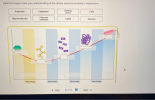 Label the image to test your understanding of the cellular reactions involved in metabolism. Anabolism Catabolism Building blocks Cells Macromolecules Precursor molecules Lipids Glucose Yields energy Uses energy Uses energy Uus energy < Prev 2 of 5 !! Next >
What is the difference between catabolism and anabolism? You can choose more than one answer. 2...
What is the difference between catabolism and anabolism? You can choose more than one answer. 2 point. Catabolism generates energy. Catabolism expends energy. Anabolism generates energy. Anabolism expends energy.
Chapter 5 – Microbial Metabolism Know the following terms: Catabolism Exergonic  
Chapter 5 – Microbial Metabolism Know the following terms: Catabolism Exergonic Coenzymes Anabolism Endergonic Holoenzymes Metabolism Apoenzymes Cofactors How can enzymes promote chemical reactions in the substrates? How can temperature, pH and concentration affect the activity of enzymes? Know the chart of Glycolysis
sidering how cellular metabolism (catabolism and anabolism) works, explain why a bacteria. faster on this complex...
 sidering how cellular metabolism (catabolism and anabolism) works, explain why a bacteria. faster on this complex medium (glucose, beef extract, yeast extract, peptone, and water) vs. this fined/synthetic medium (sucrose, KzHPO., KH PO, (NH), HPO4, MgSO4, FeSO4, MnSO4, and water 6. Explain why Conside 4. Complement proteins, which are part of your immune system, can for large pores in the cytoplasmic 5. Escherichia coli is a facultative acrobe. Imagine a culture of E coli growing at 37°C in a complex...
What are the steps of bacterial reproduction/binary fission? What are bacterial endospores? How do they form?...
 What are the steps of bacterial reproduction/binary fission? What are bacterial endospores? How do they form? How is an endospore different from a vegetative bacterium? From a fungal spore? Compare pure and mixed culture. Why is a pure culture needed to identify a pathogen? What is biofilm growth? What are the steps of biofilm formation? What is the architecture of a biofilm? Why are biofilms resistant to antibiotic treatment? Or to human immune response? What is metabolism? Catabolism? Anabolism? How...
1. How do the terms hypothesis and theory differ in meaning and application? 2. Why do you think...
1. How do the terms hypothesis and theory differ in meaning and application? 2. Why do you think physical scientists, such as those working in the fields of physics, chemistry, astronomy, etc., might say that research in the social sciences is unscientific? 3. What materials can a researcher provide others with in order to help them replicate a study? 4. How can applied research help you understand an issue your university or community is currently facing? 5. Identify three ways in which a study might...
 1. What is the difference between catabolism, anabolism, and metabolism? 2. What is an enzyme? 3. Differentiate between apoenzyme and holoenzyme. 4. A)What is the function of an enzyme? B)What type of reactions are they involved in?
 Label the image to test your understanding of the cellular reactions involved in metabolism. Anabolism Catabolism Building blocks Cells Macromolecules Precursor molecules Lipids Glucose Yields energy Uses energy Uses energy Uus energy < Prev 2 of 5 !! Next >
 sidering how cellular metabolism (catabolism and anabolism) works, explain why a bacteria. faster on this complex medium (glucose, beef extract, yeast extract, peptone, and water) vs. this fined/synthetic medium (sucrose, KzHPO., KH PO, (NH), HPO4, MgSO4, FeSO4, MnSO4, and water 6. Explain why Conside 4. Complement proteins, which are part of your immune system, can for large pores in the cytoplasmic 5. Escherichia coli is a facultative acrobe. Imagine a culture of E coli growing at 37°C in a complex...
 What are the steps of bacterial reproduction/binary fission? What are bacterial endospores? How do they form? How is an endospore different from a vegetative bacterium? From a fungal spore? Compare pure and mixed culture. Why is a pure culture needed to identify a pathogen? What is biofilm growth? What are the steps of biofilm formation? What is the architecture of a biofilm? Why are biofilms resistant to antibiotic treatment? Or to human immune response? What is metabolism? Catabolism? Anabolism? How...
Most questions answered within 3 hours.
-
Where is the error in this code sequence?
String s1 = "Hello";
String s2 = "ello";...
asked 1 year ago -
Financial data for Joel de Paris, Inc., for last year
follow:
Joel de Paris, Inc.
Balance...
asked 1 year ago -
Consider this reaction:
Al2(SO4)3 (aq)+ BaCl3
(aq) Al2Cl6 (aq)- +
3BaSO4(s) . What is the...
asked 1 year ago -
Suppose that Savneet is considering increasing her
recent random sample from 20 car rentals to 40...
asked 1 year ago -
Trucks arrive at an unloading terminal at an average rate of 120
per hour.
Trucks arrive...
asked 1 year ago -
Why are methanol and ethanol completely soluble in water while
octanol is not very little soluble....
asked 1 year ago -
A facilities manager at a university reads in a research report
that the mean amount of...
asked 1 year ago -
When the CuSO4 is rehydrated by adding water to the anhydrous
compound, is this an endothermic...
asked 1 year ago -
A ray of sunlight is passing from diamond into crown glass; the
angle of incidence is...
asked 1 year ago -
A block of mass 0.249 kg is placed on top of a light, vertical
spring of...
asked 1 year ago -
how do the kidneys compensate in the presences of acidosis
a) trigger hyperventilate
b) reserve acid...
asked 1 year ago -
Question 501 pts
The rental rate of capital to the firm increases. Which of the
following...
asked 1 year ago