Describe the different types of lipids and their special characteristics. Give examples where appropriate.
Describe the different types of lipids and their special characteristics. Give examples where appropriate.
Homework Answers
Lipids are organic compounds that contain hydrogen, carbon, and oxygen atoms which helps as a structural and functional backbone of living cells.
Simple Lipid :-
Esters of fatty acids with various alcohols.
Fats: Esters of fatty acids with glycerol. Oils are fats in the liquid state.
Waxes: Esters of fatty acids with higher molecular weight monohydric alcohols.
Complex Lipids
Esters of fatty acids containing groups in addition to alcohol and a fatty acid.
Phospholipids: Lipids containing, in addition to fatty acids and alcohol, a phosphoric acid residue. They frequently have nitrogen-containing bases and other substituents, eg, in glycerophospholipids the alcohol is glycerol and in sphingophospholipids the alcohol is sphingosine.
Glycolipids (glycosphingolipids): Lipids containing a fatty acid, sphingosine, and carbohydrate.
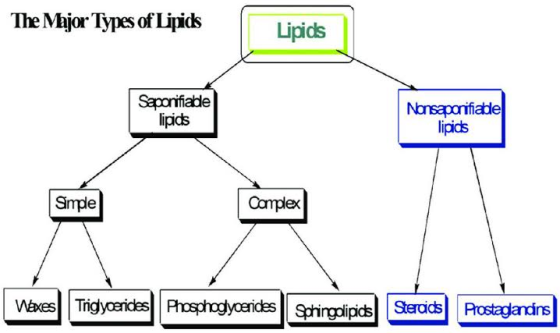
Classification of
Lipids :-
Lipids that are ester or amides of fatty acids :-
waxes – are carboxylic acid esters where both R groups are long straight hydrocarbon chain . Performs external protective functions. Example: Beeswax
Beeswax is an ester formed by combining palmitic acid with a 30-carbon alcohol.
Fats:
(a) They are esters of fatty acids with glycerol.
(b) They are found in nature in large quantities.
(c) They are the best reserve of food material in the human body.
(d) They act as insulator for the loss of body heat.
(e) They act as a padding material for protecting internal organs.
Physical Properties of Fats:
(a) The fats are insoluble in water, but readily soluble in ether, chloroform, benzene, carbon tetrachloride.
(b) They are readily soluble in hot alcohol but slightly soluble in cold.
(c) They are themselves good solvents for other fats, fatty acids, etc.
(d) They are tasteless, odorless, colourless and neutral in reaction.
(e) Several neutral fats are readily crystallized, e.g., beef, mutton.
(f) Their melting points are low.
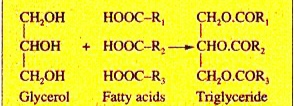
Complex lipids:-
Phospholipids (phosphatides):
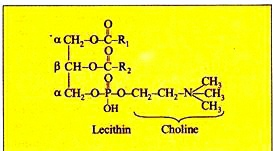
(i) They are esters of fatty acids with glycerol containing an esterified phosphoric acid and a nitrogen base.
(ii) They are present in large amounts in nerve tissue, brain, liver, kidney, pancreas and heart.
Biological functions of phospholipids:
(i) They increase the rate of fatty acid oxidation.
(ii) They act as carriers of inorganic ions across the membranes.
(iii) They help blood-clotting.
(iv) They act as prosthetic group to certain enzymes.
Classification:
It is based on the type of alcohol present in the phospholipid.
There are three types:
1. Glycerophosphatides — In this, glycerol is the alcohol group.
Example:
(i) Phosphatidyl ethanolamine (cephalin).
(ii) Phosphatidyl choline (Lecithin).
(iii) Phosphatidyl serine.
2. Phosphoinositides — In this, inositol is the alcohol.
Example:
Phosphatidyl inositol (Lipositol).
3. Phosphosphingosides — In this, sphingosine is an amino alcohol.
Example:
Sphingomyelin.

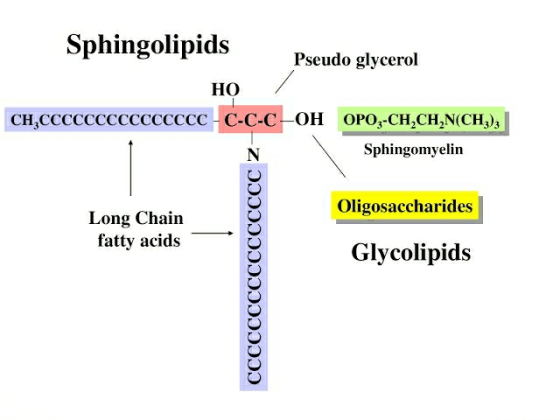
Glycolipids:
These contain an amino alcohol (sphingosine or iso-sphingosine) attached with an amide linkage to a fatty acid and glycosidically to a carbohydrate moiety (sugars, amino sugar, sialic acid).
These are further classified into:
(i) Cerebrosides.
(ii) Gangliosides.
(i) Cerebrosides:
(a) Cerebrosides contain galactose, a high molecular weight fatty acid and sphingosine. Therefore, they may also be classified as sphingolipids.
(b) They are the chief constituent of myelin sheath.
(c) They may be differentiated by the type of fatty acid in the molecule.
(ii) Gangliosides:
(a) These are glycolipids occurring in the brain.
(b) Gangliosides contain ceramide (sphingosine + fatty acids), glucose, galactose, N-acetylgalactosamine and sialic acid.
Sphingolipid, any member of a class of lipids (fat-soluble constituents of living cells) containing the organic aliphatic amino alcohol sphingosine or a substance structurally similar to it. Among the most simple sphingolipids are the ceramides (sphingosine plus a fatty acid), widely distributed in small amounts in plant and animal tissues. The other sphingolipids are derivatives of ceramides.
Steroids:
The steroids are often found in association with fat. They have a similar cyclic nucleus resembling phenanthrene (rings A, B, C) to which a cyclopentane ring (D) is attached. The parent substance is better designated as cyclopentano perhydrophenanthrene. The position on the steroid nucleus are numbered as shown in below.
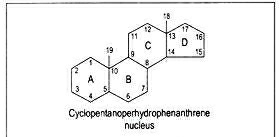
Methyl side chains occur typically at positions 10 and 13 (constituting C atoms 19 and 18). A side chain at position 17 is usual (as in cholesterol). If the compound has one or more hydroxyl groups and no carbonyl or carboxyl groups, it is a sterol, and the name terminates in -OL.
Prostaglandins (PG):
(a) They virtually exist in every mammalian tissue and act as local hormones.
(b) They have important physiologic and pharmacologic activities.
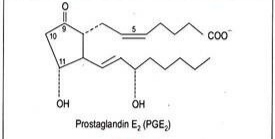
(c) They are synthesized in vivo by cyclization of the center of the carbon chain of 20-C polyunsaturated fatty acids (e.g., arachidonic acid) to form a cyclopentane ring.
(d) Three different eicosanoic fatty acids give rise to three groups of eicosanoids characterized by the number of double bonds in the side chains, e.g., PG1, PG2, PG3. Variations in the substituent groups attached to the rings give rise to different types in each series of prostaglandins, as for example, “E” type of Prostaglandin has a keto group in position 9, whereas the “F” type has a hydroxyl group in this position.
Prostacyclin’s (PGI):
(a) They are formed in vascular endothelium and continually formed in heart. They are also formed in kidneys.
(b) They are formed from cyclic endo-peroxide PGH2 by the action of microsomal Prostacyclin synthetase.
(c) They inhibit platelet aggregation and gastric secretion from the pyloric mucosa.
(d) They decrease blood pressure and protect coronary arteries.
(e) They increase renal blood flow and stimulate renin production.
(f) They are inhibited by hyperlipemia, vit. E deficiency and radiation.
Add Answer to:
Describe the different types of lipids and their special
characteristics. Give examples where appropriate.
The following statements describe different types of lipids. Fill in the blanks by dragging the appropriate...
 The following statements describe different types of lipids.
Fill in the blanks by dragging the appropriate term to its correct
location. Note: If you answer any part of this question
incorrectly, a single red X will appear indicating that one or more
of the terms are placed incorrectly.
Compounds that contain a fused ring system are called These have three 6-membered rings and one 5 membered ring. Some of these compounds are found in biological membranes. are the building blocks...
The following statements describe different types of lipids.
Fill in the blanks by dragging the appropriate term to its correct
location. Note: If you answer any part of this question
incorrectly, a single red X will appear indicating that one or more
of the terms are placed incorrectly.
Compounds that contain a fused ring system are called These have three 6-membered rings and one 5 membered ring. Some of these compounds are found in biological membranes. are the building blocks...
Discuss what a hospital is and describe the different types of hospitals. Give examples of the...
Discuss what a hospital is and describe the different types of hospitals. Give examples of the types of hospitals in your respective community, and how these hospitals impact community member’s ability to receive care. Sub: HCM 6005 - Operations in Health Care Management MBA Minimum 500 words, please. Thank You
Describe the three broad categories of contracts. Give examples of three different procurement circumstances where use...
Describe the three broad categories of contracts. Give examples of three different procurement circumstances where use of a contract from each category is appropriate.
Describe the characteristics and common uses of structured data. Provide examples as necessary. Describe the characteristics...
Describe the characteristics and common uses of structured data. Provide examples as necessary. Describe the characteristics of unstructured data (e.g., big data) and where these data elements may be found. Provide examples as necessary. Discuss the common business analysis role and the types of data that may be used. Provide examples as necessary. Discuss the use of analytics and the types of data that may be used. Provide examples as necessary
Describe and give examples of the characteristics of "anti-progressive"
Describe and give examples of the characteristics of "anti-progressive"
Describe the four types of inventory. Give examples.
Describe the four types of inventory. Give examples.
Describe the key characteristics of the different types of management. (25 marks)
Describe the key characteristics of the different types of management. (25 marks)
Identify the different types of validity and give examples of each. Identify the types of reliability...
Identify the different types of validity and give examples of each. Identify the types of reliability and provide examples of each.
Give examples of different types of leaves and their functions. Why is there such a diversity?...
Give examples of different types of leaves and their functions. Why is there such a diversity? Why would so many types of leaves evolve?
discusses four types of interfund transactions. Describe two of these transactions and give examples of the...
discusses four types of interfund transactions. Describe two of these transactions and give examples of the two you choose to describe. Do not give the same examples as the textbook.
 The following statements describe different types of lipids.
Fill in the blanks by dragging the appropriate term to its correct
location. Note: If you answer any part of this question
incorrectly, a single red X will appear indicating that one or more
of the terms are placed incorrectly.
Compounds that contain a fused ring system are called These have three 6-membered rings and one 5 membered ring. Some of these compounds are found in biological membranes. are the building blocks...
The following statements describe different types of lipids.
Fill in the blanks by dragging the appropriate term to its correct
location. Note: If you answer any part of this question
incorrectly, a single red X will appear indicating that one or more
of the terms are placed incorrectly.
Compounds that contain a fused ring system are called These have three 6-membered rings and one 5 membered ring. Some of these compounds are found in biological membranes. are the building blocks...
Most questions answered within 3 hours.
-
Where is the error in this code sequence?
String s1 = "Hello";
String s2 = "ello";...
asked 11 months ago -
Financial data for Joel de Paris, Inc., for last year
follow:
Joel de Paris, Inc.
Balance...
asked 11 months ago -
Consider this reaction:
Al2(SO4)3 (aq)+ BaCl3
(aq) Al2Cl6 (aq)- +
3BaSO4(s) . What is the...
asked 11 months ago -
Suppose that Savneet is considering increasing her
recent random sample from 20 car rentals to 40...
asked 11 months ago -
Trucks arrive at an unloading terminal at an average rate of 120
per hour.
Trucks arrive...
asked 11 months ago -
Why are methanol and ethanol completely soluble in water while
octanol is not very little soluble....
asked 11 months ago -
A facilities manager at a university reads in a research report
that the mean amount of...
asked 11 months ago -
When the CuSO4 is rehydrated by adding water to the anhydrous
compound, is this an endothermic...
asked 11 months ago -
A ray of sunlight is passing from diamond into crown glass; the
angle of incidence is...
asked 11 months ago -
A block of mass 0.249 kg is placed on top of a light, vertical
spring of...
asked 11 months ago -
how do the kidneys compensate in the presences of acidosis
a) trigger hyperventilate
b) reserve acid...
asked 11 months ago -
Question 501 pts
The rental rate of capital to the firm increases. Which of the
following...
asked 11 months ago