The factorial of a nonnegative n written as n! is defined as follows: n!= n*(n-1)*(n-2) *...
The factorial of a nonnegative n written as n! is defined as follows: n!= n*(n-1)*(n-2) * .... *1 (for all values of n greater than 0) and 0! =1. For example 5! = 5*4*3*2*1 which is 120. (can also be 1*2*3*4*5)
Write a C++ program that reads a nonnegative integer and computes and prints its factorial.
Homework Answers
Program:
#include <iostream>
using namespace std;
int main()
{
int num,fact=1,i ;
char *process;
cout<<"Enter a non-negative number: ";
cin>>num;
if(num>0)
{
for(i=num;i>=1;i--)
{
fact=fact*i;
}
cout<<"Factorial of the "<<num<<" is
"<<fact;
}
else
{
cout<<"Please enter a non-negative(positive) number!!";
}
return 0;
}
Output:
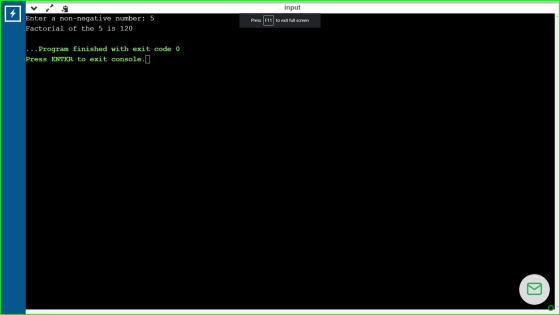
Add Answer to:
The factorial of a nonnegative n written as n! is defined as
follows: n!= n*(n-1)*(n-2) *...
5. (10 points) The factorial of a nonnegative integer n is written n! and is defined...
 5. (10 points) The factorial of a nonnegative integer n is written n! and is defined as follows. n 2) ..1 (for values of n greater than 1) nn (n-l) and n-# 1 (for n 0 or n-1) l. Write a program that reads a nonnegative integer and computes and prints its factoria
The factorial of a non negative integer n is written n! and is defined as follows:...
The factorial of a non negative integer n is written n! and is defined as follows: n! = n · (n – 1) · (n – 2) · … · 1 (for values of n greater than 1) and n! = 1 (for n = 0 or n = 1). For example, 5! = 5 · 4 · 3 · 2 · 1, which is 120. Use while statements in each of the following: Write a C# Windows Forms Application...
Calculating the Factorial of a Number - PSEUDOCODE In mathematics, the notation n! represents the factorial...
Calculating the Factorial of a Number - PSEUDOCODE In mathematics, the notation n! represents the factorial of the nonnegative integer n. The factorial of n is the product of all the nonnegative integers from 1 up through n. For example: 7! = 1 × 2 × 3 × 4 × 5 × 6 × 7 = 5,040 and 4! = 1 × 2 × 3 × 4 = 24 Design a program that asks the user to enter a nonnegative...
DONE IN PYTHON The factorial of a non-negative integer n, denoted by n!, is the product...
DONE IN PYTHON The factorial of a non-negative integer n, denoted by n!, is the product of all positive integers less than or equal to n. For example, 5 ! = 5 × 4 × 3 × 2 × 1 = 120. The value of 0! is 1. Write a program, with comments, to do the following: 20 points Ask the user to enter a positive integer n. between 1 and 20 ; You may assume the user will enter...
Write a method named factorial that accepts an integer n as a parameter and returns the...
 Write a method named factorial that accepts an integer n as a parameter and returns the factorial of n, or n!. A factorial of an integer is defined as the product of all integers from 1 through that integer inclusive. For example, the call of factorial(4) should return 1 2 3 4, or 24. The factorial of 0 and 1 are defined to be 1. You may assume that the value passed is non-negative and that its factorial can fit...
Recursive definition for factorial: a0 = 1, an = n * an-1 procedure factorial(n: nonnegative integer)...
Recursive definition for factorial: a0 = 1, an = n * an-1 procedure factorial(n: nonnegative integer) if n = 0 then return 1 else return n * factorial( n - 1 ) Trace the execution of the factorial algorithm described above for input 7. Track the number of times factorial is invoked (with the first invocation with input 7 as invocation 0) and the value returned by each invocation.
Done in C++ using visual studio Instructions to solve all three problems below using function •...
Done in C++ using visual studio Instructions to solve all three problems below using function • The value of n should be asked from user in the main() and pass the value of n to an additional function as argument value; Ex: Factorial(n). • The functions should calculate the values according to the formulas below and return the values. • Then the main() function should print out those returned values. • All three parts should have their own separate function,...
Written in expanded form, the usual factorial function is n! = n middot (n - 1)...
 Written in expanded form, the usual factorial function is n! = n middot (n - 1) middot (n - 2) ... 3 middot 2 middot 2 middot 1. The difference between elements in the product is always 1. It can be writ in recursive form as n! = n middot (n - 1)! (e.g., 10! = 10 middot 9!, 23! * 23 middot 22!, 4! = 4 3!, etc.). The purpose of this problem is to generalize the factorial function...
Consider the following program that reads a number of nonnegative integers into an array and prints...
Consider the following program that reads a number of nonnegative integers into an array and prints the contents of the array. Complete the missing parts, add new function prototypes and function definitions, and test the program several times. Add the following to the program: Write a void function that prints the list of nonnegative integers in reverse. Write a void function that prints all the numbers stored in the list that are greater than 10. It will also print the...
If n is an integer greater than 0, n factorial (n!) is the product: n* (n-1)...
If n is an integer greater than 0, n factorial (n!) is the product: n* (n-1) * (n-2) * ( n-3)… * By convention, 0! = 1. You must write a program that allows a user to enter an integer between 1 and 7. Your program must then compute the factorial of the number entered by the user. Your solution MUST actually perform a computation (i.e., you may not simply print “5040” to the screen as a literal value if...
 5. (10 points) The factorial of a nonnegative integer n is written n! and is defined as follows. n 2) ..1 (for values of n greater than 1) nn (n-l) and n-# 1 (for n 0 or n-1) l. Write a program that reads a nonnegative integer and computes and prints its factoria
 Write a method named factorial that accepts an integer n as a parameter and returns the factorial of n, or n!. A factorial of an integer is defined as the product of all integers from 1 through that integer inclusive. For example, the call of factorial(4) should return 1 2 3 4, or 24. The factorial of 0 and 1 are defined to be 1. You may assume that the value passed is non-negative and that its factorial can fit...
 Written in expanded form, the usual factorial function is n! = n middot (n - 1) middot (n - 2) ... 3 middot 2 middot 2 middot 1. The difference between elements in the product is always 1. It can be writ in recursive form as n! = n middot (n - 1)! (e.g., 10! = 10 middot 9!, 23! * 23 middot 22!, 4! = 4 3!, etc.). The purpose of this problem is to generalize the factorial function...
Most questions answered within 3 hours.
-
Where is the error in this code sequence?
String s1 = "Hello";
String s2 = "ello";...
asked 11 months ago -
Financial data for Joel de Paris, Inc., for last year
follow:
Joel de Paris, Inc.
Balance...
asked 11 months ago -
Consider this reaction:
Al2(SO4)3 (aq)+ BaCl3
(aq) Al2Cl6 (aq)- +
3BaSO4(s) . What is the...
asked 11 months ago -
Suppose that Savneet is considering increasing her
recent random sample from 20 car rentals to 40...
asked 11 months ago -
Trucks arrive at an unloading terminal at an average rate of 120
per hour.
Trucks arrive...
asked 11 months ago -
Why are methanol and ethanol completely soluble in water while
octanol is not very little soluble....
asked 11 months ago -
A facilities manager at a university reads in a research report
that the mean amount of...
asked 11 months ago -
When the CuSO4 is rehydrated by adding water to the anhydrous
compound, is this an endothermic...
asked 11 months ago -
A ray of sunlight is passing from diamond into crown glass; the
angle of incidence is...
asked 11 months ago -
A block of mass 0.249 kg is placed on top of a light, vertical
spring of...
asked 11 months ago -
how do the kidneys compensate in the presences of acidosis
a) trigger hyperventilate
b) reserve acid...
asked 11 months ago -
Question 501 pts
The rental rate of capital to the firm increases. Which of the
following...
asked 11 months ago