The factorial of a non negative integer n is written n! and is defined as follows:...
The factorial of a non negative integer n is written n! and is defined as follows: n! = n · (n – 1) · (n – 2) · … · 1 (for values of n greater than 1) and n! = 1 (for n = 0 or n = 1).
For example, 5! = 5 · 4 · 3 · 2 · 1, which is 120. Use while statements in each of the following:
Write a C# Windows Forms Application that reads n from a textbox and display 1! through n! in a list box. Also, estimates the value of the mathematical constant e by using the following formula (with accuracy of 6 decimal places) :
e = 1 + 1/1! + 1/2! + 1/3! + ...
Homework Answers
Here is code:
NumberSeries.cs:
using System;
using System.Windows.Forms;
namespace WindowsFormsApp
{
public partial class NumberSeries : Form
{
public NumberSeries()
{
InitializeComponent();
}
private void btnCalculate_Click(object sender, EventArgs
e)
{
int value = int.Parse(txtInput.Text);
if(value < 1)
{
MessageBox.Show("Input must be positive number");
}
else
{
double result = 0;
for (int i = 0; i < value; i++)
{
result += (1.0/factorial(i));
}
lbOutput.Text = "Result is " + result.ToString("#.######");
}
}
private double factorial(int n)
{
double prod = 1;
for (int i = 1; i <= n; i++)
{
prod *= i;
}
return prod;
}
}
}
NumberSeries.Designer.cs:
namespace WindowsFormsApp
{
partial class NumberSeries
{
/// <summary>
/// Required designer variable.
/// </summary>
private System.ComponentModel.IContainer components = null;
/// <summary>
/// Clean up any resources being used.
/// </summary>
/// <param name="disposing">true if managed resources should
be disposed; otherwise, false.</param>
protected override void Dispose(bool disposing)
{
if (disposing && (components != null))
{
components.Dispose();
}
base.Dispose(disposing);
}
#region Windows Form Designer generated code
/// <summary>
/// Required method for Designer support - do not modify
/// the contents of this method with the code editor.
/// </summary>
private void InitializeComponent()
{
this.label1 = new System.Windows.Forms.Label();
this.txtInput = new System.Windows.Forms.TextBox();
this.btnCalculate = new System.Windows.Forms.Button();
this.lbOutput = new System.Windows.Forms.Label();
this.SuspendLayout();
//
// label1
//
this.label1.AutoSize = true;
this.label1.Location = new System.Drawing.Point(35, 19);
this.label1.Name = "label1";
this.label1.Size = new System.Drawing.Size(76, 13);
this.label1.TabIndex = 0;
this.label1.Text = "Enter value n: ";
//
// txtInput
//
this.txtInput.Location = new System.Drawing.Point(123, 16);
this.txtInput.Name = "txtInput";
this.txtInput.Size = new System.Drawing.Size(100, 20);
this.txtInput.TabIndex = 1;
//
// btnCalculate
//
this.btnCalculate.Location = new System.Drawing.Point(81,
81);
this.btnCalculate.Name = "btnCalculate";
this.btnCalculate.Size = new System.Drawing.Size(75, 23);
this.btnCalculate.TabIndex = 2;
this.btnCalculate.Text = "Calculate";
this.btnCalculate.UseVisualStyleBackColor = true;
this.btnCalculate.Click += new
System.EventHandler(this.btnCalculate_Click);
//
// lbOutput
//
this.lbOutput.AutoSize = true;
this.lbOutput.Location = new System.Drawing.Point(94, 52);
this.lbOutput.Name = "lbOutput";
this.lbOutput.Size = new System.Drawing.Size(0, 13);
this.lbOutput.TabIndex = 3;
//
// NumberSeries
//
this.AutoScaleDimensions = new System.Drawing.SizeF(6F, 13F);
this.AutoScaleMode = System.Windows.Forms.AutoScaleMode.Font;
this.ClientSize = new System.Drawing.Size(256, 139);
this.Controls.Add(this.lbOutput);
this.Controls.Add(this.btnCalculate);
this.Controls.Add(this.txtInput);
this.Controls.Add(this.label1);
this.Name = "NumberSeries";
this.Text = "NumberSeries";
this.ResumeLayout(false);
this.PerformLayout();
}
#endregion
private System.Windows.Forms.Label label1;
private System.Windows.Forms.TextBox txtInput;
private System.Windows.Forms.Button btnCalculate;
private System.Windows.Forms.Label lbOutput;
}
}
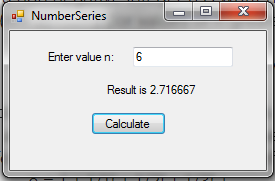
Output:
Add Answer to:
The factorial of a non negative integer n is written
n! and is defined as follows:...
The factorial of a nonnegative n written as n! is defined as follows: n!= n*(n-1)*(n-2) *...
The factorial of a nonnegative n written as n! is defined as follows: n!= n*(n-1)*(n-2) * .... *1 (for all values of n greater than 0) and 0! =1. For example 5! = 5*4*3*2*1 which is 120. (can also be 1*2*3*4*5) Write a C++ program that reads a nonnegative integer and computes and prints its factorial.
5. (10 points) The factorial of a nonnegative integer n is written n! and is defined...
 5. (10 points) The factorial of a nonnegative integer n is written n! and is defined as follows. n 2) ..1 (for values of n greater than 1) nn (n-l) and n-# 1 (for n 0 or n-1) l. Write a program that reads a nonnegative integer and computes and prints its factoria
DONE IN PYTHON The factorial of a non-negative integer n, denoted by n!, is the product...
DONE IN PYTHON The factorial of a non-negative integer n, denoted by n!, is the product of all positive integers less than or equal to n. For example, 5 ! = 5 × 4 × 3 × 2 × 1 = 120. The value of 0! is 1. Write a program, with comments, to do the following: 20 points Ask the user to enter a positive integer n. between 1 and 20 ; You may assume the user will enter...
Write a python program to compute the factorial of a given non-negative integer n. If the...
Write a python program to compute the factorial of a given non-negative integer n. If the user inputs any integer outside the required, print “Error! Try again!”
Write a method named factorial that accepts an integer n as a parameter and returns the...
 Write a method named factorial that accepts an integer n as a parameter and returns the factorial of n, or n!. A factorial of an integer is defined as the product of all integers from 1 through that integer inclusive. For example, the call of factorial(4) should return 1 2 3 4, or 24. The factorial of 0 and 1 are defined to be 1. You may assume that the value passed is non-negative and that its factorial can fit...
In Java Write a method factorial that accepts an integer parameter n and that uses recursion...
In Java Write a method factorial that accepts an integer parameter n and that uses recursion to compute and return the value of n factorial (also known as n!). Your method should throw an IllegalArgumentException if n is negative. Several calls and their return values are shown below. Call Output factorial(0); 1 factorial(1); 1 factorial(3); 6 factorial(5); 120 factorial(10); 3628800 factorial(-4); IllegalArgumentException
Written in expanded form, the usual factorial function is n! = n middot (n - 1)...
 Written in expanded form, the usual factorial function is n! = n middot (n - 1) middot (n - 2) ... 3 middot 2 middot 2 middot 1. The difference between elements in the product is always 1. It can be writ in recursive form as n! = n middot (n - 1)! (e.g., 10! = 10 middot 9!, 23! * 23 middot 22!, 4! = 4 3!, etc.). The purpose of this problem is to generalize the factorial function...
383 ng Assignments FACTORIAL CALCULATOR document and a Use Case Definition document and design a ...
 383 ng Assignments FACTORIAL CALCULATOR document and a Use Case Definition document and design a Windows application based on project shown in Figure 6-122 calculators have an operation called a factorial," which is shown on a calculator key as an idamation point. For example, 5! (5 factorial) multiplies 5 43'21 to calculate the resuls f120. Request that the user select a number from 1 to 12 and display all the factorials up to the valuc, including that value. Using loops...
If n is an integer greater than 0, n factorial (n!) is the product: n* (n-1)...
If n is an integer greater than 0, n factorial (n!) is the product: n* (n-1) * (n-2) * ( n-3)… * By convention, 0! = 1. You must write a program that allows a user to enter an integer between 1 and 7. Your program must then compute the factorial of the number entered by the user. Your solution MUST actually perform a computation (i.e., you may not simply print “5040” to the screen as a literal value if...
c++ please (1) Write a program that prompts the user to enter an integer value N...
 c++ please
(1) Write a program that prompts the user to enter an integer value N which will rpresent the parameter to be sent to a function. Use the format below. Then write a function named CubicRoot The function will receive the parameter N and return'its cubic value. In the main program print the message: (30 Points) Enter an integer N: [. ..1 The cubic root of I.. ] is 2 update the code om part and write another function...
c++ please
(1) Write a program that prompts the user to enter an integer value N which will rpresent the parameter to be sent to a function. Use the format below. Then write a function named CubicRoot The function will receive the parameter N and return'its cubic value. In the main program print the message: (30 Points) Enter an integer N: [. ..1 The cubic root of I.. ] is 2 update the code om part and write another function...
 5. (10 points) The factorial of a nonnegative integer n is written n! and is defined as follows. n 2) ..1 (for values of n greater than 1) nn (n-l) and n-# 1 (for n 0 or n-1) l. Write a program that reads a nonnegative integer and computes and prints its factoria
 Write a method named factorial that accepts an integer n as a parameter and returns the factorial of n, or n!. A factorial of an integer is defined as the product of all integers from 1 through that integer inclusive. For example, the call of factorial(4) should return 1 2 3 4, or 24. The factorial of 0 and 1 are defined to be 1. You may assume that the value passed is non-negative and that its factorial can fit...
 Written in expanded form, the usual factorial function is n! = n middot (n - 1) middot (n - 2) ... 3 middot 2 middot 2 middot 1. The difference between elements in the product is always 1. It can be writ in recursive form as n! = n middot (n - 1)! (e.g., 10! = 10 middot 9!, 23! * 23 middot 22!, 4! = 4 3!, etc.). The purpose of this problem is to generalize the factorial function...
 383 ng Assignments FACTORIAL CALCULATOR document and a Use Case Definition document and design a Windows application based on project shown in Figure 6-122 calculators have an operation called a factorial," which is shown on a calculator key as an idamation point. For example, 5! (5 factorial) multiplies 5 43'21 to calculate the resuls f120. Request that the user select a number from 1 to 12 and display all the factorials up to the valuc, including that value. Using loops...
 c++ please
(1) Write a program that prompts the user to enter an integer value N which will rpresent the parameter to be sent to a function. Use the format below. Then write a function named CubicRoot The function will receive the parameter N and return'its cubic value. In the main program print the message: (30 Points) Enter an integer N: [. ..1 The cubic root of I.. ] is 2 update the code om part and write another function...
c++ please
(1) Write a program that prompts the user to enter an integer value N which will rpresent the parameter to be sent to a function. Use the format below. Then write a function named CubicRoot The function will receive the parameter N and return'its cubic value. In the main program print the message: (30 Points) Enter an integer N: [. ..1 The cubic root of I.. ] is 2 update the code om part and write another function...
Most questions answered within 3 hours.
-
Where is the error in this code sequence?
String s1 = "Hello";
String s2 = "ello";...
asked 10 months ago -
Financial data for Joel de Paris, Inc., for last year
follow:
Joel de Paris, Inc.
Balance...
asked 10 months ago -
Consider this reaction:
Al2(SO4)3 (aq)+ BaCl3
(aq) Al2Cl6 (aq)- +
3BaSO4(s) . What is the...
asked 10 months ago -
Suppose that Savneet is considering increasing her
recent random sample from 20 car rentals to 40...
asked 10 months ago -
Trucks arrive at an unloading terminal at an average rate of 120
per hour.
Trucks arrive...
asked 10 months ago -
Why are methanol and ethanol completely soluble in water while
octanol is not very little soluble....
asked 10 months ago -
A facilities manager at a university reads in a research report
that the mean amount of...
asked 10 months ago -
When the CuSO4 is rehydrated by adding water to the anhydrous
compound, is this an endothermic...
asked 10 months ago -
A ray of sunlight is passing from diamond into crown glass; the
angle of incidence is...
asked 10 months ago -
A block of mass 0.249 kg is placed on top of a light, vertical
spring of...
asked 10 months ago -
how do the kidneys compensate in the presences of acidosis
a) trigger hyperventilate
b) reserve acid...
asked 10 months ago -
Question 501 pts
The rental rate of capital to the firm increases. Which of the
following...
asked 10 months ago