What is happening molecularly that causes primers to not bind as well at high temperatures?
What is happening molecularly that causes primers to not bind as well at high temperatures?
Homework Answers
The high temperature causes the hydrogen bonds between the bases in two strands of template DNA to break and the two strands to separate.The bacteria's DNA polymerase is very stable at high temperatures, which means it can withstand the temperatures needed to break the strands of DNA apart in the denaturing stage of PCR. DNA polymerase from most other organisms would not be able to withstand these high temperatures, for example, human polymerase works ideally at 37˚C.
Add Answer to:
What is happening molecularly that causes primers to not bind as
well at high temperatures?
In high-throughput sequencing, the primers bind to a) oligonucleotides attached to the fragments. b) free dNTPs....
In high-throughput sequencing, the primers bind to a) oligonucleotides attached to the fragments. b) free dNTPs. c) DNA polymerase. d) the sequence fragments themselves. e) nothing.
1. Explain why the salicylic acid is insoluble at RT and soluble at high temperatures (when...
1. Explain why the salicylic acid is insoluble at RT and soluble at high temperatures (when hot)? -Explanation should include what is occurring/ happening in molecular level. -Your answer should be concise and should not exceed 100 words (please note that , if it is too long it will not be graded)
Question 3 1 pts Predict under what temperatures (all temperatures, low temperatures, or high temperatures), if...
 Question 3 1 pts Predict under what temperatures (all temperatures, low temperatures, or high temperatures), if any, the reaction will be spontaneous. A. AS rxn= +100 J/K; AH rxn= +150 kJ [ Select] B. AS rxn= - 100 J/K; AH rxn= +200 kJ [Select]
Question 5 1 pts Predict under what temperatures (all temperatures, low temperatures, or high temperatures), if...
 Question 5 1 pts Predict under what temperatures (all temperatures, low temperatures, or high temperatures), if any, the reaction will be spontaneous. A. 4NO(g)+6H2O(g) 4NH3(g)+502(g) AHrxn=+906kJ [Select] B. 2N2O(g)+O2(g)-4NO(g) AH rxn=+197.1kJ [Select] C. C3H3(g)+502(g)-3CO2(g)+4H2O(g) AH rxn=-2044kJ Spontaneous at all temperatura A
3. (4 pts.) Describe what is happening (with a brief why as well) at the origin...
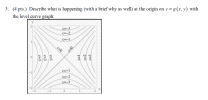 3. (4 pts.) Describe what is happening (with a brief why as well) at the origin on c = = g(x, y) with the level curve graph: C-3 CS-2 CE- CO-1 C=-2 C=-3 0
Question 6 1.5 pts Predict under what temperatures (all temperatures, low temperatures, or high temperatures), if any,...
 Question 6 1.5 pts Predict under what temperatures (all temperatures, low temperatures, or high temperatures), if any, the following reactions will be spontaneous. A. 2CO(g) + O2(g) = 2002(g), AH rxn=-566.0 kJ [ Select] B. 2NO2(g)2NO(g)+O2(g), AH rxn= +113.1 kJ [ Select ] C. 2H2(g)+O2(g)—2H2O(g), AH rxn=-483.6 kJ [ Select] D. 2H2O2(1)→2H2O(1)+O2(g), AH rxn= -196.0 kJ [Select ]
Using a diagram explain what causes an astronomically high high tide?
Using a diagram explain what causes an astronomically high high tide?
Exercise 18.38-Enhanced-with Feedback 7 of 13> Part E ReviewI ConstantsI Periodic Table In addition, predict under what temperatures (all temperatures, low temperatures, or high temperatures), if...
 Exercise 18.38-Enhanced-with Feedback 7 of 13> Part E ReviewI ConstantsI Periodic Table In addition, predict under what temperatures (all temperatures, low temperatures, or high temperatures), if any the reaction in each part will be spontaneous. Without doing any calculations, iddentify the signs of ΔSays and ΔSsurr for each of the following chemical reactions. Drag the appropriate items to their respective bins. Reset Help Reaction is spontaneous at all temperatures Reaction is spontaneous at low temperatures Reaction is spontaneous at high...
-------------high way materials----------------------------- asphalt cement is supplied as PG 70-34. what high and intermediate temperatures will...
-------------high way materials----------------------------- asphalt cement is supplied as PG 70-34. what high and intermediate temperatures will it be tested in the DSR? What temperature will it tested for cold temperature properties? Is this binder likely to be polymer modified? What rule of thumb are you using to base your answer?
what is the pros and cons that causes the lack of the high amount of insurance...
what is the pros and cons that causes the lack of the high amount of insurance coverage?
 Question 3 1 pts Predict under what temperatures (all temperatures, low temperatures, or high temperatures), if any, the reaction will be spontaneous. A. AS rxn= +100 J/K; AH rxn= +150 kJ [ Select] B. AS rxn= - 100 J/K; AH rxn= +200 kJ [Select]
 Question 5 1 pts Predict under what temperatures (all temperatures, low temperatures, or high temperatures), if any, the reaction will be spontaneous. A. 4NO(g)+6H2O(g) 4NH3(g)+502(g) AHrxn=+906kJ [Select] B. 2N2O(g)+O2(g)-4NO(g) AH rxn=+197.1kJ [Select] C. C3H3(g)+502(g)-3CO2(g)+4H2O(g) AH rxn=-2044kJ Spontaneous at all temperatura A
 3. (4 pts.) Describe what is happening (with a brief why as well) at the origin on c = = g(x, y) with the level curve graph: C-3 CS-2 CE- CO-1 C=-2 C=-3 0
 Question 6 1.5 pts Predict under what temperatures (all temperatures, low temperatures, or high temperatures), if any, the following reactions will be spontaneous. A. 2CO(g) + O2(g) = 2002(g), AH rxn=-566.0 kJ [ Select] B. 2NO2(g)2NO(g)+O2(g), AH rxn= +113.1 kJ [ Select ] C. 2H2(g)+O2(g)—2H2O(g), AH rxn=-483.6 kJ [ Select] D. 2H2O2(1)→2H2O(1)+O2(g), AH rxn= -196.0 kJ [Select ]
 Exercise 18.38-Enhanced-with Feedback 7 of 13> Part E ReviewI ConstantsI Periodic Table In addition, predict under what temperatures (all temperatures, low temperatures, or high temperatures), if any the reaction in each part will be spontaneous. Without doing any calculations, iddentify the signs of ΔSays and ΔSsurr for each of the following chemical reactions. Drag the appropriate items to their respective bins. Reset Help Reaction is spontaneous at all temperatures Reaction is spontaneous at low temperatures Reaction is spontaneous at high...
Most questions answered within 3 hours.
-
Where is the error in this code sequence?
String s1 = "Hello";
String s2 = "ello";...
asked 10 months ago -
Financial data for Joel de Paris, Inc., for last year
follow:
Joel de Paris, Inc.
Balance...
asked 10 months ago -
Consider this reaction:
Al2(SO4)3 (aq)+ BaCl3
(aq) Al2Cl6 (aq)- +
3BaSO4(s) . What is the...
asked 10 months ago -
Suppose that Savneet is considering increasing her
recent random sample from 20 car rentals to 40...
asked 10 months ago -
Trucks arrive at an unloading terminal at an average rate of 120
per hour.
Trucks arrive...
asked 10 months ago -
Why are methanol and ethanol completely soluble in water while
octanol is not very little soluble....
asked 10 months ago -
A facilities manager at a university reads in a research report
that the mean amount of...
asked 10 months ago -
When the CuSO4 is rehydrated by adding water to the anhydrous
compound, is this an endothermic...
asked 10 months ago -
A ray of sunlight is passing from diamond into crown glass; the
angle of incidence is...
asked 10 months ago -
A block of mass 0.249 kg is placed on top of a light, vertical
spring of...
asked 10 months ago -
how do the kidneys compensate in the presences of acidosis
a) trigger hyperventilate
b) reserve acid...
asked 10 months ago -
Question 501 pts
The rental rate of capital to the firm increases. Which of the
following...
asked 10 months ago