. The theoretical weight percent of carbon in (CH3)3N is: A. 20.32% B. 81.95% C. 9.97%...
. The theoretical weight percent of carbon in (CH3)3N is:
A. 20.32% B. 81.95% C. 9.97% D. 60.95% E. 23.18%
Homework Answers

Add Answer to:
. The theoretical weight percent of carbon in (CH3)3N is:
A. 20.32% B. 81.95% C. 9.97%...
Which of the following pairs can form tertiary amide? a.CH3NH2+ CH3(CH2)3COOH b.(CH3)2NH + CH3(CH2)3CHO ( CH3)3N...
Which of the following pairs can form tertiary amide? a.CH3NH2+ CH3(CH2)3COOH b.(CH3)2NH + CH3(CH2)3CHO ( CH3)3N + CH3(CH2)3CHO d.(CH3)2NH + CH3(CH2)3COOH
QUESTION 8: Which of the following is the weakest base? A. NH3 B. (CH3)3N C. CH3NH2...
 QUESTION 8:
Which of the following is the weakest base?
A.
NH3
B.
(CH3)3N
C.
CH3NH2
D.
QUESTION 9:
A compound which is insoluble in water but which dissolves in
dilute hydrochloric acid is
A.
probably an amide
B.
possibly a carboxylic acid
C.
almost certainly an amine
D.
probably neither acidic nor basic
E.
probably an ester
QUESTION 10:
We were unable to transcribe this imageQuestion 10 Which of the following compounds would be the strongest base? III ON...
QUESTION 8:
Which of the following is the weakest base?
A.
NH3
B.
(CH3)3N
C.
CH3NH2
D.
QUESTION 9:
A compound which is insoluble in water but which dissolves in
dilute hydrochloric acid is
A.
probably an amide
B.
possibly a carboxylic acid
C.
almost certainly an amine
D.
probably neither acidic nor basic
E.
probably an ester
QUESTION 10:
We were unable to transcribe this imageQuestion 10 Which of the following compounds would be the strongest base? III ON...
papl 16. Phosphatidylcholine lipids are very common in eukaryotic cell membranes. Their structure resemble trimethylamine, (CH3)3N....
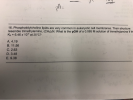 papl 16. Phosphatidylcholine lipids are very common in eukaryotic cell membranes. Their structure resemble trimethylamine, (CH3)3N. What is the pOH of a 0.085 M solution of trimethylamine if th Kb 6.46 x 10 at 25°C? A. 4.19 B. 11.56 C. 2.63 D. 3.48 E. 9.38
Limiting Reactant, Theoretical Yield and Percent Yield 2. Pentane combusts with en to form carbon dioxide...
 Limiting Reactant, Theoretical Yield and Percent Yield 2. Pentane combusts with en to form carbon dioxide and water by the following reaction: CsHız(1) + 8 O2(g) → 5 CO2(g) + 6H2O(g) a. If 8.00 g of pentane is mixed with 10.0 g of oxy compare it to either of the products). he is mixed with 10.0 g of oxygen, which is the limiting reactant? (Hint: b. What is the theoretical yield (in grams) of carbon dioxide and water for this...
Consider the titration of 40.0 mL of 0.0600 M (CH3)3N (a weak base; Kg = 6.40e-05)...
 Consider the titration of 40.0 mL of 0.0600 M (CH3)3N (a weak base; Kg = 6.40e-05) with 0.100 M HCl. Calculate the pH after the following volumes of titrant have been added: (а) 0.0 mL (b) 6.0 mL (c) 12.0 mL pH pH pH (d) 18.0 mL (e) 24.0 mL (f) 45.6 mL рH - рH: = pH
Consider the titration of 60.0 mL of 0.0400 M (CH3)3N (a weak base; Kb = 6.40e-05)...
Consider the titration of 60.0 mL of 0.0400 M (CH3)3N (a weak base; Kb = 6.40e-05) with 0.100 M HBr. Calculate the pH after the following volumes of titrant have been added: (a) 0.0 mL pH = (b) 6.0 mL pH = (c) 12.0 mL pH = (d) 18.0 mL pH = (e) 24.0 mL pH = (f) 38.4 mL pH =
b) CH, CH2 CH CH Br + SH — CHZ CH3 CH, CH, CH, Br + SH" — c) (polar protic solvents) CH, Br + (CH3)3N CH, Br + (CH3)3P...
 b) CH, CH2 CH CH Br + SH — CHZ CH3 CH, CH, CH, Br + SH" — c) (polar protic solvents) CH, Br + (CH3)3N CH, Br + (CH3)3P - — d) CH, I + CN- - DMF CHZI + CNC CH3CH20H e) CH I + OH- - CHZI + CH, CO2- (6) 14. Place 1º, 2º, 3º and Methyl carbocations in order from least stable to most stable. What factor(s) account for the stability of the most stable...
Match each of the symmetry situations with correct basis: Basis: A) Bond vectors; B) 3N; C)3N-6;...
Match each of the symmetry situations with correct basis: Basis: A) Bond vectors; B) 3N; C)3N-6; d) x axis; E) y axis; f) z axis Symmetry situations: 1) C-Cl stretches in CH2Cl2 2)All vibrational modes in Cr(CO)6; 3) All degrees of freedom in Ferrocene 4) Xe going above and below the plane XeCl4
a. Determine the pH during the titration of 31.3 mL of 0.264 M trimethylamine ((CH3)3N, Kb...
a. Determine the pH during the titration of 31.3 mL of 0.264 M trimethylamine ((CH3)3N, Kb = 6.3×10-5) by 0.264 M HI at the following points. (Assume the titration is done at 25 °C.) Note that state symbols are not shown for species in this problem. (a) Before the addition of any HI ____ (b) After the addition of 12.6 mL of HI ____ (c) At the titration midpoint ____ (d) At the equivalence point ____ (e) After adding 43.8...
10-12 explanation C) carbon bonded to three alkyl groups 10 B X 10) Which of the...
 10-12 explanation
C) carbon bonded to three alkyl groups 10 B X 10) Which of the following compounds is a secondary alcohol? CH3-O-H B) CH3 CH3-C-CH3 OH Ở CH3 - CH-O-CH3 CH3 D) OH CH3-CH2 -C- CH3 CH3 E) CH3 - CH-OH CH3 11) What is the name of the following compound: CH3-CH2-CH2-CH-CH2? A) 1-pentene B) 4-pentane C) 4-ene-pentane b) 2-pentane E) none of the above 12) 12) D X Name the following compound: CH3 - C -CH A) propanal
10-12 explanation
C) carbon bonded to three alkyl groups 10 B X 10) Which of the following compounds is a secondary alcohol? CH3-O-H B) CH3 CH3-C-CH3 OH Ở CH3 - CH-O-CH3 CH3 D) OH CH3-CH2 -C- CH3 CH3 E) CH3 - CH-OH CH3 11) What is the name of the following compound: CH3-CH2-CH2-CH-CH2? A) 1-pentene B) 4-pentane C) 4-ene-pentane b) 2-pentane E) none of the above 12) 12) D X Name the following compound: CH3 - C -CH A) propanal
 QUESTION 8:
Which of the following is the weakest base?
A.
NH3
B.
(CH3)3N
C.
CH3NH2
D.
QUESTION 9:
A compound which is insoluble in water but which dissolves in
dilute hydrochloric acid is
A.
probably an amide
B.
possibly a carboxylic acid
C.
almost certainly an amine
D.
probably neither acidic nor basic
E.
probably an ester
QUESTION 10:
We were unable to transcribe this imageQuestion 10 Which of the following compounds would be the strongest base? III ON...
QUESTION 8:
Which of the following is the weakest base?
A.
NH3
B.
(CH3)3N
C.
CH3NH2
D.
QUESTION 9:
A compound which is insoluble in water but which dissolves in
dilute hydrochloric acid is
A.
probably an amide
B.
possibly a carboxylic acid
C.
almost certainly an amine
D.
probably neither acidic nor basic
E.
probably an ester
QUESTION 10:
We were unable to transcribe this imageQuestion 10 Which of the following compounds would be the strongest base? III ON...
 papl 16. Phosphatidylcholine lipids are very common in eukaryotic cell membranes. Their structure resemble trimethylamine, (CH3)3N. What is the pOH of a 0.085 M solution of trimethylamine if th Kb 6.46 x 10 at 25°C? A. 4.19 B. 11.56 C. 2.63 D. 3.48 E. 9.38
 Limiting Reactant, Theoretical Yield and Percent Yield 2. Pentane combusts with en to form carbon dioxide and water by the following reaction: CsHız(1) + 8 O2(g) → 5 CO2(g) + 6H2O(g) a. If 8.00 g of pentane is mixed with 10.0 g of oxy compare it to either of the products). he is mixed with 10.0 g of oxygen, which is the limiting reactant? (Hint: b. What is the theoretical yield (in grams) of carbon dioxide and water for this...
 Consider the titration of 40.0 mL of 0.0600 M (CH3)3N (a weak base; Kg = 6.40e-05) with 0.100 M HCl. Calculate the pH after the following volumes of titrant have been added: (а) 0.0 mL (b) 6.0 mL (c) 12.0 mL pH pH pH (d) 18.0 mL (e) 24.0 mL (f) 45.6 mL рH - рH: = pH
 b) CH, CH2 CH CH Br + SH — CHZ CH3 CH, CH, CH, Br + SH" — c) (polar protic solvents) CH, Br + (CH3)3N CH, Br + (CH3)3P - — d) CH, I + CN- - DMF CHZI + CNC CH3CH20H e) CH I + OH- - CHZI + CH, CO2- (6) 14. Place 1º, 2º, 3º and Methyl carbocations in order from least stable to most stable. What factor(s) account for the stability of the most stable...
 10-12 explanation
C) carbon bonded to three alkyl groups 10 B X 10) Which of the following compounds is a secondary alcohol? CH3-O-H B) CH3 CH3-C-CH3 OH Ở CH3 - CH-O-CH3 CH3 D) OH CH3-CH2 -C- CH3 CH3 E) CH3 - CH-OH CH3 11) What is the name of the following compound: CH3-CH2-CH2-CH-CH2? A) 1-pentene B) 4-pentane C) 4-ene-pentane b) 2-pentane E) none of the above 12) 12) D X Name the following compound: CH3 - C -CH A) propanal
10-12 explanation
C) carbon bonded to three alkyl groups 10 B X 10) Which of the following compounds is a secondary alcohol? CH3-O-H B) CH3 CH3-C-CH3 OH Ở CH3 - CH-O-CH3 CH3 D) OH CH3-CH2 -C- CH3 CH3 E) CH3 - CH-OH CH3 11) What is the name of the following compound: CH3-CH2-CH2-CH-CH2? A) 1-pentene B) 4-pentane C) 4-ene-pentane b) 2-pentane E) none of the above 12) 12) D X Name the following compound: CH3 - C -CH A) propanal
Most questions answered within 3 hours.
-
Where is the error in this code sequence?
String s1 = "Hello";
String s2 = "ello";...
asked 11 months ago -
Financial data for Joel de Paris, Inc., for last year
follow:
Joel de Paris, Inc.
Balance...
asked 11 months ago -
Consider this reaction:
Al2(SO4)3 (aq)+ BaCl3
(aq) Al2Cl6 (aq)- +
3BaSO4(s) . What is the...
asked 11 months ago -
Suppose that Savneet is considering increasing her
recent random sample from 20 car rentals to 40...
asked 11 months ago -
Trucks arrive at an unloading terminal at an average rate of 120
per hour.
Trucks arrive...
asked 11 months ago -
Why are methanol and ethanol completely soluble in water while
octanol is not very little soluble....
asked 11 months ago -
A facilities manager at a university reads in a research report
that the mean amount of...
asked 11 months ago -
When the CuSO4 is rehydrated by adding water to the anhydrous
compound, is this an endothermic...
asked 11 months ago -
A ray of sunlight is passing from diamond into crown glass; the
angle of incidence is...
asked 11 months ago -
A block of mass 0.249 kg is placed on top of a light, vertical
spring of...
asked 11 months ago -
how do the kidneys compensate in the presences of acidosis
a) trigger hyperventilate
b) reserve acid...
asked 11 months ago -
Question 501 pts
The rental rate of capital to the firm increases. Which of the
following...
asked 11 months ago