Please answer the question below with complete explanation and a light rays drawing of the concave...
Please answer the question below with complete explanation and a
light rays drawing of the concave mirror. Show all calculations (if
applicable).
*********
$$Q: You have a concave mirror, and you want to use it to produce an image the same size as the object. Where should you place the object?
*********
Homework Answers

Add Answer to:
Please answer the question below with complete explanation and a
light rays drawing of the concave...
An object (represented by the brown arrow) is placed near a concave lens Three sample rays of light are shown traveling from the tip of the object to the lens. On the diagram below, draw three arrows...
 An object (represented by the brown arrow) is placed near a concave lens Three sample rays of light are shown traveling from the tip of the object to the lens. On the diagram below, draw three arrows to show the subsequent paths of the three light rays given. Draw a fourth arrow to represent the image that is formed by the lens. The focal points of the lens are shown for reference Note: to locate the image, you will also...
Period A concave mirror can also be used for focusing Mirror Using the drawing at the...
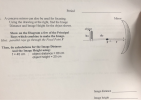 Period A concave mirror can also be used for focusing Mirror Using the drawing at the right, find the Image Distance and Image Height for the object shown. object Show on the Diagram a few of the Principal Rays which combine to make the Image. ho do Hint: parallel rays go through the Focal Point Then, do calculations for the Image Distance And the Image Height using: f 45 cmobject distance 80 cm object height- 20 cm Image distance Image...
Can i please have a detail explanation with the answer? The diagrams below show light rays...
 Can i please have a detail explanation with the answer?
The diagrams below show light rays incident on the surface of a glass prism. Complete the ray diagram to show how the light leaves the prism. glass prism
Can i please have a detail explanation with the answer?
The diagrams below show light rays incident on the surface of a glass prism. Complete the ray diagram to show how the light leaves the prism. glass prism
6. A concave mirror has a focal length of 50 cm. We want this mirror to...
6. A concave mirror has a focal length of 50 cm. We want this mirror to form a real image 1.2 times larger than an object. a) Where should we place the object? b) Draw a ray diagram to position the image. c) Where should we place the same object to obtain a virtual image 1.2 times larger than the object?
can you please help me answer theses questions ect Question 11 0 / 5 pts Light...
 can you please help me answer theses questions
ect Question 11 0 / 5 pts Light of wavelength 495 nm is incident upon a single slit with width W = 4.3 x 10⁻⁴ m. m. The figure below shows the pattern observed on a screen positioned 270 cm from the slits. What is the distance, in cm. Please round your answer to two decimal places 0.008 Question 12 5/5 pts Classes Google Slides - cre... G Question 18 0/3 pts...
can you please help me answer theses questions
ect Question 11 0 / 5 pts Light of wavelength 495 nm is incident upon a single slit with width W = 4.3 x 10⁻⁴ m. m. The figure below shows the pattern observed on a screen positioned 270 cm from the slits. What is the distance, in cm. Please round your answer to two decimal places 0.008 Question 12 5/5 pts Classes Google Slides - cre... G Question 18 0/3 pts...
need help. please answer #8-11 8. As an object moves away from a plane mirror on...
 need help. please answer #8-11
8. As an object moves away from a plane mirror on a wall and you observe the object and the image from the position of the mirror, the image of the object A. gets smaller B. may or may not get smaller, depending on where the observer is positioned. C. Is always a real image, no matter how far you are from the mirror. D. Changes from being a virtual to a real image as...
need help. please answer #8-11
8. As an object moves away from a plane mirror on a wall and you observe the object and the image from the position of the mirror, the image of the object A. gets smaller B. may or may not get smaller, depending on where the observer is positioned. C. Is always a real image, no matter how far you are from the mirror. D. Changes from being a virtual to a real image as...
2. (3 pts.) A spherical, concave mirror has a radius of curvature of 75.0 cm. You...
 2. (3 pts.) A spherical, concave mirror has a radius of curvature of 75.0 cm. You have a small, well-lit plastic action figure that is 10.0 cm tall, and you want to create a real image of it that is 1.50 times as large as the original object. (Hint: Watch your signs the real image will be inverted, so the magnification should be negative.) At what distance from the mirror should you place the object? Show your work completely
A concave mirror has a focal length 55 cm. Where should you place an object to...
A concave mirror has a focal length 55 cm. Where should you place an object to get a real image at: a) 83.5 cm from the mirror? b) 1.8 m from the mirror? Explain the outcome of your calculations.
A concave lens refracts parallel rays in such a way that they are bent away from...
 A concave lens refracts parallel rays in such a way that they are
bent away from the axis of the lens. For this reason, a concave
lens is referred to as a diverging lens.
Part A
Consider the following diagrams, where F represents the focal point
of a concave lens. In these diagrams, the image formed by the lens
is obtained using the ray tracing technique. Which diagrams are
accurate?(Figure 1) (Figure 2) (Figure 3) (Figure 4)
Type A if...
A concave lens refracts parallel rays in such a way that they are
bent away from the axis of the lens. For this reason, a concave
lens is referred to as a diverging lens.
Part A
Consider the following diagrams, where F represents the focal point
of a concave lens. In these diagrams, the image formed by the lens
is obtained using the ray tracing technique. Which diagrams are
accurate?(Figure 1) (Figure 2) (Figure 3) (Figure 4)
Type A if...
Please complete the following ray diagrams EXPERIMENT Gaboro Concave lens: Ray diagrams do > 21 Conclusions...
 Please complete the following ray diagrams
EXPERIMENT Gaboro Concave lens: Ray diagrams do > 21 Conclusions tad, 521 Focal length determination: fe focal length of the combination S. focal length of concave lens QUESTIONS 1. A plane mirror essentially has a radius of curvature of infinity. Using the mirror equation, show that (a) the image of a plane mirror is always virtual; (b) the im- age is behind the mirror the same distance as the object is in front of...
Please complete the following ray diagrams
EXPERIMENT Gaboro Concave lens: Ray diagrams do > 21 Conclusions tad, 521 Focal length determination: fe focal length of the combination S. focal length of concave lens QUESTIONS 1. A plane mirror essentially has a radius of curvature of infinity. Using the mirror equation, show that (a) the image of a plane mirror is always virtual; (b) the im- age is behind the mirror the same distance as the object is in front of...
 An object (represented by the brown arrow) is placed near a concave lens Three sample rays of light are shown traveling from the tip of the object to the lens. On the diagram below, draw three arrows to show the subsequent paths of the three light rays given. Draw a fourth arrow to represent the image that is formed by the lens. The focal points of the lens are shown for reference Note: to locate the image, you will also...
 Period A concave mirror can also be used for focusing Mirror Using the drawing at the right, find the Image Distance and Image Height for the object shown. object Show on the Diagram a few of the Principal Rays which combine to make the Image. ho do Hint: parallel rays go through the Focal Point Then, do calculations for the Image Distance And the Image Height using: f 45 cmobject distance 80 cm object height- 20 cm Image distance Image...
 Can i please have a detail explanation with the answer?
The diagrams below show light rays incident on the surface of a glass prism. Complete the ray diagram to show how the light leaves the prism. glass prism
Can i please have a detail explanation with the answer?
The diagrams below show light rays incident on the surface of a glass prism. Complete the ray diagram to show how the light leaves the prism. glass prism
 can you please help me answer theses questions
ect Question 11 0 / 5 pts Light of wavelength 495 nm is incident upon a single slit with width W = 4.3 x 10⁻⁴ m. m. The figure below shows the pattern observed on a screen positioned 270 cm from the slits. What is the distance, in cm. Please round your answer to two decimal places 0.008 Question 12 5/5 pts Classes Google Slides - cre... G Question 18 0/3 pts...
can you please help me answer theses questions
ect Question 11 0 / 5 pts Light of wavelength 495 nm is incident upon a single slit with width W = 4.3 x 10⁻⁴ m. m. The figure below shows the pattern observed on a screen positioned 270 cm from the slits. What is the distance, in cm. Please round your answer to two decimal places 0.008 Question 12 5/5 pts Classes Google Slides - cre... G Question 18 0/3 pts...
 need help. please answer #8-11
8. As an object moves away from a plane mirror on a wall and you observe the object and the image from the position of the mirror, the image of the object A. gets smaller B. may or may not get smaller, depending on where the observer is positioned. C. Is always a real image, no matter how far you are from the mirror. D. Changes from being a virtual to a real image as...
need help. please answer #8-11
8. As an object moves away from a plane mirror on a wall and you observe the object and the image from the position of the mirror, the image of the object A. gets smaller B. may or may not get smaller, depending on where the observer is positioned. C. Is always a real image, no matter how far you are from the mirror. D. Changes from being a virtual to a real image as...
 2. (3 pts.) A spherical, concave mirror has a radius of curvature of 75.0 cm. You have a small, well-lit plastic action figure that is 10.0 cm tall, and you want to create a real image of it that is 1.50 times as large as the original object. (Hint: Watch your signs the real image will be inverted, so the magnification should be negative.) At what distance from the mirror should you place the object? Show your work completely
 A concave lens refracts parallel rays in such a way that they are
bent away from the axis of the lens. For this reason, a concave
lens is referred to as a diverging lens.
Part A
Consider the following diagrams, where F represents the focal point
of a concave lens. In these diagrams, the image formed by the lens
is obtained using the ray tracing technique. Which diagrams are
accurate?(Figure 1) (Figure 2) (Figure 3) (Figure 4)
Type A if...
A concave lens refracts parallel rays in such a way that they are
bent away from the axis of the lens. For this reason, a concave
lens is referred to as a diverging lens.
Part A
Consider the following diagrams, where F represents the focal point
of a concave lens. In these diagrams, the image formed by the lens
is obtained using the ray tracing technique. Which diagrams are
accurate?(Figure 1) (Figure 2) (Figure 3) (Figure 4)
Type A if...
 Please complete the following ray diagrams
EXPERIMENT Gaboro Concave lens: Ray diagrams do > 21 Conclusions tad, 521 Focal length determination: fe focal length of the combination S. focal length of concave lens QUESTIONS 1. A plane mirror essentially has a radius of curvature of infinity. Using the mirror equation, show that (a) the image of a plane mirror is always virtual; (b) the im- age is behind the mirror the same distance as the object is in front of...
Please complete the following ray diagrams
EXPERIMENT Gaboro Concave lens: Ray diagrams do > 21 Conclusions tad, 521 Focal length determination: fe focal length of the combination S. focal length of concave lens QUESTIONS 1. A plane mirror essentially has a radius of curvature of infinity. Using the mirror equation, show that (a) the image of a plane mirror is always virtual; (b) the im- age is behind the mirror the same distance as the object is in front of...
Most questions answered within 3 hours.
-
Where is the error in this code sequence?
String s1 = "Hello";
String s2 = "ello";...
asked 10 months ago -
Financial data for Joel de Paris, Inc., for last year
follow:
Joel de Paris, Inc.
Balance...
asked 10 months ago -
Consider this reaction:
Al2(SO4)3 (aq)+ BaCl3
(aq) Al2Cl6 (aq)- +
3BaSO4(s) . What is the...
asked 10 months ago -
Suppose that Savneet is considering increasing her
recent random sample from 20 car rentals to 40...
asked 10 months ago -
Trucks arrive at an unloading terminal at an average rate of 120
per hour.
Trucks arrive...
asked 10 months ago -
Why are methanol and ethanol completely soluble in water while
octanol is not very little soluble....
asked 10 months ago -
A facilities manager at a university reads in a research report
that the mean amount of...
asked 10 months ago -
When the CuSO4 is rehydrated by adding water to the anhydrous
compound, is this an endothermic...
asked 10 months ago -
A ray of sunlight is passing from diamond into crown glass; the
angle of incidence is...
asked 10 months ago -
A block of mass 0.249 kg is placed on top of a light, vertical
spring of...
asked 10 months ago -
how do the kidneys compensate in the presences of acidosis
a) trigger hyperventilate
b) reserve acid...
asked 10 months ago -
Question 501 pts
The rental rate of capital to the firm increases. Which of the
following...
asked 10 months ago