Illustrate and describe how the lack operon of Escherichia coli functions (include in your response what...
Illustrate and describe how the lack operon of Escherichia coli functions (include in your response what happens with a. high glucose/low lactose, b. high glucose/high lactose, c. low glucose/low lactose, and d. low glucose/high lactose).
Homework Answers
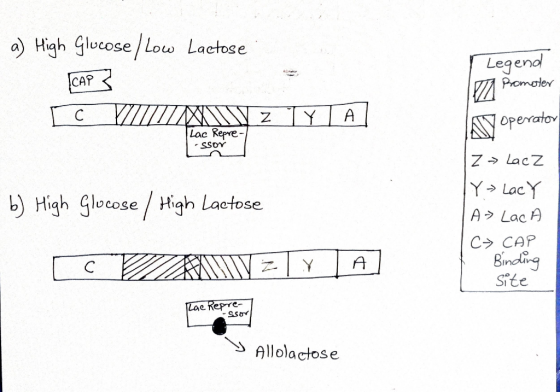
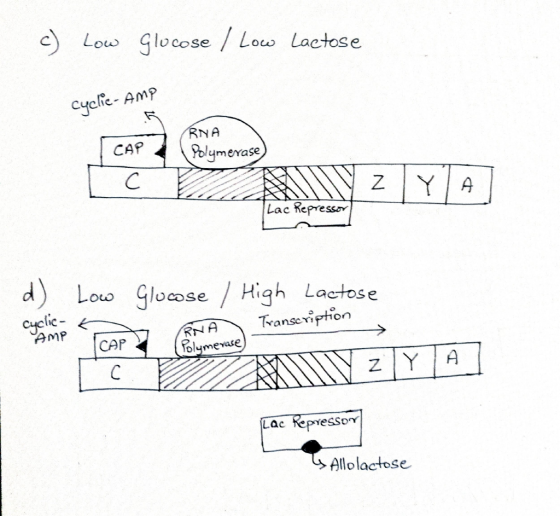
The Lac Operon in E. coli operates by sensing both Glucose and Lactose levels. In order for the Lac Operon to be turned on, Glucose needs to be absent and Lactose needs to be present (although it is Allolactose, an isomer of Lactose that is required to allow the genes of the Lac operon to be transcribed).
The Lac Operon is comprised of three 'structural' genes. Thsese are:
- Lac Z: This codes for
 -Galactosidase, an enzyme that cleaves Lactose into Glucose and
Galactose
-Galactosidase, an enzyme that cleaves Lactose into Glucose and
Galactose - Lac Y: This codes for
-Galactoside permease, a protein that allows Lactose to be imported
into the cell.
- Lac A: This codes for
-Galactoside transacetylase, an enzyme that transfers an Acetyl
group from Acetyl CoenzymeA to Lactose and other sugars containing
Galactose.
 -Galactosidase, an enzyme that cleaves Lactose into Glucose and
Galactose
-Galactosidase, an enzyme that cleaves Lactose into Glucose and
GalactoseThe other components of the Lac Operon include:
- A CAP binding site, a region upstream of the structural genes that CAP (Catabolite Activator Protein) binds to
- A promoter region, that binds RNA Polymerase prior to transcription
- The Operator region (the operator overlaps with the promoter) which is bound by Lac Repressor Protein when Lactose is absent.
The Lac Operon is turned on when glucose is not present and Lactose is available. When Lactose is present in the cell, some of the Lactose is converted into Allolactose, an isomer of Lactose. Allolactose is able to bind to the Lactose Repressor protein, which normally blocks the transcription of the Lac Operon. However, when Lactose levels are low, no Allolactose is present in the cell and Lac Repressor is able to bind to the Operator region of the Lac Operon and prevent Transcription.
The Lac Operon is also controlled by Glucose Levels in the cell. When Glucose levels are high, CAP is unable to bind to the CAP binding site. The CAP protein is an important Transcription factor as it recruits RNA Polymerase to the Lac promoter. However CAP binding to the CAP binding site is dependent on the presence of cyclic-Adenosine monophosphate (cAMP). Under high glucose conditions, cAMP levels are low, which in-turn prevents CAP binding to DNA. However, when Glucose levels are low, cAMP concentrations increase and cAMP-CAP is able to bind to the CAP binding site and recruit RNA Polymerase.
Add Answer to:
Illustrate and describe how the lack operon of
Escherichia coli functions (include in your response what...
3. Describe the “logic circuit” of the Lac operon. Which proteins are bound or not to...
3. Describe the “logic circuit” of the Lac operon. Which proteins are bound or not to DNA in each case? a. Glucose low, lactose low. b. Glucose high, lactose low. c. Glucose low, lactose high. d. Glucose high, lactose high
You have systematically mutagenized the lac operon in E. coli to produce a mutation that disrupts...
You have systematically mutagenized the lac operon in E. coli to produce a mutation that disrupts the function of each of the following elements: a. the promoter for LacI (P(I)) b. the LacI gene c. CRP binding site d. the promoter for the lac operon (P(lac)) e. the operator sequence f. a mutation in lacZ that disrupts the coding region but does not disrupt transcription g. a mutation in lacZ that blocks transcription For each of the above mutations, what...
Describe and label the regions on the lac operon. Include the following: regulatory gene, promoter region,...
Describe and label the regions on the lac operon. Include the following: regulatory gene, promoter region, operator, structural genes, and repressor. What happens in the presence of glucose? Lactose?
answer the following questions about lac operon: a) if the lack repressor protein is bound to...
answer the following questions about lac operon: a) if the lack repressor protein is bound to the operator, are the E.coli metabolized lactose or not? explain your reasoning. b) If the lack repressor protein is bound to the operator and cellular glucose levels are low, is cAMP-CAP complex bound adjacent to the promotor, or not? explain your reasoning. c) if the lack repressor protein is bound to the operator and cAMP - CAP is bound to the CAP site, are...
1. Describe how bacteria regulate genes through operons. 2. What is the difference between a repressible...
 1. Describe how bacteria regulate genes through operons. 2. What is the difference between a repressible and inducible genetic system? 3. Expression of the Lac operon is under the controls of (1) the Lacl repressor and (2) CAP. Consider each of the following conditions and determine which factors will be acting on the operon. Predict the rate of gene expression. Conditions Lac Operon fon" or "off" CAP present" or "absent" at Lac Operon Predict the rate of gene expression (none,...
a) For the lac operon, will the repressor or RNA polymerase be bound to the operon in this situation? Draw what wil...
 a) For the lac operon, will the repressor or RNA polymerase be bound to the operon in this situation? Draw what will be happening on the operon below. PROMOTER OPERATOR Lactose Enzyme 1 Lsctose Enzyme2 Lactose Enzyme 3 NO b) Will transcription occur? c) Describe what is happening (with vocabulary words). YES 2. Bobby Joe is fasting today, how will the E. coli in her stomach respond to the lack of Tryptophan? a) For the trp operon, will the repressor...
Describe the structural features and mechanism of assembly of Escherichia coli P (Pap) pili. Use a diagram to illustrate...
Describe the structural features and mechanism of assembly of Escherichia coli P (Pap) pili. Use a diagram to illustrate you answer. When are these pili used during infection, and how is receptor specificity determined in this system? [ESSAY TYPE QUESTION]
Quiz 10 1. (2 points) Which of the following conditions would lead to the highest levels of lac operon expression? a) High lactose, high glucose b) High lactose, low glucose c) Low lactose, high...
 Quiz 10 1. (2 points) Which of the following conditions would lead to the highest levels of lac operon expression? a) High lactose, high glucose b) High lactose, low glucose c) Low lactose, high glucose d) Low lactose, low glucose e) None of the above would have any lac operon expression 2. (2 points) Which of the following is true concerning molecular genetics? a) tRNA carries amino acids into the nucleus in eukaryotic cells b) DNA polymerase moves towards the...
The intracellular concentrations of cAMP in Escherichia coli are controlled by adenylate cyclase, which is encoded...
The intracellular concentrations of cAMP in Escherichia coli are controlled by adenylate cyclase, which is encoded by the Cya gene. Withdrawal of the glucose from the growth medium causes a reduction of ATP and a dramatic stimulation of the cyclase activity and the production of cAMP. Consider two E. coli strains with the following genotypes, where “+” indicates a wild-type gene with normal function and “-” indicates a loss-of-function allele: Strain A: Cya- CAP+ I+ P+ O+ Z- Y+ Strain...
Most of what we know about the lac operon in E. coli has come from the...
Most of what we know about the lac operon in E. coli has come from the genetic analysis of various mutants. Below is a list of mutants for regions of the operon. A + superscript indicates no mutation and normal function of that region, - indicates a knock out and no function of that region, c indicates the mutation resulted in constitutive action of that region. The effect of the mutation is determined by expression of the lacZ gene as...
 1. Describe how bacteria regulate genes through operons. 2. What is the difference between a repressible and inducible genetic system? 3. Expression of the Lac operon is under the controls of (1) the Lacl repressor and (2) CAP. Consider each of the following conditions and determine which factors will be acting on the operon. Predict the rate of gene expression. Conditions Lac Operon fon" or "off" CAP present" or "absent" at Lac Operon Predict the rate of gene expression (none,...
 a) For the lac operon, will the repressor or RNA polymerase be bound to the operon in this situation? Draw what will be happening on the operon below. PROMOTER OPERATOR Lactose Enzyme 1 Lsctose Enzyme2 Lactose Enzyme 3 NO b) Will transcription occur? c) Describe what is happening (with vocabulary words). YES 2. Bobby Joe is fasting today, how will the E. coli in her stomach respond to the lack of Tryptophan? a) For the trp operon, will the repressor...
 Quiz 10 1. (2 points) Which of the following conditions would lead to the highest levels of lac operon expression? a) High lactose, high glucose b) High lactose, low glucose c) Low lactose, high glucose d) Low lactose, low glucose e) None of the above would have any lac operon expression 2. (2 points) Which of the following is true concerning molecular genetics? a) tRNA carries amino acids into the nucleus in eukaryotic cells b) DNA polymerase moves towards the...
Most questions answered within 3 hours.
-
Where is the error in this code sequence?
String s1 = "Hello";
String s2 = "ello";...
asked 10 months ago -
Financial data for Joel de Paris, Inc., for last year
follow:
Joel de Paris, Inc.
Balance...
asked 10 months ago -
Consider this reaction:
Al2(SO4)3 (aq)+ BaCl3
(aq) Al2Cl6 (aq)- +
3BaSO4(s) . What is the...
asked 10 months ago -
Suppose that Savneet is considering increasing her
recent random sample from 20 car rentals to 40...
asked 10 months ago -
Trucks arrive at an unloading terminal at an average rate of 120
per hour.
Trucks arrive...
asked 10 months ago -
Why are methanol and ethanol completely soluble in water while
octanol is not very little soluble....
asked 10 months ago -
A facilities manager at a university reads in a research report
that the mean amount of...
asked 10 months ago -
When the CuSO4 is rehydrated by adding water to the anhydrous
compound, is this an endothermic...
asked 10 months ago -
A ray of sunlight is passing from diamond into crown glass; the
angle of incidence is...
asked 10 months ago -
A block of mass 0.249 kg is placed on top of a light, vertical
spring of...
asked 10 months ago -
how do the kidneys compensate in the presences of acidosis
a) trigger hyperventilate
b) reserve acid...
asked 10 months ago -
Question 501 pts
The rental rate of capital to the firm increases. Which of the
following...
asked 10 months ago