In dominant gene interactions, selfing a F1 dihybrid produces a 9:6:1 phenotypic ratio. How many genotypes...
In dominant gene interactions, selfing a F1 dihybrid produces a 9:6:1 phenotypic ratio. How many genotypes are associated with the 9/16 class?
A) 3
B) 4
C) 6
D) 9
E) 10
Homework Answers

Add Answer to:
In dominant gene interactions, selfing a F1 dihybrid produces a
9:6:1 phenotypic ratio. How many genotypes...
8. Diagram the dihybrid cross in Drosophila. (2.5) a. Use the gene symbols dpt/dp and se*/se...
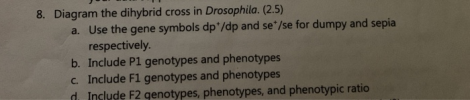 8. Diagram the dihybrid cross in Drosophila. (2.5) a. Use the gene symbols dpt/dp and se*/se for dumpy and sepia respectively. b. Include P1 genotypes and phenotypes c. Include F1 genotypes and phenotypes d Include F2 genotypes, phenotypes, and phenotypic ratio
What is the phenotypic ratio expected after a dihybrid self cross displaying dominant suppression? How do...
What is the phenotypic ratio expected after a dihybrid self cross displaying dominant suppression? How do you work this out? I know its 13:3 but how do they get this?
A cross between two individuals who are heterozygous for two genes, one gene with dominant inheritance...
A cross between two individuals who are heterozygous for two genes, one gene with dominant inheritance and the other with codominant inheritance. Assuming independent assortment of the two genes, what phenotypic proportions would be observed in the F1? A) 3:6:3:1:2:1 B) 16:9:9:3:3:1 C) 12:9:3:1 D) 9:3:3:1 E) 1:1:1:1
The recessive gene sh produces shrunken endosperm in corn kernels and its dominant allele sh+ produces...
The recessive gene sh produces shrunken endosperm in corn kernels and its dominant allele sh+ produces full, plump kernels. The recessive gene c produces colorful endosperm and its dominant allele c+ produces colored endosperm. Two homozygous plants are crossed, producing and F1 all phenotypically plump and colored. The F1 plants are testcrossed and the following offspring were produced: 149 shrunken, colored, 4035 shrunken, colorless, 152 plump, colorless and 4032 plump, colored. a. What were the phenotypes and genotypes of the...
. . . Activity E. Predicting the outcome of a dihybrid cross The resulting phenotypic ratios...
 . . . Activity E. Predicting the outcome of a dihybrid cross The resulting phenotypic ratios in the F2 generation of a dihybrid cross (2 traits) can be quite different than those observed from a monohybrid cross. But the process is essentially the same. First you list all possible gametes each parent and subsequent parents can produce. Second, you then assign the gamete possibilities to the Punnett square and fill it in. Finally you count the progeny and determine the...
WORD BANK: Complementary gene interaction, Duplicate gene action, Dominant gene interaction, Recessive epistasis, Dominant epistasis, Dominant...
 WORD BANK: Complementary gene interaction, Duplicate gene action, Dominant gene interaction, Recessive epistasis, Dominant epistasis, Dominant suppression. 1. In cats, the Dense pigment gene, D/d, codes for melanophilin, a protein involved in the transportation and gment into a growing hair. A separate gene, M/m, is responsible for the production of the pigment, with M producing black pigment and mm producing brown. When a cat has two recessive d alleles, its fur is a light gray color regardless of which alleles...
Questions 1-6 BIOL 366 Mono and Dihybrid Crosses Recitation Problem Set Directions: For problems 1-6, do...
 Questions 1-6
BIOL 366 Mono and Dihybrid Crosses Recitation Problem Set Directions: For problems 1-6, do the following A. List how many genes are involved B. List how many alleles are involved. C. Identify symbols and genotypes / phenotypes D. List the genotypes of the parents E. Diagram and complete a Punnett square F. Give the phenotype percentages/ration of the offspring 1. In dogs, erect ears (E) is dominate over droopy ears (e). What are the results if two heterozygous...
Questions 1-6
BIOL 366 Mono and Dihybrid Crosses Recitation Problem Set Directions: For problems 1-6, do the following A. List how many genes are involved B. List how many alleles are involved. C. Identify symbols and genotypes / phenotypes D. List the genotypes of the parents E. Diagram and complete a Punnett square F. Give the phenotype percentages/ration of the offspring 1. In dogs, erect ears (E) is dominate over droopy ears (e). What are the results if two heterozygous...
In sweet peas, two genes (genes A and B) control flower color. The dominant alleles of...
 In sweet peas, two genes (genes A and B) control flower color. The dominant alleles of both genes produce enzymes that function in the biochemical pathway shown to convert colorless precursors to a purple pigment. The recessive alleles do not produce enzyme. Therefore, at least one dominant allele of both gene A and gene B are required for purple flowers. Answer the questions about this biochemical pathway. ΑΑ, Αα BB, Bb Enzyme A Enzyme B Colorless precursor 1 Colorless precursor...
Which of the following is true regarding dihybrid crosses? A. Each parent involved in the cross...
Which of the following is true regarding dihybrid crosses? A. Each parent involved in the cross is heterozygous for at least one of the two genes being assessed. B. Two gene loci are assessed and the parents can be any genotype at these two loci. C. There are 9 different fertilization possibilities. D. The ratio 9:3:3:1 means that of the possible outcomes in offspring; 9/16 will express the dominant phenotype for both loci, 3/16 will express the dominant phenotype for...
A genotypic ratio of 1:2:1 and a phenotypic ratio of 3:1 results from a(n) _______ cross.
A genotypic ratio of 1:2:1 and a phenotypic ratio of 3:1 results from a(n) _______ cross. A. test B. monohybrid C. dihybrid D. allelic
 8. Diagram the dihybrid cross in Drosophila. (2.5) a. Use the gene symbols dpt/dp and se*/se for dumpy and sepia respectively. b. Include P1 genotypes and phenotypes c. Include F1 genotypes and phenotypes d Include F2 genotypes, phenotypes, and phenotypic ratio
 . . . Activity E. Predicting the outcome of a dihybrid cross The resulting phenotypic ratios in the F2 generation of a dihybrid cross (2 traits) can be quite different than those observed from a monohybrid cross. But the process is essentially the same. First you list all possible gametes each parent and subsequent parents can produce. Second, you then assign the gamete possibilities to the Punnett square and fill it in. Finally you count the progeny and determine the...
 WORD BANK: Complementary gene interaction, Duplicate gene action, Dominant gene interaction, Recessive epistasis, Dominant epistasis, Dominant suppression. 1. In cats, the Dense pigment gene, D/d, codes for melanophilin, a protein involved in the transportation and gment into a growing hair. A separate gene, M/m, is responsible for the production of the pigment, with M producing black pigment and mm producing brown. When a cat has two recessive d alleles, its fur is a light gray color regardless of which alleles...
 Questions 1-6
BIOL 366 Mono and Dihybrid Crosses Recitation Problem Set Directions: For problems 1-6, do the following A. List how many genes are involved B. List how many alleles are involved. C. Identify symbols and genotypes / phenotypes D. List the genotypes of the parents E. Diagram and complete a Punnett square F. Give the phenotype percentages/ration of the offspring 1. In dogs, erect ears (E) is dominate over droopy ears (e). What are the results if two heterozygous...
Questions 1-6
BIOL 366 Mono and Dihybrid Crosses Recitation Problem Set Directions: For problems 1-6, do the following A. List how many genes are involved B. List how many alleles are involved. C. Identify symbols and genotypes / phenotypes D. List the genotypes of the parents E. Diagram and complete a Punnett square F. Give the phenotype percentages/ration of the offspring 1. In dogs, erect ears (E) is dominate over droopy ears (e). What are the results if two heterozygous...
 In sweet peas, two genes (genes A and B) control flower color. The dominant alleles of both genes produce enzymes that function in the biochemical pathway shown to convert colorless precursors to a purple pigment. The recessive alleles do not produce enzyme. Therefore, at least one dominant allele of both gene A and gene B are required for purple flowers. Answer the questions about this biochemical pathway. ΑΑ, Αα BB, Bb Enzyme A Enzyme B Colorless precursor 1 Colorless precursor...
Most questions answered within 3 hours.
-
Where is the error in this code sequence?
String s1 = "Hello";
String s2 = "ello";...
asked 10 months ago -
Financial data for Joel de Paris, Inc., for last year
follow:
Joel de Paris, Inc.
Balance...
asked 10 months ago -
Consider this reaction:
Al2(SO4)3 (aq)+ BaCl3
(aq) Al2Cl6 (aq)- +
3BaSO4(s) . What is the...
asked 10 months ago -
Suppose that Savneet is considering increasing her
recent random sample from 20 car rentals to 40...
asked 10 months ago -
Trucks arrive at an unloading terminal at an average rate of 120
per hour.
Trucks arrive...
asked 10 months ago -
Why are methanol and ethanol completely soluble in water while
octanol is not very little soluble....
asked 10 months ago -
A facilities manager at a university reads in a research report
that the mean amount of...
asked 10 months ago -
When the CuSO4 is rehydrated by adding water to the anhydrous
compound, is this an endothermic...
asked 10 months ago -
A ray of sunlight is passing from diamond into crown glass; the
angle of incidence is...
asked 10 months ago -
A block of mass 0.249 kg is placed on top of a light, vertical
spring of...
asked 10 months ago -
how do the kidneys compensate in the presences of acidosis
a) trigger hyperventilate
b) reserve acid...
asked 10 months ago -
Question 501 pts
The rental rate of capital to the firm increases. Which of the
following...
asked 10 months ago