identify the muscles for each degree of freedom in leg and arm + range of motion...
Homework Answers


Add Answer to:
identify the muscles for each degree of freedom in leg and arm +
range of motion...
An ACL patient is doing leg extensions to strengthen his quadriceps muscles. With no additional weight...
 An ACL patient is doing leg extensions to strengthen his quadriceps muscles. With no additional weight added, the patient's lower leg (shank+foot) has a mass of 6.25 kg. The center of mass of the lower leg segment is located 32 cm from the axis of rotation of the knee joint. The leg is flexed 25 degree down from horizontal. The quadriceps muscle acts through the patellar tendon, which inserts 5 cm from the axis of rotation of the knee joint...
the type of joint/range of movement and finally to determine how the bones, muscles and tendons...
 the type of joint/range of movement and finally to determine how the bones, muscles and tendons work together to move about the joint. Materials: rubber tubing leg bones musculoskeletal model of the whole body tape Procedure: Examination of the KNEE and accompanying leg bones Carefully collect the three main bones of the knee. Lay the bones on the lab bench and place them in their proper positions to form a functional joint. Identify the following structures or where they would...
PROBLEM 2 Knee Extension - The angular motion of the lower leg about the knee joint,...
 PROBLEM 2 Knee Extension - The angular motion of the lower leg about the knee joint, and the forces and torques produced by the muscles crossing the knee joint during knee flexions and extensions have been investigated by a number of researchers utilizing different experimental techniques. One of these techniques is discussed here. Consider the person illustrated in Fig. 10.12. The test subject is sitting on a table, with the back placed against a back rest and the lower legs...
Problem 3: The figure shows the sketch of a 2 degree-of-freedom (planar) robot arm, where the...
 Problem 3: The figure shows the sketch of a 2 degree-of-freedom (planar) robot arm, where the link 1 (i.e., the yellow link) and the link 2 (i.e., the pink link) are attached through a prismatic (sliding) joint which only allows for a relative translation. The joint O is equipped with a motor that supplies the external torque, t(t), whereas the joint A is equipped with a pneumatic actuator that supplies the external force, F(t). Mass centers of the links 1...
Please help with ALL Muscles Across 1) either of two large muscles of the chest 6)...
 Please help with ALL
Muscles Across 1) either of two large muscles of the chest 6) Any skeletal muscle having three origins 8) Any skeletal muscle having two origins Down 2 Either of two flat triangular muscles of the moving the shoulders and arms 3) Muscles of the stomach. er and upper that are involved in Oem oto back part of the leg that forms 4) A broad flat muscle on other side of the back greater part of the...
Please help with ALL
Muscles Across 1) either of two large muscles of the chest 6) Any skeletal muscle having three origins 8) Any skeletal muscle having two origins Down 2 Either of two flat triangular muscles of the moving the shoulders and arms 3) Muscles of the stomach. er and upper that are involved in Oem oto back part of the leg that forms 4) A broad flat muscle on other side of the back greater part of the...
1) Describe each range of motion and an example of an associated joint for each motion...
1) Describe each range of motion and an example of an associated joint for each motion (do not use the same example).
Describe each range of motion and an example of an associated joint for each motion (do...
Describe each range of motion and an example of an associated joint for each motion (do not use the same example). Flexion/extension Abduction/adduction Circumduction Rotation
(10 pts) Consider the multi degree of freedom system of Fig. I a) Write the equations...
 (10 pts) Consider the multi degree of freedom system of Fig. I a) Write the equations of motion. b) Identify the mass matrix and the stiffness matrix Fig. 1 A multi degree of freedom system
Animations de show review View Help PDFelement orientation Cat- dorsal view: right hind leg Identify muscles:...
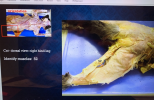 Animations de show review View Help PDFelement orientation Cat- dorsal view: right hind leg Identify muscles: 52
Given the six-degree of freedom equations of motion below, Translational Equations of motion V=PW _ RU...
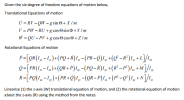 Given the six-degree of freedom equations of motion below, Translational Equations of motion V=PW _ RU + g cos@sinO +Y1m W=QU-. PV + g cos@cost+21m Rotational Equations of motion cry Linearize (1) the z-axis (W) translational equation of motion, and (2) the rotational equation of motion about the z-axis (R) using the method from the notes.
 An ACL patient is doing leg extensions to strengthen his quadriceps muscles. With no additional weight added, the patient's lower leg (shank+foot) has a mass of 6.25 kg. The center of mass of the lower leg segment is located 32 cm from the axis of rotation of the knee joint. The leg is flexed 25 degree down from horizontal. The quadriceps muscle acts through the patellar tendon, which inserts 5 cm from the axis of rotation of the knee joint...
 the type of joint/range of movement and finally to determine how the bones, muscles and tendons work together to move about the joint. Materials: rubber tubing leg bones musculoskeletal model of the whole body tape Procedure: Examination of the KNEE and accompanying leg bones Carefully collect the three main bones of the knee. Lay the bones on the lab bench and place them in their proper positions to form a functional joint. Identify the following structures or where they would...
 PROBLEM 2 Knee Extension - The angular motion of the lower leg about the knee joint, and the forces and torques produced by the muscles crossing the knee joint during knee flexions and extensions have been investigated by a number of researchers utilizing different experimental techniques. One of these techniques is discussed here. Consider the person illustrated in Fig. 10.12. The test subject is sitting on a table, with the back placed against a back rest and the lower legs...
 Problem 3: The figure shows the sketch of a 2 degree-of-freedom (planar) robot arm, where the link 1 (i.e., the yellow link) and the link 2 (i.e., the pink link) are attached through a prismatic (sliding) joint which only allows for a relative translation. The joint O is equipped with a motor that supplies the external torque, t(t), whereas the joint A is equipped with a pneumatic actuator that supplies the external force, F(t). Mass centers of the links 1...
 Please help with ALL
Muscles Across 1) either of two large muscles of the chest 6) Any skeletal muscle having three origins 8) Any skeletal muscle having two origins Down 2 Either of two flat triangular muscles of the moving the shoulders and arms 3) Muscles of the stomach. er and upper that are involved in Oem oto back part of the leg that forms 4) A broad flat muscle on other side of the back greater part of the...
Please help with ALL
Muscles Across 1) either of two large muscles of the chest 6) Any skeletal muscle having three origins 8) Any skeletal muscle having two origins Down 2 Either of two flat triangular muscles of the moving the shoulders and arms 3) Muscles of the stomach. er and upper that are involved in Oem oto back part of the leg that forms 4) A broad flat muscle on other side of the back greater part of the...
 (10 pts) Consider the multi degree of freedom system of Fig. I a) Write the equations of motion. b) Identify the mass matrix and the stiffness matrix Fig. 1 A multi degree of freedom system
 Animations de show review View Help PDFelement orientation Cat- dorsal view: right hind leg Identify muscles: 52
 Given the six-degree of freedom equations of motion below, Translational Equations of motion V=PW _ RU + g cos@sinO +Y1m W=QU-. PV + g cos@cost+21m Rotational Equations of motion cry Linearize (1) the z-axis (W) translational equation of motion, and (2) the rotational equation of motion about the z-axis (R) using the method from the notes.
Most questions answered within 3 hours.
-
Where is the error in this code sequence?
String s1 = "Hello";
String s2 = "ello";...
asked 11 months ago -
Financial data for Joel de Paris, Inc., for last year
follow:
Joel de Paris, Inc.
Balance...
asked 11 months ago -
Consider this reaction:
Al2(SO4)3 (aq)+ BaCl3
(aq) Al2Cl6 (aq)- +
3BaSO4(s) . What is the...
asked 11 months ago -
Suppose that Savneet is considering increasing her
recent random sample from 20 car rentals to 40...
asked 11 months ago -
Trucks arrive at an unloading terminal at an average rate of 120
per hour.
Trucks arrive...
asked 11 months ago -
Why are methanol and ethanol completely soluble in water while
octanol is not very little soluble....
asked 11 months ago -
A facilities manager at a university reads in a research report
that the mean amount of...
asked 11 months ago -
When the CuSO4 is rehydrated by adding water to the anhydrous
compound, is this an endothermic...
asked 11 months ago -
A ray of sunlight is passing from diamond into crown glass; the
angle of incidence is...
asked 11 months ago -
A block of mass 0.249 kg is placed on top of a light, vertical
spring of...
asked 11 months ago -
how do the kidneys compensate in the presences of acidosis
a) trigger hyperventilate
b) reserve acid...
asked 11 months ago -
Question 501 pts
The rental rate of capital to the firm increases. Which of the
following...
asked 11 months ago