The generic reaction A + B + C --> D has the rate law rate =...
The generic reaction A + B + C --> D has the rate law rate = k[A][B]1/2[C]. The initial rate at certain concentrations of A, B, and C is 0.0115 M/s. What is the rate if the concentration of A is halved, B is increased by 9x, and C is doubled?
Homework Answers

Consider the following reaction: A + B + C +D The rate law for this reaction...
 Consider the following reaction: A + B + C +D The rate law for this reaction is as follows: Rate = k Alla B11/2 Suppose the rate of the reaction at certain initial concentrations of A, B, and C is 1.14x10⁻² M/s. Part A What is the rate of the reaction if the concentrations of A and C are doubled and the concentration of B is tripled? VO AED A O O ? Rate 2 = M/s Submit Request Answer
Consider the following reaction: A+B+C→D The rate law for this reaction is as follows: Rate=k[A][C]2[B]1/2 Suppose...
Consider the following reaction: A+B+C→D The rate law for this reaction is as follows: Rate=k[A][C]2[B]1/2 Suppose the rate of the reaction at certain initial concentrations of A, B, and C is 1.19×10⁻² mol⋅L−1⋅s−1 . What is the rate of the reaction if the concentrations of A and C are doubled and the concentration of B is tripled?
Review Constants Periodic Table Consider the following reaction: A + B + C D The rate...
 Review Constants Periodic Table Consider the following reaction: A + B + C D The rate law for this reaction is as follows: Part A Rate = k., A][C] B1/2 What is the rate of the reaction if the concentrations of A and C are doubled and the concentration of B is tripled? Suppose the rate of the reaction at certain initial concentrations of A, B, and C is 1.19x10⁻² M/s. 18 AU A O O ? Rate 2 =...
A reaction obeys the rate law: rate = k [A]2[B]. At some set of concentrations, the...
A reaction obeys the rate law: rate = k [A]2[B]. At some set of concentrations, the rate is found to be 8.2 x 10⁻² M/sec. What will be the rate of reaction if the concentration of A is halved and the concentration of B is doubled? A. 4.1 x 10⁻² M/sec B. 8.2 x 10⁻² M/sec C. 5.0 x 10⁻¹ M/sec D. 1.6 x 10⁻¹ M/sec
2.c and 2.d 2. The rate law for the reaction A+B a. Write the rate law...
 2.c
and 2.d
2. The rate law for the reaction A+B a. Write the rate law expression. C + D is first order in [A] and second order in [B]. Rate low- k[A] [B]² b. What is the overall order of reaction? 1 +2= 3 c. How does the rate change if [A] is halved and [B] is tripled?! d. Given the data below, propose initial concentrations for A and B that would enable you to empirically determine the given...
2.c
and 2.d
2. The rate law for the reaction A+B a. Write the rate law expression. C + D is first order in [A] and second order in [B]. Rate low- k[A] [B]² b. What is the overall order of reaction? 1 +2= 3 c. How does the rate change if [A] is halved and [B] is tripled?! d. Given the data below, propose initial concentrations for A and B that would enable you to empirically determine the given...
What is the rate of the reaction if the concentrations of A and C are doubled...
 What is the rate of the reaction if the
concentrations of A and C are doubled and the concentration of B is
tripled?
Exercise 14.85 13 of 32 > I Review | Constants 1 Periodic Table Consider the following reaction: A + B + C + D The rate law for this reaction is as follows: Part A Rate = k[A][C] B11/2 What is the rate of the reaction if the concentrations of A and C are doubled and the...
What is the rate of the reaction if the
concentrations of A and C are doubled and the concentration of B is
tripled?
Exercise 14.85 13 of 32 > I Review | Constants 1 Periodic Table Consider the following reaction: A + B + C + D The rate law for this reaction is as follows: Part A Rate = k[A][C] B11/2 What is the rate of the reaction if the concentrations of A and C are doubled and the...
answer all The reaction A+B +C+D rate = k[A] [B]? has an initial rate of 0.0730...
 answer all
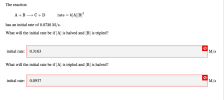
The reaction A+B +C+D rate = k[A] [B]? has an initial rate of 0.0730 M/s. What will the initial rate be if [A] is halved and (B) is tripled? initial rate: 0.3163 M What will the initial rate be if (A] is tripled and (B) is halved? initial rate: 0.0937 For the reaction 2 H2O(g) = 2H2(g) + O2(g) the equilibrium concentrations were found to be [H,O] = 0.250 M, [H] = 0.330 M, and (0,] = 0.800...
answer all
The reaction A+B +C+D rate = k[A] [B]? has an initial rate of 0.0730 M/s. What will the initial rate be if [A] is halved and (B) is tripled? initial rate: 0.3163 M What will the initial rate be if (A] is tripled and (B) is halved? initial rate: 0.0937 For the reaction 2 H2O(g) = 2H2(g) + O2(g) the equilibrium concentrations were found to be [H,O] = 0.250 M, [H] = 0.330 M, and (0,] = 0.800...
The reaction A + B -> C + D has been found to obey the following...
The reaction A + B -> C + D has been found to obey the following rate law: rate=k[A][B]2 and has an initial rate of 0.0130 M/s. What will be the rate of the reaction if [A] is tripled and [B] is halved?
Suppose that the reaction A + B --> C has a rate law of Rate =...
Suppose that the reaction A + B --> C has a rate law of Rate = k[A][B]2. How would the rate of this reaction change if [A] was doubled and [B] was halved? Question 13 options: rate quadruples rate increases to x8 rate drops to 1/8th rate doubles more information is needed to make this prediction rate drops to 1/4th no change in the rate rate halves
The reaction A+B rightarrow C+D rate=k[A][B]^2 has an initial rate of 0.0300 M/s. What will the...
 The reaction A+B rightarrow C+D rate=k[A][B]^2 has an initial rate of 0.0300 M/s. What will the initial rate be if [A] is halved and [B] is tripled? What will the initial rate be if [A] is tripled and [B] is halved?
 Consider the following reaction: A + B + C +D The rate law for this reaction is as follows: Rate = k Alla B11/2 Suppose the rate of the reaction at certain initial concentrations of A, B, and C is 1.14x10⁻² M/s. Part A What is the rate of the reaction if the concentrations of A and C are doubled and the concentration of B is tripled? VO AED A O O ? Rate 2 = M/s Submit Request Answer
 Review Constants Periodic Table Consider the following reaction: A + B + C D The rate law for this reaction is as follows: Part A Rate = k., A][C] B1/2 What is the rate of the reaction if the concentrations of A and C are doubled and the concentration of B is tripled? Suppose the rate of the reaction at certain initial concentrations of A, B, and C is 1.19x10⁻² M/s. 18 AU A O O ? Rate 2 =...
 2.c
and 2.d
2. The rate law for the reaction A+B a. Write the rate law expression. C + D is first order in [A] and second order in [B]. Rate low- k[A] [B]² b. What is the overall order of reaction? 1 +2= 3 c. How does the rate change if [A] is halved and [B] is tripled?! d. Given the data below, propose initial concentrations for A and B that would enable you to empirically determine the given...
2.c
and 2.d
2. The rate law for the reaction A+B a. Write the rate law expression. C + D is first order in [A] and second order in [B]. Rate low- k[A] [B]² b. What is the overall order of reaction? 1 +2= 3 c. How does the rate change if [A] is halved and [B] is tripled?! d. Given the data below, propose initial concentrations for A and B that would enable you to empirically determine the given...
 What is the rate of the reaction if the
concentrations of A and C are doubled and the concentration of B is
tripled?
Exercise 14.85 13 of 32 > I Review | Constants 1 Periodic Table Consider the following reaction: A + B + C + D The rate law for this reaction is as follows: Part A Rate = k[A][C] B11/2 What is the rate of the reaction if the concentrations of A and C are doubled and the...
What is the rate of the reaction if the
concentrations of A and C are doubled and the concentration of B is
tripled?
Exercise 14.85 13 of 32 > I Review | Constants 1 Periodic Table Consider the following reaction: A + B + C + D The rate law for this reaction is as follows: Part A Rate = k[A][C] B11/2 What is the rate of the reaction if the concentrations of A and C are doubled and the...
 answer all
The reaction A+B +C+D rate = k[A] [B]? has an initial rate of 0.0730 M/s. What will the initial rate be if [A] is halved and (B) is tripled? initial rate: 0.3163 M What will the initial rate be if (A] is tripled and (B) is halved? initial rate: 0.0937 For the reaction 2 H2O(g) = 2H2(g) + O2(g) the equilibrium concentrations were found to be [H,O] = 0.250 M, [H] = 0.330 M, and (0,] = 0.800...
answer all
The reaction A+B +C+D rate = k[A] [B]? has an initial rate of 0.0730 M/s. What will the initial rate be if [A] is halved and (B) is tripled? initial rate: 0.3163 M What will the initial rate be if (A] is tripled and (B) is halved? initial rate: 0.0937 For the reaction 2 H2O(g) = 2H2(g) + O2(g) the equilibrium concentrations were found to be [H,O] = 0.250 M, [H] = 0.330 M, and (0,] = 0.800...
 The reaction A+B rightarrow C+D rate=k[A][B]^2 has an initial rate of 0.0300 M/s. What will the initial rate be if [A] is halved and [B] is tripled? What will the initial rate be if [A] is tripled and [B] is halved?
Most questions answered within 3 hours.
-
Where is the error in this code sequence?
String s1 = "Hello";
String s2 = "ello";...
asked 10 months ago -
Financial data for Joel de Paris, Inc., for last year
follow:
Joel de Paris, Inc.
Balance...
asked 10 months ago -
Consider this reaction:
Al2(SO4)3 (aq)+ BaCl3
(aq) Al2Cl6 (aq)- +
3BaSO4(s) . What is the...
asked 10 months ago -
Suppose that Savneet is considering increasing her
recent random sample from 20 car rentals to 40...
asked 10 months ago -
Trucks arrive at an unloading terminal at an average rate of 120
per hour.
Trucks arrive...
asked 10 months ago -
Why are methanol and ethanol completely soluble in water while
octanol is not very little soluble....
asked 10 months ago -
A facilities manager at a university reads in a research report
that the mean amount of...
asked 10 months ago -
When the CuSO4 is rehydrated by adding water to the anhydrous
compound, is this an endothermic...
asked 10 months ago -
A ray of sunlight is passing from diamond into crown glass; the
angle of incidence is...
asked 10 months ago -
A block of mass 0.249 kg is placed on top of a light, vertical
spring of...
asked 10 months ago -
how do the kidneys compensate in the presences of acidosis
a) trigger hyperventilate
b) reserve acid...
asked 10 months ago -
Question 501 pts
The rental rate of capital to the firm increases. Which of the
following...
asked 10 months ago